Kenneth A. Germanson, president emeritus, Wisconsin Labor History Society, prepared this paper for the May 22, 2019, public input session at Kenosha concerning the proposed Wisconsin Historical Museum to be built in Madison.
The state of Wisconsin was born and grew into a Great State thanks to the working people who toiled on the state’s farms, its many industries or upon the Great Lakes and the state’s waterways.
More than their sweat and brains, the state’s workers also understood they had the power to build a state that provides for all people to live in a healthy and productive environment. They understood, too, that such power came only through organizing themselves into labor unions, farm associations and cooperatives. Too often history concentrates solely upon the politicians and moneyed leaders to tell the story of our state
and the nation. Let’s not forget the people – our hard-working ancestors who foresaw that through their trials and struggles they could build a future for all of the children and grandchildren of the future.
Thus, it is only fitting that these workers and their collective organizations be prominently enshrined within the walls of the proposed new Wisconsin History Museum in Madison.
There are plenty of examples of how working people have joined together to create a better life, not only for their own families but also for their neighbors and friends and generations to come.
Back in the 19thCentury when the industrial revolution spread into Wisconsin, workers faced terrible exploitation in toiling in incredibly unsafe and unhealthful conditions, working long hours, yet failing to earn enough to move their families out of squalid hardly livable dwellings. The quest for the eight-hour day became a symbol for their actions to bring about a better life, and nowhere was that more vigorously fought than in Wisconsin.
In Milwaukee in 1886, that coalesced into massive eight-hour-day rallies, parades and marches, ending with Wisconsin’s bloodiest labor event in history – the Bay View Massacre – when the state militia fired into the marchers, killing seven. That event has been credited with helping to spur on the development of progressive political parties in Milwaukee, like the Socialists, who worked with the Progressive Republicans of “Fighting Bob” La Follette, to pass many far-reaching legislative initiatives that made Wisconsin a forerunner in socially positive policies.
Twelve years later, in Oshkosh, then the Millwork Capital of the Midwest, Carpenters’ Union members struck seven factories for 10 weeks, shutting down production in the city. After the strike was settled, two local union officers and the union rep from Chicago were charged with conspiracy. Why? Their crime was only that they helped to organize the workers; at the time, such activities were sometimes considered to be “robbing” the company owner of his profits. Famed attorney Clarence Darrow came from Chicago to argue the case – taking eight hours in a final summary argument – to win acquittal. It was a landmark decision in that case.
The 1933 milk strikes are an example in which desperate farmers organized to withhold selling their milk when the prices got below a certain level. Many farmers organized into milk pools, basically cooperatives, to halt other farmers from marketing their milk, hoping to boost prices. This tactic was used in all parts of the state, often resulting in violence, with at least three deaths reported. It was a desperate tactic done in desperate times and should not be forgotten. While the strikes themselves may not have led to immediate relief for Wisconsin dairy farmers of the day, they did highlight their difficult economic situations and likely helped to bring about the New Deal agricultural reforms of Franklin D. Roosevelt, as well as the organization of farm groups like the Grange, the Farmers Union and the Farm Bureau.
These are just three examples of collective actions that involved the ordinary citizens of the state. There are many more, including the long Kohler Strikes of the 1930s and from 1954 to 1965; the UAW-Allis Chalmers strikes of both 1940-41 and 1946-47; the paper mill worker’s quest the Fox Valley during 1901 and 1902 for having Saturday night off. Just to name a few.
Not as well-known, but just as worthy of being memorialized, are those examples of how workers and farmers, through their collective organizations, have contributed to the welfare of the entire community. Since its founding in 1893, the Wisconsin Federation of Labor (forerunner to the Wisconsin State AFL-CIO) was constant in its fight for a strong public education system at all levels, K-12 into college. They have sought strong building and health codes that protect the entire community. Nonprofits benefit from the volunteer work provided by members of unions and cooperatives, both by providing vital staffing and as members of boards. United Way campaigns no doubt benefit from the support of the labor movement at all levels in urging members to make substantial contributions that benefit communities throughout the state.
There is a unfortunate tendency when developing a Museum of any type at focusing on building structures, because they are easy to portray. There’s even greater tendency to focus on industry leaders or politicians, while neglecting the people who have toiled to produce the goods and services and who have gone on to foster collective actions through unions and other organizations to improve the living standards for everyone.
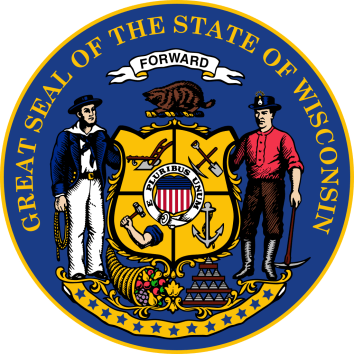
It is most fitting to note that the Great Seal of the State of Wisconsin honors the state’s worker heritage. The two figures on the seal are a sailor and a miner and they frame a shield containing a plow (farming), a pick and shovel (mining), anchor (navigation) and an arm and hammer (manufacturing).
The new Wisconsin Historical Museum needs to recognize the people of Wisconsin, not merely its buildings or the big name business leaders or politicians. Ken Germanson – May 23, 2019
 Advoken's Blog
Leave a comment