
No toilet paper to buy? Nor disinfectant? Eggs? Bread?
Today’s empty shelves are rarely caused by shortages of the goods, but by the hoarding and over-buying by many panicked American families. Sadly, this hoarding mentality seems to be growing exponentially; when my neighbor buys several packages of toilet paper rolls, I’m tempted to rush to the store to get my rolls of toilet paper. After all wouldn’t I be justified in doing so? What happens when there is no more TP?
But, I should restrain myself. The fact is will likely be plenty of toilet paper rolls — and other critical goods — available as long as we don’t hoard; the markets are being re-stocked on a regular basis.
Perhaps we need to bring back the spirit that motivated many Americans during World War II — often termed the “greatest generation.” Remember, the war was won not only 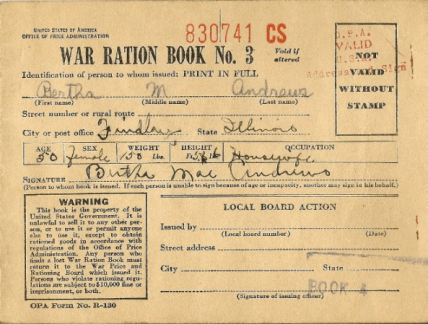 by the soldiers, sailors and marines at the front, but by the citizens at home who worked in the war plants (see “Rosie the Riveter”) and cut back or changed their consumption habits (and their life style) all in the cause of supporting our troops in order to end the war successfully.
True, there were Americans in the period from 1941 through 1945 who hoarded goods, who lied about their needs to obtain more ration stamps or who profiteered through their businesses. Yet, it was my observation — as a teenager during those years — that Americans more generally accepted the sacrifices necessitated by supporting the war effort. I recall that hoarding was frowned upon as unpatriotic.
Yet, the U.S. government enacted a strict rationing program, particularly covering sugar, milk, butter, gasoline, paper goods, shoes, nylons and silk.
Take gasoline, for example. Rationing began nationwide on December 1, 1942 and ended on August 15, 1945. Most car-owners got an “A” card sticker for their windshield, entitling the vehicle to four gallons a week (about 45 to 60 miles of driving in the cars of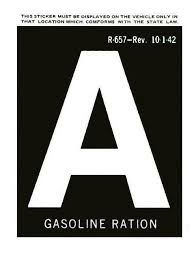 the period). Business owners and key personal in vital industries got a “B” card, or eight gallons a week. Doctors, nurses and other key workers got a “C” card, allowing a high level of driving. And speed limits were 35 MPH for the duration. For a short time in 1943, rations were reduced further and all pleasure driving was outlawed.
My dad got a “B” card, largely because he worked in the tanning industry and leather goods were in heavy demand, due to the need to provide footgear to our fighting troops. His “B” card allow basically enough gas to get him to and from work. Obviously, our family took no vacations during the summer as we had in the years leading up to the war.
Your ration book was guarded with as much care as you would a valued family heirloom; you didn’t mislay it or lose it. In a spirit of neighborliness, we’d share any unused stamps with a relative, friend or neighborhood who might be in more urgent need.
I spent most of the war years either delivering newspapers or working as a clerk-soda jerk in a drug store. To conserve newsprint, the newspapers severely cutback on they number of pages; the usually thick Milwaukee Journal of the da y was no more than eight pages in size on Saturdays, for example, which severely curtailed my ability to toss the rolled up paper onto a porch from my bicycle.
Our drugstore prided itself on its hot fudge sundaes; we used a premier fudge and used one of the areas finest ice creams. Eventually, the milk shortage grew so bad that we could no longer get vanilla ice cream, forcing us to make our famous hot fudge sundaes with pineapple sherbet. It wasn’t the same, but our customers understood. After all we were all in this fight together!
Today’s coronavirus crisis is very much a war and it will require all of us to sacrifice in many ways. To be truly neighborly, we must restrict the urge to hoard and rush to the store to gather everything off the shelves.
Perhaps we need to adopt the attitude of the “greatest generation” of World War II. — Ken Germanson, March 22, 2020
 Advoken's Blog
Leave a comment