Sometimes I look at the world through rose-colored glasses.
I must admit I did that on the tragic election night of 2016. I actually thought that the crude, boorish, racist, sexist buffoon we elected might rise to the occasion and eventually become a true leader. God knows, our nation has faced enough crises to give him plenty of occasions to surprise us and take statesman-like actions. We’re still waiting.
History is replete with examples where presidents have exceeded expectations. I was born when Herbert Hoover was president and among the 13 presidents who succeed him up to the President Trump, everyone of them has surprised us, beginning with Franklin D. Roosevelt. When he was elected, Roosevelt was a blue-blooded politician without much of a social philosophy or commitment. Yet, through the shrewd selection of committed aides and cabinet members and a unique political sensitivity, he fashioned perhaps the greatest social revolution in our history. And, history tells us also how he steered a basically isolationist country to support our Allies – namely the British and French – to beat back Adolph Hitler.
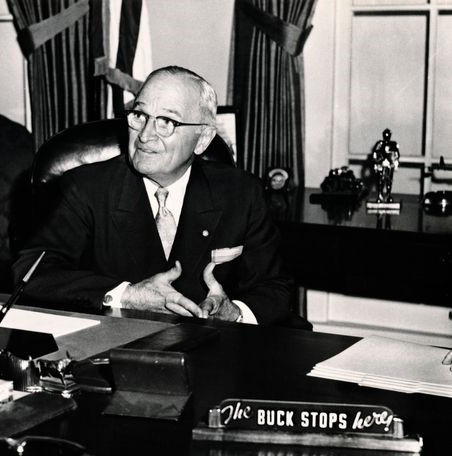
FDR’s sudden death on April 14, 1945 thrust an unprepared Harry S. Truman into the presidency just three months after his inauguration as vice-president. He did not even know there was an atom bomb in the making at the time, and just four months later had to make the decision to drop that bomb on Hiroshima and Nagasaki, thrusting the world into the nuclear age. With a philosophy of recognizing “the buck stops here” (so said a sign on his desk), Truman made that decision in the belief it would shorten the war and save lives in the long run. In retrospect, it may have been the wrong decision, but he made it and showed leadership. Truman, often mocked for his nasal-Midwest voice and having failed in the haberdashery business, showed guts also in vetoing (unsuccessfully) the Taft-Hartley Act of 1947 that permanently stifled the growth of the nation’s labor unions.
Gen. Dwight Eisenhower, praised as a great general, was a lackluster president, but he displayed a strong moral and ethical presence so important in those postwar years. He was too slow to censure Joe McCarthy’s irresponsible red-baiting crusade or to champion civil rights, but eventually he did, with decisiveness. Ike, most importantly, warned the nation against the unbridled and dangerous power of the military-industrial complex. Sadly, he was right.
President John F. Kennedy’s time in office was sadly too brief; he was inaugurated on Jan. 20, 1961 with great promise. He helped pave the way – though perhaps too hesitantly – for the start of progressive civil rights legislation.
And what can we say about Lyndon Johnson? Truly a politician in any sense of the word. Certainly a bit corrupt and a Southerner, LBJ surprised all of us by spurring the passage of the truly game-changing Civil Rights and Voting Rights Acts, plus developing the Great Society. Then, he failed us by heightening the Vietnam War, a war he publicly supported but I felt he truly was troubled by. [i]
Even the despised Richard Nixon recognized the special nature of the presidency when he resigned instead having the nation go through a painful impeachment process that he might even have survived. And, remember, he signed into law both the Environmental Protection and Occupational Safety and Health Acts.
Gerald Ford, the nation’s only un-elected president[ii], showed political courage in offering partial amnesty to the so-called draft dodgers from the Vietnam War and in eventually supporting abortion rights to the displeasure of many in his own party.
Perhaps Jimmy Carter was too nice a guy to be an effective president. Yet, his leadership was based in values of decency and competence; though a Southerner, he openly supported the rights of Black Americans. He was eaten up, however, by a small-minded media and the conniving of Republicans who used the Iran-hostage-taking incident to manipulate public opinion.
Somehow the B-actor Ronald Reagan blundered through, promising “morning in America” and having several prominent theatrical moments, including his famous “take down this wall” promise about the Berlin Wall.
George H.W. Bush certainly could not be called a “great” president, but he did support the revolutionary Americans With Disabilities Act of 1990 in spite of major business opposition. And, he had the courage to support a bill increasing taxes, even though it violated his own “read my lips” campaign promise not to do so.
Bill Clinton came into office with lots of promise: a gifted orator, a winning personality, an unquestionable level of intelligence and experience in government. Yet, he failed in providing the leadership needed to move the country forward, signing into law the awful welfare reform bill, failing to pass any form of health care legislation and supporting “tough on crime” laws. Clinton did, however, paved the way for greater inclusion of women into leadership, appointing an unusually high number to his cabinet, plus making Ruth Bader Ginsburg only the second woman to be made Supreme Court justice.
Even George W. Bush had flashes of real leadership in the aftermath of Sept. 11, 2001 when he rallied the nation, only to plunge it into his dishonest, ill-advised adventure in Iraq. “W” also supported a sound immigration reform plan, in spite of resistance from many of his own party.
In my mind, Barack Obama exuded honesty, integrity and inspirational leadership often during his presidency, even though many felt he fell short in furthering civil rights and the causes of workers and their unions. Yet, his leadership in creating and shepherding through the Affordable Care Act can’t be questioned, even though the law itself fell short of bona fide health care reform.
Some of you may question my judgments on these 13 past presidents; nonetheless, it’s apparent to me that they all displayed moments of true, unselfish leadership. We have yet to see that from the current occupant in the White House. Will he surprise us in the remaining six months of his term? Don’t hold your breath. – Ken Germanson, July 1, 2020
__________________
[i] I was present when a small group of labor union editors met with President Johnson in the White House in April 1968 and heard him tell of the concern he felt in the continuation of the Vietnam War. To me he displayed sincere sorrow at his decision. Perhaps it was an act, but I felt not.
[ii] Ford became Nixon’s vice-president after the elected VP, Spiro Agnew, resigned due to corruption charges. Ford had been a prominent Michigan congressman.
 Advoken's Blog
Leave a comment