It was Aug, 6, 1945 – just two days before my 16th birthday – and it may have become a day that helped more than any other to form my strong view that wars are a needless horror.
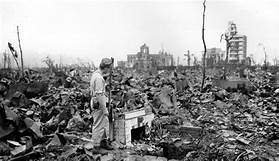
It was nearing suppertime on that day and I had just arrived home, having ridden my bike some four miles, my makeshift set of golf clubs on my back, from Currie Park Golf Course. It was a sunny, clear, beautiful day. My folks were gathered around the radio in our bungalow, listening to the news reports of the dropping of a horrible bomb on the Japanese city of Hiroshima.
“Listen to this,” they hushed me as I entered the living room.
The words “equivalent to 100 blockbusters” caught my attention as the radio announcers tried to describe the extent of the damage to this city. At the time, the blockbuster bomb, developed by the United States, was a massively destructive bomb, dropped from the air to obliterate entire blocks, hitting military targets and innocent men, women and children alike. The thought of a bomb that could do 100 times that damage was incomprehensible.
In those days before television, all we had were pictures from the daily newspaper, Life or Look magazine and the newsreels we saw at the movie house. Our minds had been flooded with pictures of flattened houses and stores. Occasionally, there’d be a picture of a dead human being, but for the most part such personal horrors were not shown, either censored by the Armed Forces or edited out due to the sensibilities of the editors. Perhaps that’s why we couldn’t comprehend the full horrors of war.
The dropping of this monster was justified as helping to shorten the war. It was indeed a devil’s bargain: trading the lives of nearly 150,000 Japanese for perhaps a half million more had the war continued.
As if to nail down the bargain, three days later the US dropped a second atom bomb on Nagasaki, killing up to another 75,000 folks. Within a week, on Aug. 15, 1945, the Japanese dropped down their arms and we all traipsed down to clog Milwaukee’s main drag, Wisconsin Avenue, to kiss the girls and celebrate V-J Day.
President Truman took full responsibility for the decision to drop the bomb and never wavered in claiming it was the right decision. Most Americans at the time agreed with him, since the War had been dragging on since Pearl Harbor Day (Dec. 7,1941) and it had greatly impacted the daily lives of all of us. To a high school student like myself at the time, we were relieved at the war’s end since it meant that perhaps we were not to be drafted into the Army. (Of course, we were not to be spared that privilege; most of us ended up being drafted into serving in the Korean War five years later.)
A year later the true horrors of Hiroshima were revealed in John Hersey’s long narrative in the New Yorker magazine, entitled “Hiroshima.” In it, he told the stories of six victims of the bombing, a narrative in stark, unadorned commentary that was truly terrifying and horrible. (The value of Hersey’s work is shown in a recent book by Lesley M.M. Blume , “Fallout: The Hiroshima Cover-Up and the Reporter Who Revealed It to the World.”) (Blume’s book is reviewed here)
Today – Aug. 6, 2020, another bright, clear August day – I teared up viewing an MSNBC “Morning Joe” segment on the Anniversary of the dropping of the bomb. It made me wonder again how war can motivate otherwise moral human beings to commit unbelievable horrors upon others, even the most innocent of us.
In the intervening 75 years, world leaders have mercifully shied away from the use of nuclear weapons, but now many of the current leaders are running away from anti-nuclear pledges and treaties, including our own government. Perhaps, they all ought to revisit the horrors of Hiroshima and Nagasaki. They all ought read John Hersey’s short book. – Ken Germanson, Aug. 6, 2020
 Advoken's Blog
Leave a comment