Labor Day 2021 could mark a crossroads in the future fortunes of America’s working families. Will the “rich get richer and the poor get poorer” trend continue? Will working people continue to be at the mercy of long hours, manipulative managers and unsafe and unhealthy conditions continue?
Unless working people begin to understand we live in a society of classes, the corporate / managerial / financial class versus the working class, American workers are doomed to a future of second class status. Most tragically their children and grandchildren are similarly fated. The United States is no longer a society where a person through hard work and perseverance can expect to move into a high economic status. Horatio Alger is no more.
Only during the relatively brief three decades (1950 to 1980) have American workers achieved a degree of economic equality. The post-World War II era was a time of promise for working families, when the sons and daughters of industrial workers could go to college or when the family could own a ranch home in the suburbs or when they could buy a cottage “up north.” It was a time of progressive taxation when those at the top faced a 90% income tax rate.
How did that come about? Because workers in the 1930s realized that only through solidarity could they improve their status in life.
Whether it was due to the privations of the Great Depression or the realization that workers were being terribly exploited, workers understood that only by rising up and joining together to speak in one-voice could they bring about change. During the early 1930s, even when jobs were scarce, workers walked out on their jobs and struck industrial plant after industrial plant. There were numerous disruptions of all types: unemployed worker marches in Milwaukee in 1933, World War I veterans in the great “bonus marches” and plant walkouts.
The early 1930s were time of disruption and Franklin Delano Roosevelt (a politician with a wealthy patrician upbringing and one who had no particular left-wing ideology) realized that to keep peace within the nation actions had to be taken to help America’s working families rise from the poverty in which they lived. In 1935 he signed into law two historic laws, the Social Security Act which not only provided assistance for the elderly but created a safety net for many of America’s poor and the National Labor Relations Act that established the right of collective bargaining for private sector workers.
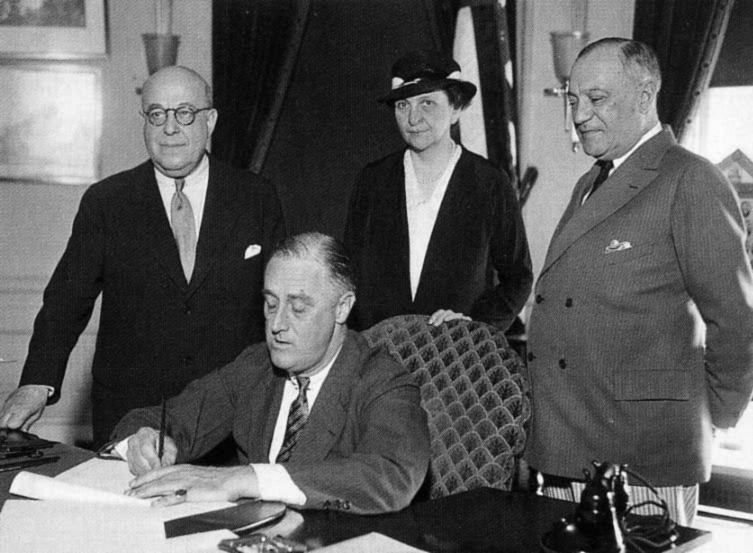
The NLRA may have been the law that helped most directly to bring the nation out of the Depression since it established the right to form unions, and as workers joined unions and more and more went on strike, wage levels soon began to bring most prosperity to workers.
FDR and the Democrats in Congress in 1935 didn’t pass the NLRA (named the Wagner Act after its chief sponsor Sen. Robert Wagner (D-NY)) out of any burning sympathy for the working class. Congress passed the law to bring an end to the disruptions (the strikes and demonstrations) that were occurring in the nation. In short, they passed these laws to end such mass actions and, some believe, to assure the survival of the capitalistic system. So massive were the strikes that many feared the nation may turn to accept communism.
Section 1 of the Wagner Act stated the purpose of the law was to remedy the situations that “lead to strikes and other forms of industrial strife or unrest, which have the intent or the necessary effect of burdening or obstructing commerce.”
The Wagner Act would not have been passed without the selfless sacrifice of millions of American workers who banded together to demand equality.
By 1954, 34% of American workers were union members and the typical worker had gained a degree of equity. In the 1980s, when some 20% of workers were union, the typical CEO’s pay was only 42 times that of the production worker. Today, when less than 10% of American workers are in unions, the CEO is now earning 280 times more than the worker in his/her shops.
Now, on Labor Day 2021, the question is whether American workers can begin to understand that their best bet to earn family-supporting wages on jobs that are both safe and healthy is to realize their class status. Only then will workers mobilize and act in solidarity to take the mass actions that bring about change.
It won’t be easy: the worker protections built into the Wagner Act not only have been eroded by the Congress and the Courts through the years but the nature of the workplace has changed. The factory environment that nurtured the togetherness of the 1930s is largely gone; today’s workers often work remotely or are being sold on the idea of being “independent,” as Uber and Lyft seeks to do. This makes organizing difficult. In addition, since President Reagan’s firing of PATCO Strikers 40 years ago, managements have become more skilled in beating back organizing efforts.
There’s promise, however, in that unions are more popular with the public with a recent Gallup Poll showing that 64% of Americans view unions as a “positive.” Working people have their fate in their own hands. Only by working together in solidarity can equity occur. Ken Germanson, Sept. 6, 2021
 Advoken's Blog
Leave a comment