When the morning newspaper gave out last night’s score
What a year this has been for Milwaukee sports! The Bucks becoming NBA champions and the Brewers on their way to the playoffs, with a promise of a World Series in the offing.
Yet, each morning when I pick up the morning Milwaukee Journal Sentinel to learn the score of the previous night’s game, what do I normally see. “The game ended too late for inclusion in this morning’s paper. Please refer to our website.” Ugh, I don’t wanna run to the computer; I want to sit down with my morning coffee and read the sports’ news.
It astounds me that with all the technology at the disposal of our modern newspapers that they can’t publish the results of any game lasting past 9:30 p.m. It wasn’t always that way.
From 1957 to 1962, I worked in the newsroom of the Milwaukee Sentinel, the city’s only morning paper then. We admittedly played second fiddle then to the well-regarded Milwaukee Journal, a paper once regularly ranked among the top five in the nation. The Sentinel was owned by Hearst, Inc., the giant chain run in stingy fashion by William Randolph Hearst and his family.
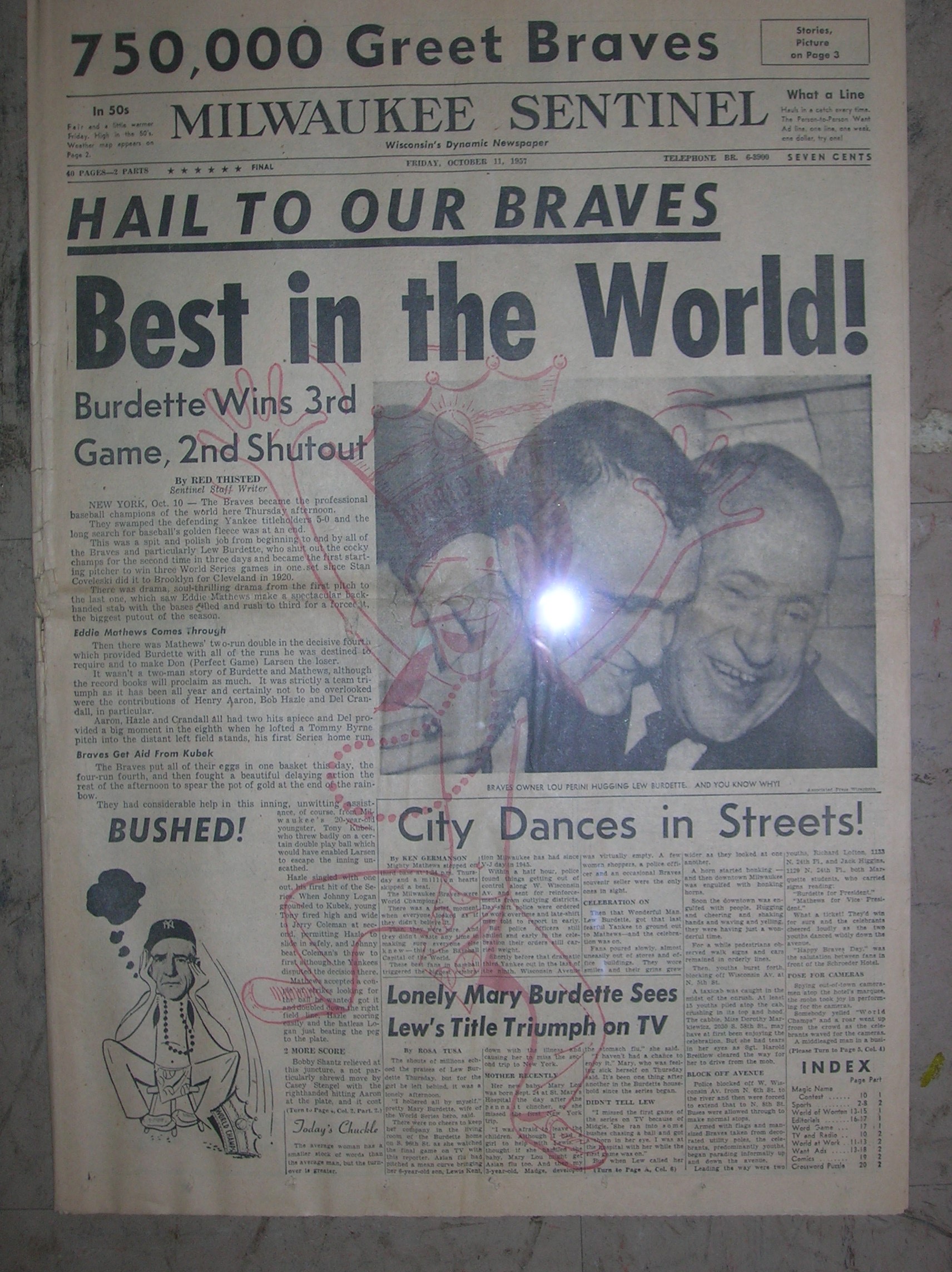
We were astoundingly short-staffed with the Journal probably having three reporters to every Sentinel reporter. Yet, the Sentinel was a vital part of Milwaukee in those years, particularly during the exciting winning years of the Milwaukee Braves, 1957 and 1958. Circulation bounced during those baseball seasons, with the Sentinel often bearing the good or bad news of the Braves game, whether it ended at 9:30 p.m. or in the case of West Coast games as late as 12:30 a.m. Milwaukee time. In those days, newspaper boxes dotted the landscape, stationed at nearly every bus stop as well as at the gates of every large workplace in the area. The papers were always quickly scooped up by thousands of factory and office workers each day.
Remember, there was no modern digital technology available; yet, the morning Sentinel delivered the news of a Braves win or loss to more than 200,000 households the next morning.
There was tremendous teamwork involved in the newsrooms of the Sentinel and it was exciting to be a part of it. The paper’s Braves writer, Red Thisted, wrote his stories from the press box at old County Stadium, passing them onto a Western Union telegraph operator who would telegraph the words to the Sentinel building, then located at Plankinton and Michigan. For years, the words came out in tape to another WU operator who then glued the strips paper, which would be sent to the sport desk, where an editor would mark it up, signifying which letters were capitals and editing any grammar or style changes with standard editing marks.
It was then sent by pneumatic tube to the composing room where it would be distributed to a linotype operator to be typed up, and made into lines of lead type that would be placed into a chase containing all of the contents of a particular page. Once a page was made up, it was sent to a stereotyper where it would be pressed into a cardboard-like sheet. That sheet would then be molded in lead into a circular form to be placed on a printing press roller.
Then, the presses would roll and within less than 30 minutes the first papers for the run would be sent to the mail room to be sorted and placed on trucks to be delivered to carrier boys (normally no girls in those days), newspaper boxes, drugstores and other outlets.
The speed with which the Sentinel staffers got the news out was astounding. And for those of us who were part of the process it was exciting and nerve-wracking. Surprisingly, there appeared to be few errors in these hurried-up stories. Instead, I think, it often prompted us to produce our best work. I remember writing a story about a city bus, loaded with rush hour passengers, that got lost on a dark early evening in December in Washington Park. I wrote the story on deadline in less than 15 minutes; a few months later the story won a national award for humor writing.
And we staffers loved to scoop the mighty Journal. The Sentinel’s longtime and legendary police reporter, George Pitrof, ran across the story of a coming indictment of a well-known Milwaukee baker who was to be accused of murdering his wife with a poisoned pie. George learned about the story in the early morning of a Saturday and sat on it until about 4:15 p.m. when he phoned it into the city editor. I was entering the newsroom from another assignment just at that moment and Walter “Chick” Wegner, the city editor, yelled at me to get to the rewrite desk to take the story from Pitrof. I typed it up, editing Pitrof’s words as I typed, sending each paragraph as I wrote it to the desk for editing. We got it done in less than 15 minutes. The detailed story appeared in our first edition of the Sunday paper headlining this sensational story, beating the Journal.
So I wonder why with today’s cell phones, email setups and cloud technology I can’t get last night’s Milwaukee Brewers score. – Ken Germanson, Sept. 14, 2021

 Advoken's Blog
Leave a comment