• Perhaps it’s time for loyal unionists to quit fooling ourselves.  In recent years, many of us have wondered about the future of our unions, but any talk of our unions dying has rarely been tolerated.

    You’re only falling into the rhetoric of the anti-union crowd, was the warning.  As we’ve watched the percentage of workers in unions drop to 11% — and less than 7% among private sector workers – most of us have skirted the issue, using cute euphemisms like “strengthening unions” or “rebuilding organized labor.”

    Brothers and sisters, it’s time to look at reality: unless matters change soon, the labor union movement (as we know it) may soon be so insignificant as to be nonexistent.  To be sure, we’re not in the grave yet; labor’s influence in the 2012 national election, for instance, was substantial in many ways, and in spite of President Obama’s relatively decent margin, he might not have won without labor’s support that gave the Democratic Party the wherewithal and bodies it needed to mobilize voters, particularly minority voters that were so critical.

    If trends continue, the 2012 election may have been labor’s last hurrah.

    Harold Meyerson, editor of The American Prospect and Washington Post columnist, writes that the death of the labor movement would be a disaster for the nation as a whole.  In a recent long essay, he argued that liberals in this nation should be reminded of how important the labor movement has been to passing vital progressive legislation and to fostering living wages and benefits for all Americans in the last 80 years.

    Thus, the loss of a strong labor movement should be no trivial matter to liberals and all Americans who yearn for a just and progressive society.

    Meyerson’s essay is worth taking time to read and digest.  Here are a few high points from the essay:

    The weakening of labor in the last three decades has caused wages for all workers to remain stagnate – or to drop.

    “ . . . Workers today are better educated and more productive.  What they lack is power!”

    Growing employer opposition to unions has made it difficult to expand unionization into the service sector.  Weak labor laws make it easier for companies to stifle organizing.

    Massive shift of manufacturing to the anti-union culture of the South weakened traditional blue collar unions.

    History of unions opting in post World War II period to “business unionism,” coupled with failure of many liberals to support worker issues, caused labor to lose direction.

    As moderate Democrats move to the middle, the causes of working people suffer.

    What to do?  Meyerson has a few thoughts on how to turn things around, but agrees there is no easy solution in the offing.  It will take a potpourri of solutions to turn back the forces that seek the death of organized labor, and among them, he argues, are such promising actions as found in many municipalities throughout the nation where “living wage” and similar laws have been passed.  It’s easier to pass such laws in cities where labor remains strong to pass such laws.

    Coalition building – that is, linking up with neighborhood groups, immigrant organizations or others – is critical, since labor can’t do it alone.  In an extension of this strategy, Meyerson refers to Stephen Lerner (who ran the SEIU’s Justice for Janitors campaign) who advocates broadening labor’s demands beyond workplace issues and joining with others to urge, among other causes, reforms in the banking industry to better serve the community.

    One factor that Meyerson failed to mention is that labor may have lost the battle for the American mind.  In a democracy, the people should have the final say, but the people can make the wrong choice if they are fed with faulty information.

    In the last election, President Obama was able to overcome some outlandish myths through a concerted and expensive campaign.  For the labor movement to survive as we have known it since 1935, we will need the same sort of truth-telling campaign.  That campaign must be built on more than rhetoric, and must stem from the instillation of a new spirit of innovative thought, openness and vigor.

    Many in labor have begun doing much of what is suggested here; it’s obvious more needs to be done.  And, our liberal friends need to realize how linked their causes are with ours.  Time’s a-wasting.  Act now or the organized labor movement may indeed face a death knell.  – Ken Germanson, Dec. 5,  2012.
  • A strong, vibrant labor movement is a must if our nation and its citizens are to thrive.  As the percentage of workers in unions has fallen from a high nearly 60 years ago of 34% to the current 11%, so has the typical income of working families.  The growing gap between the wealthy and all others has grown to unconscionable levels, already damaging the vitality of our economy so needed to keep the economic engine running smoothly.

    No one should rejoice in the increasing weakness in the labor movement; traditionally its strength is necessary for everyone to prosper, including the wealthy corporate bigwigs who seek to weaken – or even eradicate – all unions.

    That’s why we herald the new weapons that unions have been using to fight back to strengthen their influence and build strength.

    The United Food and Commercial Workers Union took a big gamble when it sought to stage a nationwide picketing of Walmart on the day after Thanksgiving.  Some observers think the OUR Walmart effort may have failed, and perhaps the numbers of participants were not as much as the supporters wanted, but it did bring national attention to Walmart’s antiunion practices.  See link.

    The chances of a massive demonstration, to be sure, were not high, since in these times when jobs are hard to come it’s apparent the vast numbers of dissatisfied Walmart workers were justifiably scared to publicly show their prounion feelings since they may face retaliation.

    Taking on the nation’s largest employer is a Herculean task, but it’s imperative to start somewhere, and the Black Friday effort is a beginning.

    Then there is the worker center movement that involves partnering with community organizations to set up sites where nonunion workers may go to resolve disputes with their employers or to gain assistance with personal issues involving basic needs.  In Milwaukee, the United Steelworkers teamed up with Voces de la Frontera, a community organization, in seeking union representation for workers at Palermo Pizza.  Some 350 workers are involved in a strike that began July 1st.

    This may be a difficult strategy, too, since the organizing effort faces many odds, particularly due to the fact that many of the workers who are Hispanic have been targeted by the Immigration and Naturalization Service enforcement.  Yet, the strategy shows that labor is building credibility within the Hispanic community and is recognizing that a union needs community support to organize.

    Traditional organizing is nearly impossible these days, due to the drop in manufacturing employment, unfair foreign imports and growing unfavorable labor laws.

    Regardless of how successful the new strategies will be in the short run, they point to a positive trend among our unions to look for new ways to become strong again.  All of America needs stronger unions and everyone should herald this development. – Kenneth A. Germanson, Nov. 24,  2012. 

  • To Parody “Thanks for the Memory,” a popular song introduced in 1938 and made popular as the signature tune for Comedian Bob Hope:

    Thanks for the Memory

    Of gorging and puffing

    From turkey and stuffing

    Filled with sweet potato

    And lettuce with tomato.


    Of family and friends

    And talk that never ends

    Of hoping that no feuds

    Grow out of ancient moods.


    Of crucial third downs

    That draw the frowns

    Of mom who’s unable

    To bring men to the table.


    Of the many boasts

    That come with the toasts

    As dad reaches poetic heights

    While the kids sneak bites.


    Thanks for the memory

    Of the warm and tasty repast

    Of many Thanksgiving Days past,

    While thinking often about

    Those who are left out.

  • My sleep-deprived brain is just racing with thoughts on this cloudy November morning in Milwaukee.

    Most Promising Moment for the Future:  The rights of women were advanced, as they now will hold nearly 20 seats in the 100-seat U.S. Senate.  Tammy Baldwin in Wisconsin became the first female U. S. Senator from our state and Claire McGaskill came from behind to win.

    Two Republicans who originally had large margins in their campaigns were up-ended mainly because of insensitive remarks they made about rape during their campaign:  Todd Akin in Missouri and Mourdock in Indiana.

    Notice to politicians:  Remember women make up 52% of the voting population.  Women didn’t win the right to vote until 1920, but now they’re  making their voices heard.

    Funniest Moment on TV News Casts Tuesday night: Karl Rove, GOP premier strategist and the wunderkind of the George W. Bush, era tried to regain credibility as he continued to say Mitt Romney was going to not only win Ohio, but the election, even as all the Networks, including his own at Fox News, were projecting President Obama the winner in Ohio, thus putting the President over the magical 270 vote total and reassuring his election.

    While the Fox News anchors stoically announced the result, Rove continued to theorize how Romney’s vote still would climb due to missing precincts in the rural areas of Ohio.  To convince him, Fox News put on an elaborate charade with the camera’s following Megyn Kelly, the anchor, announcer down several hallways to the Fox decision room where dozens of analysts were pouring over computers.  There the lead analysts plainly said they stood comfortably behind their projection of an Obama victory in Ohio and the nation.  View the video clip.

    The decision room people were clearly pros at their work, something all decision-makers need.  Rove, however, continued to be clouded by his own dreamy reality and in spite of their reassurance plodded onward for a while with his cockamamie theorizing.  For complete report on this incident, click here.

    Most Sobering Realization:  The Republicans maintained control of the House of Representatives and the Democrats still don’t have enough votes in the Senate to overturn GOP filibustering, an art their party leaders have mastered over the last four years.  President Obama may have won a convincing victory – and the GOP lost several Senate races they once considered to be theirs – but their leaders remained adamant in Congress.

    Senate Leader Mitch McConnell flat out said the President must show bi-partisanship by accepting the Republican positions on key items like taxes, cuts to entitlements and defense spending.  The GOP continues to peddle the fiction that they have been open to compromise, while the record of the past four years documents that President Obama made plenty of overtures across the aisle, even adopting many Republican ideas – like the mandates in Obamacare which come out of an earlier playbook of the conservative think tank Heritage Foundation and from Romney’s own Massachusetts health care plan.   President Obama will have a difficult four years ahead.

    Most Joyful Development:  The election of the first openly gay U.S. Senator (Tammy Baldwin in Wisconsin) and the passage of four statewide referenda supporting gay marriages in Maine, Maryland, Minnesota and Washington.  How far the nation has come in accepting gay rights in some 20 years is astounding.  Remember the heat President Clinton got when “Don’t Ask Don’t Tell” went into effect, and that measure was totally flawed!

    Sadly, the country is split on this issue, with the four states passing it all being in the North.  But gay rights have moved forward in this nation.

    Most Disappointing Result:  Republicans regained control of the Wisconsin State Senate, giving them carte blanche to do what ever they want.  If they maintain the strict party discipline they exhibited in Gov. Walker’s first two years, they will be unstoppable.  In early morning interviews, Republican leaders seemed bound and determined to pass legislation assisting business in doing away with regulations that protect the public and employees, trimming business taxes even further and cutting back on state aid to municipalities.  In addition, Republicans are set to pass mining legislation that would begin the denuding of the forestlands and vacation spots in the North.  The 18-15 GOP margin in the Senate would mean Sen. Dale Schultz of Richland Center would need to find at least one other GOPer to join with him in seeking balanced mining legislation.

    The Republicans legislated their way to victory by redistricting seats for the Legislature in such a way that makes it difficult for Democrats to seize control in the immediate future.  Dark times may be ahead for Wisconsin’s working people if they succeed in their pro-business, anti-consumer and anti-worker agenda.

    Most Welcome Realization: No more robo calls.

    By Ken Germanson, Milwaukee, Nov. 7, 2012

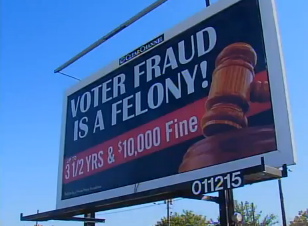
  • You know what’s a crime?  It’s when one group seeks to block other citizens from voting.

    Yet, that has been the goal of the Republican Party in the current election.  They’ve made no bones about setting up barrier after barrier to make it difficult for people to vote, particularly low-income persons and minorities.

    The most recent evidence of that shows up on 85 billboards in the Milwaukee area, many of them in low-income neighborhoods, proclaiming:  “Voter Fraud is a Felony,” followed by the word, “3 ½ yrs & $1,000 fine.”  Now, on Oct. 22, just two weeks before the election and following several weeks when the signs were clearly visible, Clear Channel — the company responsible — has decided to take them down.  They bowed to citizen criticism, but the harm may have already been done in throwing fear into the hearts of many people confused about election procedures.

    Like many other efforts by Republicans, it was nothing but a blatant attempt to scare low-income voters from casting ballots, knowing full well that the vast majority are likely to vote for Democratic candidates.  It’s bad enough that voter registration rules are becoming more complicated, causing problems for low-income persons who

    These billboard, originally placed in Wisconsin and Ohio, are to be taken down, based on decision of Clear Channel after complaints by citizen groups.

    find it difficult to find the time (away from work) or the transportation needed to get to a place to register.

    All of these rules, the Republicans claim, were made to assure an honest election; but common sense tells us otherwise.  Convictions for voter fraud are rare in Wisconsin, averaging between 12 and 20 a year, according to the Government Accountability Board.  Since fraud is not widespread, why else spend thousands of dollars, except to scare off potential Democratic voters?

    According to Clear Channel, the billboards are paid for by a “Private Family Foundation,” but the company refuses to say more, keeping the source of the considerable cost of the billboard secret.  Thus the saga of the dirty billboards has ended, another example of the lengths to which Republicans have gone to stack the 2012 election outcomes.

    Those who seek to curb the right of other citizens to vote are downright un-American.  And is that not even a bigger crime?  Ken Germanson, Oct. 23, 2012.

  • The year 2011 was remarkable for two incidents that foretell the future as people struggle for economic equality in the United States.  The first was the February and March uprising of workers in Wisconsin to preserve their right for public employee collective bargaining as well as to express their general concern with the attacks upon all workers.

    Secondly, and exactly a year ago this month the Occupy Wall Street movement energized millions not only in the US but throughout the world.  The Occupy movement was dramatic, and it created the idea of the “99%” of people struggling while the 1% sit in the lap of luxury.  Yet the movement itself has by and large fizzled, much like a spent rocket the day after the Fourth of July.

    More than 100,000 fill Capitol Square in Madison in March 2011 rally.

    It is apparent the enthusiasm generated in 2011 has gone; few people run to rallies anymore. Why is that?  The people are still hurting (though some minor pockets of relief are developing), but the rich keep getting richer and corporate profits continue to grow.

    On the other hand, the Tea Party is alive and kicking, causing just as much malicious mischief as ever.   Meanwhile, polls continue to show that the Tea Party represents but a minority of Americans and that few share the Party’s extreme goals.  Why then does it continue to thrive while the Occupy Movement appears near death?

    The Tea Party is still around for one reason: It has a structure.  That was due to its funding base, which includes both billionaires like the Koch brothers and their corporate cronies as well as some duped middle class folks.  It is also due to the fact that several institutional entities exist to collect the funds, make decisions as to how to spend them and generally promote the cause.  It has made is possible for Tea Party leaders to put much effort into politics, electing legislators at all levels who are ideologically committed to their nefarious cause.  

    After the Occupiers were chased out of the Wall Street park and the city plazas throughout the nation, the movement lost its only tactic.  There was no institution developed to carry on it work, no political action committees ready to take up the cause.  In effect, there was no phone number, no mailing address or website.  When the occupy sites went empty, supporters had no where to go or nothing to do to carry on the fight.

    Of course, that spontaneity was one of the strengths of the Occupy Movement.  It acknowledged the fact that it was a leaderless movement.  Sadly, that was also the cause of its demise.

    That’s why the labor movement is so critical for liberals and those who believe in balancing the economic scales.  It is the only institution that exists that has the power and the infrastructure to challenge the corporate-funded power of the right.

    To many liberals, however, the labor movement is too rigid, too inflexible and old-fashioned.  These liberals ought re-look at labor:  Fresh and progressive leadership has risen in many unions ridding them of some of their more hidebound practices. Many liberals also decry that labor gets involved in things like the Chicago Teachers Strike, which they may feel was insensitive to the needs of students and their parents.  Well, liberals, whether it is the Chicago Teachers in 2012 or the railroad workers and coal miners in 1946,  working people, will often go into unpopular — but from the view of the workers themselves  necessary (repeat that, necessary) — strikes or job-actions causing lots of wringing of the hands.

    Look at the Wisconsin Uprising; it continued to work solely because it had the institution of organized labor to provide the needed infrastructure.  A year after the winter rallies, another huge rally was held in Capitol Square in Madison and thousands were mobilized in the partially successful recall movement.  While being seriously outspent, the recall did dump three senators (enough to control the Senate) while falling short in recalling the governor.

    It’s time for all Americans who share the goal of income equality to realize that a strong, vigorous labor movement may be the only hope for wage- and benefit-deprived working people.  Let’s hope our ivory-towered liberal friends realize that, too.  — Ken Germanson, Sept. 15, 2012.

  • Like many older American cities, Edgerton, Wisconsin, has a proud and honorable heritage.  On a recent, and hot, weekend in July, the city celebrated that history with a ceremony entitled “Tobacco Heritage Days.”

    That Edgerton would continue to celebrate “tobacco” as its heritage is understandable, but troubling.

    It’s understandable since at onetime it was nicknamed the “Tobacco Capital of the World.”  Yes, in Wisconsin, and not Virginia or North Carolina.  Due to a combination of available railroad transportation, favorable soil and climate, a thriving tobacco industry grew up there about 150 years ago.

    According to the celebration’s website: “Over 55 tobacco warehouses, both frame and brick, lined the main streets and railroad tracks. The town boasted several fine hotels which were full to overflowing when tobacco buyers from all over the country and Europe conducted business with the local dealers and growers. Sadly, no hotels remain, but several yellow brick warehouses are a testimony to our city’s hey-day.”

    Furthermore some tobacco farming is still going on in the area; therefore it makes some sense to celebrate the crop.

    Yet, it’s troubling, largely since society at large now realizes the harm, both in personal health and in costs for the entire economy, that occur from the habit.

    State laws have banned smoking in public places for two years now, and in general the large majority of people approve the prohibitions, even among smokers themselves.  Most smokers take their first cigarettes as teens or young adults, and so many are doomed to a lifetime of smoking, many to an early death or debilitating illness.  And, as we all know, once you get the habit, it’s a real challenge to kick it.

    The celebration’s website tucks one small disclaimer in its history section, “We do not encourage the use of tobacco by young people / adults. We are informing you on the history of this crop, how it came to our area and made our city what it is today.”  Sadly, that’s hardly enough to override the publicity promoted by using “tobacco” in the celebration’s title.

    Why Edgerton continues to celebrate its heritage in the name of King Tobacco mystifies me.  It’s a community with a proud population and obviously has much to offer.  Why not just call it: “Edgerton Heritage Days?”  I’m sure the folks attending will enjoy the same fun and community spirit as ever.

  • Our recent blog, “Is Labor Losing the Battle for the Public Mind” has generated some interesting comments and ideas.

    Fortunately, none of them spent time playing the “blame game” on the failure to recall Wisconsin Gov. Scott Walker, but focused upon how working people and unions should respond to turn the tide.

    You can see some of the comments following the blog, including one from my friend David Giffey of Arena, WI, who noted that the voices of those many activists who aren’t union members need to be heard.  He noted that in the last century workers achieved much of their gains through militancy, boycotts and strikes, which seemed have gone out of favor.  To engage the majority of workers in the cause, he said, labor will have to keep its message simple.

    Giffey’s call for more inclusivity by labor was echoed by others as well.  Nicholas Hoffman, museum curator in Appleton, was one of many who emailed the author directly with comments.  He called for doing a better job of reaching out to families in rural Wisconsin, who favored Walker heavily.  Those families, too, are facing economic turmoil.

    Thomas Martin Sobottke, who writes a regular blog entitled “Struggles for Justice,” wrote:  “I think the labor movement must make any disenfranchised American working person a member of the movement and (then) we go to the streets and demand jobs and a fair wage from those that control them.  Putting down any barrier to union membership and the movement needs to be pursued even further.”

    Labor already has the beginnings of efforts to involve workers in nonunion settings, which could be used as the basis for broadening involvement in the causes of working people.  That was suggested by David Newby, president emeritus of the Wisconsin State AFL-CIO, who mentioned the “Working America” coalition that could broaden its activities, and by Ray MacDonald of the Steelworkers, who reminded us that the Steelworkers have an associate member program.  Other unions, we believe, should be working on similar strategies.

    UW-Extension School for Workers prof David Nack observed that Democrat Tom Barrett largely dodged the labor rights’ issue in the campaign.  Nack was correct, of course, and his comments echoed the point of the original blog that “labor” may indeed be perceived as a negative to candidates for public office.  (What a sad commentary on the state known for its progressive history involving workers and labor!)

    David Riemer, who unsuccessfully ran against Walker for County Executive and is a former top administrator for both former Governor Jim Doyle and Milwaukee Mayor John Norquist, called for the liberal message to focus on economic security, education, and freedom, all of which he said were “American values” that would lure many voters toward more progressive voting.

    Thus the tone of nearly all of those who responded recognized the value of greater inclusivity into the mix.  Can that be achieved?  This blogger thinks so as long as all of us broaden our thinking and open our minds.

    Finally, Christine Neumann-Ortiz, executive director of Voces de la Frontera in Milwaukee, offers a suggestion on how the process can begin.  She says that unionists can assist in the effort of an independent union to organize Palermo Pizza in Milwaukee.  Many immigrants are involved in that effort, and already the AFL-CIO and the Steelworkers are assisting.  Others may make donations to the cause.  By reaching out to assist other workers achieve their goals – even if it’s not with “my” union – we can again put the labor movement back in the public mind as a “positive force” for all society.

    What do you think?  Ken Germanson, June 8, 2012, Milwaukee WI

  • As I write this, it has been more than 24 hours since the network declared Scott Walker the winner over Milwaukee Mayor Tom Barrett in the Wisconsin recall elections – enough time to digest the hurt and to put the loss into perspective.  Don’t despair, this will not be another lament or excuse for the outcome.  There has been plenty of that.

    What is critical is what lesson was learned.

    The basic message that any labor union activist or sympathizer should take from this loss is: The typical voter cares not a “hoot” about unions or collective bargaining rights.  This fact is shocking to those of us who have battled for years for worker rights.  How can it be that so few care?  Aren’t collective bargaining rights the only thing that frees a worker from the “slavery” enforced by his boss?  Of course, collective bargaining is critical to a worker’s freedom, but so few understand that.

    Take the statistics from the exit polling done in the recall vote.  Among persons from union households, 38% still voted for Scott Walker.  That’s nearly four out of 10 who don’t understand that it was through collective bargaining that their households gained income, basic on-the-job rights and benefits.  (Incidentally, 61% of those from nonunion households voted for Walker.)

    Even though the loss of collective bargaining rights for public workers fueled the frenzy and furor of the last 16 months, some 60% of voters did not feel such rights were important, or opposed them outright.  How could it be that after all the news coverage and hardwork by thousands of unionists across the state that so few understood or cared about the importance of collective bargaining for workers?  That’s the question that is most bothersome.

    Part of the problem is that so few persons today understand labor unions and labor rights.  In the 1950s, when nearly four out of 10 households contained union workers, words like “strike,” “contract,” “scab” and “solidarity” were in everyone’s understanding.   Now, with but 11 percent of workers in unions, there are fewer labor households and less interest in unions.

    Unions are hardly ever covered by the media.  It wasn’t too long ago that newspapers in most big cities – including Milwaukee – had fulltime reporters assigned to the labor beat, often with backup from other reporters.  Now the Milwaukee Journal Sentinel in this town has none; in fact it doesn’t even assign one reporter to become a parttime specialist on the topic.   Despite the fact that the State Legislature passed a law making the teaching of labor history part of the state’s educational standards, schools still largely ignore the subject.

    The fact is that most people in Wisconsin – and probably even more in many less unionized states – don’t know, understand or care about the loss of collective bargaining rights.

    The history of labor means much more than informing people that it was only through collective bargaining that paid holidays and vacations and health insurance became a reality for ALL workers, mainly because of unionized workers exercised their collective bargaining rights.  It must show, too, that such rights are basic to helping free workers from being nothing more than paid slaves and that the loss of those rights could soon doom more and more workers to return to the horrendous and unsafe working conditions of yore!

    In an election based largely on worker rights, too few understood anything about those rights.  If Tuesday night’s victory by Walker and his big business cronies proved anything, it proved unions are losing a battle for the public mind.

    That fact makes it critical to develop ongoing strategies in public education, and key to that is to continue to study and disseminate the history of labor. — Ken Germanson, June 6,  2012.  Milwaukee WI.

  • (A comment by Ann Germanson, wife of the writer of this blog)

    Wisconsin voters who narrowly elected Scott Walker governor in 2010 didn’t know that he was planning to “divide and conquer” the citizens he was sworn to serve.   Maybe they weren’t aware Walker came into the office as a representative of the American Legislative Executive Council (ALEC), which for 40 years has been co-opting state legislatures to make sure they pass bills in the interests of the Koch Brothers and other big corporations.

    The voters didn’t expect their Republican-controlled state government, supposedly concentrating on jobs issues, would instead be doing ALEC’s bidding by engaging in attacks on unions, public education and social services while enacting burdensome voter suppression rules, aimed at keeping Democrats from the polls.

    Now, of course, all these things have been brought to light – notably by Walker himself as he enthusiastically assured “David Koch” in that infamous phone call that Wisconsin would be the “first domino” to fall in ALEC’s campaign to impose complete Republican political control on this country.

    All this should be enough to justify a recall election and to remove Walker from office.