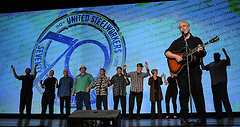
• Tom Juravich leads the cast of the multi-media show that featured the 70th Anniversary celebration of the founding convention of the United Steelworkers

    In the early days of World War II – May of 1942 – some 1700 delegates from local unions of the Steel Workers Organizing Committee (SWOC) and the Amalgamated Association of Iron, Steel and Tin Workers gathered in the Music Hall of the Cleveland Public Auditorium to form the United Steelworkers of America.

    Seventy years later, on a bright, warm spring day, another 1700 met in the same Music Hall to celebrate the anniversary of the founding of the Union and its long history of struggle.  On Thursday, May 24, the crowd in the Music Hall was a mixture of local union representatives, International Union staff and retirees.  Among the active Steelworkers were some 500 members of the Next Generation, the USW’s young members’ organization, composed of workers under the age of 35.

    This mixture of old, not-so-old and young helped to reinforce the theme that the members of Steelworkers Union – in the words of President Leo Gerard – would “inherit the past and make the future.”

    In an enthusiastic speech following a nearly two-hour multimedia presentation of the union’s history, Gerard reminded the audience that they “inherited the history of those who died” in the earlier struggles.  He said it was the obligation of the union’s current members to follow up and continue the struggle for a better future for all.

    “We’re standing on the future they gave us,” he said.

    The multimedia show was an inspiring portrait of the union’s history, with a collection of actors reading scripts while images of historic photos appeared on a back drop.  Often they were accompanied by Labor History Professor Tom Juravich (University of Massachusetts) on the guitar.

    The spirit of the show infected the audience which often interrupted the performers with cheers that added to the enthusiasm of the day.

    The script, written by Lisa Jordan, director of the USW Education and Membership Development Dept., created a truly lively, meaningful summary of the Union’s efforts through the years, concentrating on areas where the Steelworkers were significant leaders, such as in safety and health, racial justice, and the expansion into global unionism while dealing with the issues of unfair foreign trade.  What was most amazing was that the dozen or so actors who came onto the stage in multiple scenes were so professional even though they were Steelworker members or staffers.

    This was more than a ‘rah-rah” session; the presentation was balanced and truthful, showing successes as well as those times when the challenges could not be immediately overcome.  If anything, it reinforced the belief that the fight must continue, a sentiment that President Gerard stated over and over again.

    Turning to the present-day challenges, Gerard expressed a fear of what could happen, particularly in the coming elections, if the anti-worker forces win, possibilities that exist both in Canada and theUnited States.

    “Now I wake up every morning and I’m angry as hell,” he roared.  “I’m afraid they might win and take away our heritage.”

    The morning program was followed by afternoon workshops, concentrating largely on how to mobilize the Union’s many tools – along with its history – to continue the fight.
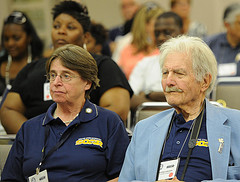
    George Edwards, 94 (right) was at the only delegate from the founding convention in 1942 in the audience at the 70th Anniversary celebration in Cleveland.

    There was one living connection with the original founding convention.  One of the delegates to that convention – 94-year-old George Edwards – was in the audience and was greeted with a standing ovation when he was introduced.

    Judging from the reaction and interest shown during the program, it was obvious the participants were stirred by the heritage they had inherited, and thus were ready to arm themselves to continue the fight that the Steelworkers began 70 years earlier.  Ken Germanson, May 26, 2012

    NOTE:  Photos courtesy of United Steelworkers by  Steven DietzSharp Image Studios

    For full report, click here.
  • As the U.S. Catholic Conference of Bishops continued to try to force its medieval prohibitions to contraception down the throats of Americans this past weekend, it’s time to consider the story of a Saudi journalist, Hamza Kashgari.

    He was detained by the Malaysian police on Feb. 9, when he was stopped at Kuala Lumpur International Airport at the request of the Saudi government.   Since then, despite hurried efforts of supporters to halt the return of Kashgari to Saudi Arabia, he was secretly returned to his home country.  (Read more)

    No he is not a murderer.  He merely wrote something which the Saudi government considers blasphemy, which is punishable by death.  According to Daily Beast, Kashgari wrote about an imaginary meeting with the Prophet Mohammed on Twitter.   The offending word addressed to the Prophet were:

    ”On your birthday, I will say that I have loved the rebel in you, that you’ve always been a source of inspiration to me, and that I do not like the halos of divinity around you. I shall not pray for you.”

    Yes, in Saudi Arabia, blasphemy is considered a crime punishable by death; and the courts there are renowned for the authoritarian rulings; thus Kashgari has little chance of a fair trial, and may face death.

    I considered this as I read about the U. S. Conference of Catholic Bishops who are still not satisfied with the compromise offered by President Obama over the contraception issue.  Now, I have written something critical of the bishops who pretend to speak for the Church that I was baptized into, confirmed by and married in.

    Perhaps my mere mention of my feelings that the Bishop’s view is “medieval” would bring a death penalty upon my head if the Catholic Church — or any other religious institution, like the burgeoning evangelicals — began to run our government.

    Yet, that’s just what the Church seems to want to do, as it tries to ram its views on contraception down the throats of the general public and more specifically the hundreds of thousands of its own

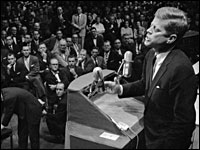
    John F. Kennedy speaking to religious leaders in Houston on Sept. 12, 1960.

    employees in hospitals, schools, nursing homes and other enterprises throughout our nation.

    President John F. Kennedy, in his great speech in Houston, Texas, in his 1960 campaign for President promised he’d keep his Catholic faith out of his government decision-making.  And he did!

    Now, the Bishops, coupled with the entire Republican leadership for obvious political reasons, are seeking to make their view of things the “law of the land.”  All Christians, non-Christians and atheists alike should fear the creation of a religious state, as it is neither supportive of family values nor compassion but rather just another dictatorial state where a mere “tweet” could bring death.  Ken Germanson, Feb. 13, 2012.

  • Criticizing the President is a great American past-time, and certainly there has been no lack of criticism toward Barack Obama. And, such criticism of a President is proper and within bounds, when it concerns policies. But the personal attacks have been something else, such as the innuendo and rumor thrown at Mr. Obama by the idiotic question of whether he was born in Kenya instead of Hawaii.

    Was that not just a sly maneuver to constantly remind voters that he is black – and therefore not one of “us,” meaning a lily white person?

    Now, comes Wisconsin’s 9th District Congressman James Sensenbrenner to make fun of the First Lady by saying she has a “big butt” in criticizing her commendable crusade to reduce childhood obesity. Milwaukee Journal Sentinel Columnist Eugene Kane called the remark “racist,” noting that he couldn’t recall another First Lady who had ever been similarly attacked by a clearly offensive, nasty remark.  Read column.

    Then there’s the story about the 11th U.S. Circuit Court of Appeals that a year ago ruled that there were no racial overtones when a white manager at a Tyson chicken plant in Gadsden AL called the adult black men employed there as “boy.” Now, just before Christmas, the Court has made the unusual move of reversing itself and agreeing that the term “boy” is offensively racist.  See story.

    How the learned judges of the 11th Circuit in Atlanta could have dismissed the use of the word “boy” in the South as anything but hurtful to black men in the first place speaks volumes about how far this nation still has to go to understand how racist terms can hurt. How could they not know that the term “boy” connotes inferiority and enslavement itself?

    The judges in the 11th Circuit are from the South, and may have grown up using the term “boy” to refer to their black neighbors. That’s still no excuse, especially for supposed educated men wearing dark robes.

    Now, Rep. Sensenbrenner is a born and bred northerner, representing folks in the counties bordering Milwaukee County. He made the “big butt” remark in a small group to be sure, but it matters little that he likely would not have said it in front of a microphone. The Congressman has apologized to the First Lady but such apologies are meaningless. The fact that he said indicates what his attitude is.

    Sadly, too, Rep. Sensenbrenner’s racism rests in many of us, if we’re honest about it, just as it rested in the souls of the justices of the 11th Circuit.

    Some may question whether we’re merely being “politically correct” in looking to avoid the use of hurtful references of a person’s anatomy or the use of terms like “boy.” It’s more than that: it’s a basic attitude that needs to be corrected. And racist attitudes can be just as prevalent in Wisconsin as they can be in Georgia. – Ken Germanson, Dec. 29, 2011

  • Roundy’s Inc. has basically cornered the food market business in the Milwaukee area, as its Pick ‘n Save and Metro Market Stores have garnered more than half of the grocery business.

    It’s only natural then that the alternate weekly newspaper, Shepherd Express, which distributes its free weekly papers each Wednesday throughout the area, would find that more than 75% of its circulation of 262,000 would be through the two Roundy food chains.

    Now, obviously bowing to right-wing complaints, the company has notified Shepherd Express that as of Nov. 5 it will no longer permit the paper to be stacked at the entrances and exits of its many stores.

    What prompted this?  It all started last April, according to Publisher Louis Fortis in the Oct. 27th Shepherd Express, when the newspaper was told to remove its newspapers from the company’s five stores in suburban Brookfield in April 2011, a day after the newspaper announced on the front page its endorsement of JoAnne Kloppenburg for Supreme Court justice.  Kloppenburg enjoyed wide support of Democrats and liberals in the state in her close but losing race against Justice David Prosser, who was strongly supported by conservatives (of which Brookfield has many).

    Now Roundy’s has banned the Shepherd from ALL of its stores, robbing the 192,700 readers who on the average each week pick up the paper at the stores from easy access to the paper.

    It’s a “business decision,” Roundy’s claims; yet, it certainly has ideological overtones.  The Shepherd has traditionally supported Democrats and many liberal causes; yet, it is an independent voice that has also been critical of many politicians and leaders on the left.  The newspaper has become a Milwaukee tradition, after being established during the heady days of the 1960s; it has successfully outlived all other alternate newspapers that have sprouted up from time to time in the community, largely since it has complete coverage of the arts, offers humor and comment by respected columnists.

    With the Journal Company almost totally commanding the print media market in the Milwaukee area (the Journal Sentinel and its monopoly of suburban and neighborhood weeklies), it’s critical that such a strong competitor as the Shepherd Express continue to exist and continue to be a vital source of information.  Financed by its advertising revenue, the Shepherd Express remains subscription-free — as long as there are enough outlets where readers can pick it up (and advertisers are able to reach a substantial audience).

    With the loss of Roundy’s stores among its distribution points, the Shepherd Express could easily become an economic casualty of shrunken ad revenue, and a lost source of alternate opinion in the area.  All of us who believe that the health of our democracy requires the freest flow of ideas, opinions and information should be alarmed at this decision of Roundy’s.

    No one says Roundy’s is required by law to permit the distribution of any and all newspapers, but certainly in the interests of fair play and democracy they have no business in banning the Shepherd Express while their stores continue to offer access to many other newspapers, including the Journal Sentinel, the Wall Street Journal and the Chicago Tribune.

    WHAT TO DO: Call “Chairman Bob” Mariano of Roundy’s at 414-231-5804 and politely ask him to please continue serving his customers by permitting access to the Shepherd Express.

    Ken Germanson, Oct. 28, 2011

  • Why is it that I have the impression that liberals are losing the battles?  Yet, I wonder:  How can that be when you analyze the polls about various issues and find the public as a rule favoring individually virtually every major progressive piece of legislation?

    Take the idea of taxing the wealthy and the corporations.  It’s no contest: the public – even a plurality of Republicans – loves the idea.  And the wars in Afghanistan and Iraq: the majority says get us out of there.  Global warming: it’s not only 95% of scientists who see it as a real human problem, but so does a majority of ordinary citizens.

    Yet, the politicians who favor these ideas are scared stiff of pushing them through to law, afraid they’ll alienate some hidden power (read Tea Party and similar nuts) out there that will short circuit their careers.

    A carload of us drove out to spend seven hours Saturday, Sept. 17, at Madison’s Fighting BobFest 10th Anniversary program, hearing from a host of progressive (or is it liberal?) speakers wax eloquent on issues close to all of our “bleeding heart” sentiments.  To a person we wondered if – as exhilarating as the day was – whether we wasted a day that was only more preaching to the choir.

    Some of the finest speakers of the liberal community brought down the house with successive applause, standing ovations and cheers and whistles.  The crowd – which filled at least two-thirds of the house (seating capacity is 10,231) – seemed to erupt in applause almost constantly.

    After introduction by Ed Garvey, the Madison attorney and two-time statewide candidate, the program began immediately with Mike McCabe, executive  director of the nonpartisan Wisconsin Democracy Campaign, who called the growing amounts of money going into political campaigns “a crime,” and noting that the historic development of Wisconsin’s  progressive legislation of 1911 (workers compensation, the vocational school system and much more) grew out of earlier legislation that banned corporate money in political campaigns.   Now, with recent Supreme Court rulings that have brought corporate money into campaigns, he said the “first problem facing the nation is money in politics.”

    Tony Schultz, a Farmer’s Union member from Athens,Wisconsin, showed that farmers can be eloquent progressives, as well.  Retired Congressman Dave Obey offered an eloquent and philosophical commentary on the social contract that Americans of all political persuasions had accepted as standard American behavior until the growth of the uncaring reactionary right after the Reagan years.

    Senator Bernie Sanders, the only Independent in the Senate (and a socialist), offered a full menu of reforms which – as they were citied – drew raucous applause and often standing ovations.  Along with former Texas Agriculture Commissioner Jim Hightower, Sen. Sanders stressed the need for strong unions.  “Without collective bargaining, you’re reduced to collective begging,” Sanders said, while Hightower called the dramatic landing on the Hudson River in 2010 a “union-made miracle on the Hudson,” since all of the actors in that heroic rescue were union members from Chesley “Sully” Sullenberger himself and the flight attendants to the rescuing firefighters and EMTs.

    What Sanders also said made the most impression on me as we pondered about the futility of “speaking to the choir” only.  After running down the progressive agenda, which included single-payer health insurance, stronger labor unions, taxing of the wealthy, fairer foreign trade policies, and removing our troops from current wars, he said pointedly, “Not one point that I mentioned is not what the overwhelming majority of Americans want.”

    And he was right, if you are to believe many recent polls.  Now more than 80% of Americans agree that spending to build bridges, roads and schools is important; 71% said that any budget deficit plan should include both spending cuts and more taxes, particularly on the rich.

    So how do we begin to get this message out to the entire congregation of American voters – and not merely keep the secret within the choir loft.  For one thing, we need to figure out a way to speak out over the constant falsehoods spouted by Fox News and talk radio; we need to get the local media more aware of these issues, a difficult task since the news hole is tightening up.

    Somehow, we have to make an issue of the fact that this gathering in Madison of perhaps 7,000 persons listening to top national speakers was worth covering.  (To my knowledge there was not a word about Fighting BobFest in the Milwaukee Journal Sentinel nor on the local television stations.)  It’s a fact that our message is getting lost in the din of a mainstream media that seems to find plenty of space for Tea Party meetings that attract even one-tenth or one-hundred as many participants.

    Yet, my friends, there is the social media; witness the April Spring in the Mideast where Twitter and Facebook and such helped spur those citizen uprisings; there are the traditional door-to-door, citizen grassroots efforts as well.

    Whatever we do, we must recognize that while such feel-good gatherings as Fighting BobFest may be exhilarating they are indeed nothing but choir practice; we need to sing out across the rooftops to the entire congregation.

    Ken Germanson, Sept. 19, 2011


  • Of all the Old Forgers, Billy Simpson was the contrarian of the bunch, always disagreeing with everyone of us, it seemed.  Well, for one reason he always – and I mean always – voted Republican.  As for the rest of us, I guess you can figure how we voted.

    Yet, Billy was a generous guy, always ready to lend a helping hand, to spend a Saturday helping someone move or to come over and help paint a room or fix an alternator on my old Ford.  Besides, when he wasn’t talking politics, he could be funny, quipping back into his old Kentucky dialect.

    As we straggled into Sophie’s Forge Café on the Tuesday after Labor Day to occupy the round table at the front of the place, I could see something was bothering Billy.  He was already there when I arrive, sitting alone, glumly looking into a cup of Sophie’s dark coffee.

    “What’s up, Billy?” I asked, taking a seat opposite him. 

    Before he could answer, the front door of the café opened letting in a waft of cool September air along with another of the Old Forgers, Albert Henry Strassmann (known only among us as “Al”), who joined us.

    “Looks like my daughter and her family, both dogs and a cat and our grandson are moving in,” Billy finally replied.

    “He still hasn’t found a job?” Al queried.

    “Nope, and it’s been two years now and he’s really been looking.”

    *****

    We were well-versed on Billy’s family situation; his son-in-law was laid off from the forge over two years ago when the place downsized and anyone with less than 15 years’ seniority was tossed out.  We’d all gotten to know the son-in-law, a quiet but nice guy named Sam, since he worked at the plant and usually came to union meetings.  He was a good worker and always on time, but the guy had “no real skill and had only a GED to show for his education.

    “I suppose his unemployment ran out?” Al asked.

    “Yeah, and my daughter can only find a part-time job at minimum wage,” Billy said.

    “It’s been tough all over, Billy,” I said, quickly sorry I made the not too comforting comment.

    “And now they’re about to be evicted,” he said.  “And it’s either we pay their rent, which we’ve done for a couple of months now and can’t really afford, or have them move in with us.”

    “That’s tough, Billy,” I said, hoping to sound more sympathetic.  “Do they have to bring the dogs?”

    “My wife said ‘yes,’ the dog’s come too,” he said, a resigned look on his face.

    “Guess who’ll be on poopy patrol, Billy,” piped up Wayne Huntsinger who had since joined the conversation.

    “It better not be me,” he said, laughing a bit, trying to find some humor in the situation.

    “I got almost the same problem in my household,” Wayne said.  “My single daughter has moved back in with us since she was laid off from the school.  You know she was one of those teachers laid off when the state cut back on its school funding.”

    “She got dogs, too?” Billy asked.

    “No, just two cats.”

    Al shook his head.  “You know, the President or some of those people in Washington should come to this breakfast table with us and find out what’s going on in the real world.”

    “I don’t think any of them have a clue,” I said.

    “Yeah, what happened to the times when you could raise a family on the man’s income alone and still have money for a two-week vacation in the summer?” asked Wayne, who was nearly 80 years old and clearly the oldest among us.

    *****

    “Blame it on Reagan,” Al said.  “He fired the air traffic controllers 30 years ago to start it all.  Wages and benes have gone down, down, down since then.  And then with all the BS about ‘getting the government off our backs,’ all it did was to free up big business to do whatever in hell they wanted, and workers and the public suffered.”

    “Whoa boys,’ Billy interjected.  “If business had fewer regulation we’d have more jobs and if they could keep the profits instead of paying high taxes, they could invest in more jobs.  I blame Obama.”

    “Oh Billy,” Al replied.  “Profits are higher than ever now and where are the jobs?  Right now business have plenty of moolah available to invest in jobs, but since none of us are buying new stuff they don’t need more workers.”

    “Trickle down doesn’t work,” I echoed Al’s words.

    “You guys are just buying into that union BS,” Billy said.  “Obama’s spending us into deep debt, and our grandkids and great grandkids will have to pay.  That’s why there are no new jobs.”

    “We need jobs, Billy, and that’s why maybe we gotten spend a little now,” I said, hating to disagree with Billy, realizing the lousy personal situation he was facing.

    “Yes, Billy,” Al added.  “As President Obama said, we have a jobs crisis, not a deficit crisis.”

    “Then why doesn’t Obama show a little guys and get that message across,” Wayne said.

    “Amen,” Al said.

    “See even you guys agree Obama is at fault,” Billy crowed.

    “He and a lot of other people, too, Al concluded.

    On that we could all agree.

    — Ken Germanson, September 7, 2011 

  • After the recall elections lastTuesday night (Aug. 9), one conclusion and only one is clear:  the glass is half-full . . . or, is it half-empty?

    The truth is that both  Democrats and their progressive partners  and Republicans and their corporate partners will have reason for hope and despair from the elections.  If you read the Milwaukee Journal Sentinel (which endorsed Gov. Scott Walker in the 2010 election), it’s all over for the Democrats and labor.  They say the Democratic recall effort was a costly, unnecessary bust.  (See editorial for Aug. 11.)

    Turn to the New York Times and you’ll see them editorialize from their perch in Manhattan that the Democrats showed power and strength in the results, since they ran better in 5 of the 6 districts over the 2008 elections. (See editorial for Aug. 11)

    Listen to John Nichols of The Nation – and a state boy who was here for the whole affair – and you’ll see lots of hope that Democrats and labor have a chance to slow down and maybe stop the Walker pro-corporation express train.  (See interview with Amy Goodman.)

    Looking at it realistically – and trying not to see through rose-colored glasses – the showing of labor-backed State Senate candidates was about as good as can be expected.  All six of the districts have been traditionally Republican districts, all of which were gerrymandered into “solid” districts.  The two “wins” were about what could be expected.

    Yet, that so far is not good enough to change the political climate in Madison, particularly with so much of the state media cheering the governor in his radical ways.  Witness the state’s largest paper, the Journal Sentinel, whose coverage of the campaign and the election seemed to lose sight of the vast amounts of rightwing money that went into the Republican campaigns, while reporting over and over about the amount of money provided by labor, which was made public.  The rightwing money – coming in the form of independent advertisements – was not reported thanks to the Supreme Courts Citizens United decision and flew under the radar.

    While some media commentators seem to be convinced that Tuesday’s results will dampen spirits of Democrats to recall Walker, we haven’t seen any signs from leading progressives that would show they plan on quitting the effort.  And they shouldn’t.

    It won’t be an easy chore.  The recall can’t begin until November (just three months from now) and then petitioners need to get over 500,000 signatures statewide by January.  It sounds like a daunting task, but remember petitioners in Ohio gained nearly 1.3 million names – about six times the required amount — to force a ballot referendum in hopes of stopping that state’s new anti-labor public employee law.

    If enough signatures are gained to bring about a recall election, the tough part begins to win the statewide vote.  It’ll be a rough campaign, to be sure, but based on Tuesday’s results, it appears that voter trends are still tiding against Gov. Walker.   Then – as in Tuesday’s voting – it’ll come down to turnout.  Remember, too, that if a recall election of Walker becomes reality, it will be held under the new voting rules rammed through by the Republicans earlier this year; that means showing an ID at the polls and being prepared for challenges.

    The biggest task will be to continue to educate the voters about the true issues.  Walker has a clear message:  Cut taxes and reduce the size of government.  That will a difficult message to overcome, since it appeals to all voters and is so simple it is easy to understand.

    The message from Progressives needs to be direct as well; it won’t be enough to merely concentrate on the collective bargaining law and labor issues.  We must continue to show how the Walker budget will further damage the middle class and push more and more people into low-wage jobs, dropping more families from the middle class.  We must show how it will affect lower-income families, and how that will eventually affect all of us.

    We’ll also have to educate voters about the need to get State Identification Cards before the election so that they will be able to vote.  That may take some doing for those voters who might have difficulty getting to State Motor Vehicle Department sites to obtain such IDs.

    We can’t help but be disappointed by Tuesday’s election results, but in those results we see the seeds of victory in eventually unseating Wisconsin’s radical governor.  It will take lots of work and we can’t let a possible letdown from Tuesday’s vote cause us to quit the fight.  Consider the glass half-full!  Kenneth A. Germanson, Aug. 11, 2011


  • It was surreal, almost like a scene from a World War II movie in which trains are stopped and troopers run down the aisles checking everyone’s papers.  I was awoken from a fitful sleep by the squawking of some radio message and the clumping of shoes in the wee hours of the morning on Train No. 49 – the Lakeshore Limited from New York’s Penn Station on a 20-hour trip to Chicago.  I squinted up to see a large man in a dark green uniform shirt stomp down the aisle, his police radio loud in my ears.  I muttered to myself “what’s that idiot doing awakening this whole car?”  I looked out the window, could see a sign showing Rochester, realizing the train had stopped at this aging New York State community to take on passengers.  My watch said 1:20; it was Monday, July 25.

    Soon I heard more commotion, and a voice from the front of the railroad coach saying “Are you a U.S.citizen?”  There was a grunted reply, and then another request, apparently of some other passenger, “Are you a U.S.citizen?” And on and on down the car.

    By the time a couple of the uniformed folks got near me, I could see emblazoned in yellow, “U S Border Patrol” on the back of the dark green shirts.

    They didn’t awaken everyone; they skipped me!  I’m a very white old guy; they tend to leave us alone.  But trains these days are full of people who speak little or no English and apparently don’t look “American,” whatever that is supposed to mean these days

    What were the “past-midnight” marauders up to, I wondered.  The tones of their voices were authoritative, but not particularly nasty.  Nonetheless it was a shock to see how they roamed the aisles randomly awakening passengers with the question, “Are you a U.S.citizen?”

    How pervasive, I wondered, is this new U.S.mentality prompted by fear to assure no one is here illegally and perhaps ready to cause mayhem?  We were in Rochester, New York, nearly a hundred miles from the U.S.-Canadian border and I wondered what the U.S. Border Patrol hoped to find on Train No. 49.

    It got me to thinking that we have become a nation that is accepting of more and more police-state actions.  It appears too that President Barack Obama has done little to alter the course of begun in the Bush years, and, in fact, may be intensifying them, much to the chagrin of those of us who felt Obama’s more enlightened ways would curb this readiness to step up surveillance of our people.

    To me, at least, the appearance of the Border Patrol on Train No. 49 in the early hours of July 25 was most alarming indeed and a sad portent of where this nation has been going.  – Ken Germanson, July 27, 2011.

    NOTE:  After I wrote the blog, I decided to query the U.S. Border Patrol, a part of the Department of Homeland Security.  The Patrol maintains a quality website and even invites complaints.  So I queried them raising the question of why such searches were necessary.  Less than two hours later, I got a long response, part of which I reproduce here:

    “Border Patrol checkpoints are a critical enforcement tool for securing the Nation’s borders against all threats to our homeland. The National Strategy recognizes that control of the border cannot be achieved by merely enforcing at the line and therefore includes a substantial defense-in-depth component. We will not be able to achieve control of the border unless our apprehensions demonstrate the futility of attempting to enter the United States illegally in the first instance. For that reason, some of our enforcement actions will take place away from the physical border, at interior checkpoints, and lateral from those checkpoints. . .

    “All persons, baggage, and other merchandise arriving in or leaving the United States are subject to inspection and search by CBP officers and agents. Various laws (including 8 United States Code (U.S.C.) § 1357, 19 U.S.C. §§ 482, 1581, 1582) enforced by CBP authorize such searches. . . All Border Patrol checkpoints operate in accordance with the Constitution of the United States and governing judicial rulings. . .

    “Thank you for your consideration when traveling through a Border Patrol checkpoint. We appreciate your cooperation in allowing us to continue to safeguard our Nation’s borders.”

    You are welcome to draw your own conclusions.

  • My friend Al appeared bedraggled as he entered Sophie’s Forge Café at 7:30 on the Tuesday morning in late July for our usual breakfast of the Old Forgers.  It was already hot on a day that promised to be stifling, and Al’s usual smile was nowhere to be seen.

    “What’s wrong, Al?  Did Evelyn kick you outa the house?” Billy Simpson, one of the half a dozen of us who join this breakfast circle regularly, asked, referring to Al’s wife of more than 50 years.

    “Too damn hot,” he said grumpily, his knobby knees protruding from his shorts as he sat down.

    “Too cheap to turn on the AC, buddy?” chided Billy.

    “You know we got no air in that joint,” Al said.  It was true; the house was over a century old and had old-fashioned hot water radiator heat and conversion to AC would have been an astronomical expense.

    “It’s funny,” chimed in Felix, the lawyer in our bunch of Old Forgers, an informal group of retirees who gathered every Tuesday morning at Sophie’s, located across the street from the old forge plant where most of us spent our working lives.  There were a few non-forgers, like Felix, and we let them in; we’re pretty democratic, you see.

    “What’s funny, Felix,” I asked.

    “We all lived the first half of our lives without any air conditioning, and now we can’t live without it,” he explained.   ‘I remember when Sophie’s place had no air, just a bunch of fans.  We all survived.”

    “And we never had AC in the forge,” I added.  “They still don’t in shop areas, where the real work goes on.  Just in the offices.  What a crock?”

    “Never thought about it that way,” Billy said.  “We did the real work.  And even the supervisors, in their shacks inside the plant, were air conditioned.”

    “I used to freeze in summer when I’d go from the shop into the old Jankowski’s office with a grievance.  He kept it so cold in there, I’d shiver.” Al said.   Al was for many years the steward in the Department 22, where the large forge was located, and he had an ongoing – but working – relationship with the Department’s supervisor, Martin Jankowski.

    “But you warmed the place up quickly, I know, Al,” Billy said.  “You always had some hot words for old ‘Janko.’  God, he’d get so hot under the collar with you.”

    “Awww, he wasn’t so bad,” Al said.  “We actually got along pretty good.  He could be tough, but he was always trying to be fair and, most of all, he was good to his word.”

    “I think he was mainly interested in making sure the work got done and that we did it with quality,” I said, remembering how it was to meet with Jankowski when I took over for Al as steward after Al was elected president of our local.

    “Oh Sophie, we didn’t see you standing there,” Al said suddenly, as we all looked up to see Sophie ready to take our order, as if she had any doubt what the orders would be.

    “All you old forgers were too busy talking about the good old days to pay any attention to me,” Sophie said, her voice taking on a false note of impatience.  “Now if pretty Patti was standing here, you’d sure notice her.”

    “Ah, Sophie,” Billy said, reaching over to pat the café owner’s ample hips.  She brushed his hand away sharply.

    “But I’ll tell you guys one thing,” Sophie said.  “I remember those days of working here without AC.  I don’t want to do that again.  You boys didn’t know it then, but you all got more salt in your eggs from my sweat that dropped into them while serving you.”

    “Always said your eggs were the tastiest in town, Sophie,” Billy said.  “And we all thought you laid them.  Now the truth comes out.”

    We all laughed.  We Old Forgers could be crude sometimes, and maybe just a bit sexist.  My wife would have given me one of here chilling looks if she heard me laughing at this.

    “OK, you’re all getting your usual orders,” Sophie said, turning on the heels of her shoes and returning to the kitchen.

    Soon, we returned to our conversation about relations in the shop with old Janko.

    “It all changed when those Brit investors took over the company,” I said.  “Janko got really difficult to work with.  He couldn’t settle anything.  Everything had to be moved to arbitration.  And he was unhappy about it, too.  He retired soon after.”

    “I know,” Al added.  By then, he was president of the union, and every bargaining session became a series of near impasses.  “All the new owners wanted was to boost the bottom line and their next quarter earnings report.  Quality be damned.  Safety be damned.  Fairness be damned.  The they brought in those union-busting lawyers from Chicago.”

    “But they saved the company,” Billy said.  He had ended up in management at the company.  I think he was brain-washed by their propaganda.

    “They raped the company, and the people that worked there and this community,” Al said.  “They left but a shell here.”

    “Yeah things seem better now that local guys have bought back the forge plant,” I said.

    “I hear things are better in the shop now,” Al said.  “And the new owners are providing extra break time in all this heat.”

    “Yeah, but they even build a modern office building, with a big lawn and gardens and everything,” Billy said.

    “But they didn’t put air conditioning in the forge shop,” I said.

    “That’ll never happen,” Al said.  He was right, of course.  It would be impractical for such a work area to be cooled down in summer, but you’d think they’d at least try.

    “Just like you’ll never AC that old house of yours, Al,” Billy said.

    “Don’t remind me,” he said.  “It’s impractical to AC my joint, just like the forge shop.  Guess I’ll have to fix the window air conditioner in our bedroom, or get a new one.”

    Al laughed, and I realized these few minutes among the Old Forgers had brightened his day. – Ken Germanson

    #####

  • To be truthful, I never thought too much about Betty Ford during her time as First Lady and the years after that.  I knew, of course, of her fight against breast cancer and her subsequent battles to rid herself of the twin problems of prescription drug addiction and alcoholism.

    Now with her death on July 8, she’s very much in my thoughts.

    Here was the woman who in the 1970s, more than 30 years ago, not only bared her soul about her personal issues (a rarity in those days to be so frank), but to speak out repeatedly on behalf of the Equal Rights Amendment and to march in parades with Bella Abzug and Gloria Steinem, two of the most renowned feminists of the day.  And, horrors upon Republican horrors, she also endorsed abortion rights.

    What is remarkable in retrospect is that she did this as the wife of Gerald Ford, a conservative Republican fromGrand Rapids,Michigan, who would later become Speaker of the House of Representatives and President of theUnited Statesfor two-and-one-half years.

    Can you imagine a prominent Republican in the year 2011 even hinting that he or she might support abortion rights or such a “radical” idea as the Equal Rights Amendment.

    Betty Ford, however, was not alone among Republicans who supported such progressive ideas in the decades before Ronald Reagan.  As examples, there were Republican Senators like Wayne Morse ofOregonwho was an early leader in opposing the war in Vietnam and like Clifford Case of New Jersey and Jacob Javits of New York who could be counted upon to support organized labor.  InWisconsin, perhaps as a holdover from the progressive politics of the La Follettes, there were always a handful of Republican legislators who voted to support labor.

    Betty Ford displayed an "ERA" button during a golf tournament in 1975 while her husband was President.

    Betty Ford’s death at age 93 prompted me to wonder: what has happened to the Grand Old Party (GOP)?

    It seemed in those earlier generation Republicans there was a greater sense of community, a greater responsibility to the common good and more civility than among the current crop of leaders.  (Witness Boehner, Kantor and McConnell.)  There is a rigidity of thinking that has permeated the GOP mindset, making it almost impossible for one to stray from the mantra of no tax increases, government spending cuts, anti-abortion laws and gay rights restrictions.

    Virtually every prominent Republican now rejects Betty Ford’s views on such matters as the Equal Rights Amendment and abortion rights.

    I wonder what Betty Ford thought in her last days about the Republicans in the 21st Century.  It’s hard to imagine that she liked what she saw.  – Ken Germanson, July 9, 2011