• What a sad convergence of two articles in the June 17th Journal Sentinel.  (See column by Jim Stingl)

    First, another Wisconsinsoldier dies in defense of our democracy and second, politicians cheerfully enthuse over their role in manipulating the voting system, which is a vital part of that very democracy.

    “My family thinks it’s fun,” and “I’m having a blast,” say two of the Republican politicians who are going to be falsely running as Democrats in the upcoming recall primary elections.

    Dirty tricks?  One of the fake candidates shrugs.  “What politics aren’t a little bit dirty sometimes?”

    Should we really be expecting our fellow Americans to be dying for dirty politics?

    By Ann Germanson, Milwaukee

  • You’d think a bunch of old guys, all about the same age, could get-together without arguing.  That just doesn’t happen with our Tuesday morning group at Sophie’s Forge Café, located right across from the forge plant where we most of us put in our years of work.

    We’d been meeting every Tuesday morning at 7:30 since Billy Simpson retired nearly 20 years ago.  I’d beat him out the door by a few months, and he bumped into me at Frank’s New Deal Hardware store a few days after his retirement.

    “We old guys oughta keep in touch,” he said.

    It seemed like a good idea at the time, and mostly it is, but, well, you see, Billy can have lots of opinions.  That’s OK, but he really doesn’t know what he’s talking about.  I know, because my wife is a retired history teacher, and she really knows stuff.  So she keeps me informed.

    Anyway, he suggested rounding up a few of us forgers – that’s what we called ourselves anyway, the “Old Forgers.”  You get it?

    The upshot of the whole thing is this regular Tuesday morning breakfast.  You’ll find us all at the round table in the front of Sophie’s place, viewable through the big window she has in the front.  There are seats for eight, and usually we fill six or seven of them.  There are a couple of interlopers, my good friend Al, who’s a retired cement finisher whose knees are always killing him, and Felix, who is a real lawyer, with a law school degree and all.  He’s really smart, but he doesn’t show us up.  Just one of the boys, he is.

    Back when we worked there at the Forge, Sophie’s was a busy place, what with maybe 3,000 of us working there.  Now, it’s pretty quiet.  There are less than 600 people at the Forge now, and Sophie’s closed her back dining room except for special parties.  It ain’t like the old days, that’s for sure.  Damned imports!

    Sophie is always glad to see us, I know, even though she scolds us for talking too loud.  We can’t help it; half of us can’t hear.  You know, that loud thunder from the large forge still reverberates in our ears after all these years.  She’s slowed down, too, and it’s obvious she can’t hear either, since she always screws up the orders.  That’s why we welcome Patty, who’s younger and still has a cute figure.  Besides she gets the orders straight.

    This Tuesday’s argument started simply enough.  Billy Simpson, spying one of the young engineers for the company, stopping by Sophie’s for some schnecks (sweet rolls), said, “Look how ratty he’s dressed.  In those unpressed pants with all those pockets.”

    “Yeah, nobody dresses in suits any more, either,” added Felix.  “When my wife and I were at the ballet Saturday . . .”

    “Oh, hoity doity ballet!  Listen to him, trying to impress.”  That was Billy interrupting the barrister.

    “No, he’s not,” I argued.  I liked Felix, and I knew he was really not trying to impress, just trying to make a point.  “Let him finish, Billy.”

    “Well, at the ballet,” Felix continued, miffed at Billy’s interruption.  “You’d think guys would wear suits for a nice night out.  But no, they were there in jeans and old sweat shirts, you can’t believe it.”

    “What did you wear, Felix?” Billy asked.

    “A suit.”

    My friend Al sat quietly through this exchange, but then entered the conversation.  It was funny that when Al talked, we all listened.  He always made some sense of things, and as years went by we grew to know it was best to listen when Al talked.

    “I hate guys that wear suits,” Al said, quickly looking at Felix and adding, “Except for you Felix, my friend.”

    “Why, Al?” asked one of the other guys.

    “Simple, guys in suits are ruining the world,” he began.  “If you work for a living, like we all did, you can’t wear a suit.

    “The guys on Wall Street, those bankers who made bad loans, the financiers and the hedge fund bums who are responsible for our stealing our jobs, even the people in Congress.  They all wear suits.”

    “There are women doing that now, too” commented Sophie, who was hovering over us, ready to pour coffee and heard the comments.

    “And look at them, Sophie,” he said.  “They all are wearing suits, too.”

    I had to agree with Al.  It seemed guys and gals in suits were indeed ruining the world.

    “Not all of us in suits are so bad, Al,” Felix said.

    Al smiled.  “Think about it Felix,” he said.  “People in suits control the world, and seem to have very little interest in us, the working people.  Even our socalled friends in Congress seem to have deserted us these days.  They don’t seem to care about jobs.  But, Felix, you and few others are an exception.  You may wear a suit sometimes, but you never forgot your roots.”

    Even Billy had to agree.  “Maybe if they got their hands dirty, the suits would remember us.”

    Al smiled.  “I have a suit, I have to admit.  Bought it 16 years ago for my youngest daughter’s wedding.”

    “When you going to wear it again?” I asked.

    “Well, I hope it still fits for my funeral.”

    #####
  • “Wisconsin” is no longer that odd place that harbors guys who like to fish through the ice in winter, wear cheeseheads and hunter’s orange to Packer and Badger games in fall and drink beer and eat brats at baseball games in summer. It’s become almost a name synonymous with “worker rights,” “marches,” and “fighting back.” That’s due, of course, to the massive and historic rallies and marches over the last three months that showed Wisconsin’s turn-back-the-clock new governor, Scott Walker, and his Republican and big business cronies that huge numbers of Wisconsinites opposed his radical changes.

    These demonstrations around the State Capitol in Madison several times numbered well over 100,000 and dwarfed most protest marches of the past. Certainly they far outshone the Tea Party events throughout the country that got almost unlimited media exposure before the November 2010 elections.

    Finally, the sheer numbers of the Wisconsin rallies, most of them done in the face of shivery cold, fierce winds and often snow, grew too big for even right-wing media to ignore. And this is a lesson for those wishing to protect worker rights and to create a government that continues to care for people: we need to make noise to be heard and far more noise than our opponents on the right.

    Since we’re talking about words here, it’s fair to consider two words that best describe why the Wisconsin marches were so successful. The words? “Solidarity” and “Unity.”

    Look at the “Solidarity” shown by the workers, the public employees and all the marchers. They didn’t quit. They locked arms, rough hewn farmers and construction workers with nurses and teachers and stuck with the cause. There was no slacking off, and the crowds grew and grew, even after it appeared for a while that the fight was lost.

    Look, too, at the “Solidarity” of the Wisconsin 14 – the entire caucus of Senate Democrats who fled the state for three weeks, living out of suitcases to avoid being hauled into the Legislature and forced to create a quorum that would have permitted easy passage of the Walker antiunion/antipeople budget repair bill. They stayed firm, in spite of publicity and possible fears of damaging their political future. Not one of them waivered. That’s “Solidarity” in the truest sense.

    The “Solidarity” of both the marchers and the Wisconsin 14 fed off each other. The senators felt encouraged by seeing the huge crowds at the Capitol, while the marchers could see that their own constant walks in the cold were being heeded by the Senators.

    “Unity” came about from the fact that Wisconsin’s diverse labor union community stayed together. Though the bill’s devastating effects were aimed only at public employee unions – not including police and firefighter unions – the police and firefighter union members along with members of virtually all unions of private workers joined in the cause. Walker and the Republicans early on tried to drive a wedge between public and private union members, trying to claim the public employee union member was of a “privileged class.” Wisconsin unionists, however, weren’t buying it.

    There was “Unity, too” from many nonunion. Time after time I bumped into people who were not unionists, but who marched nonetheless, usually in support of a family member or friend who was a teacher, nurse, snowplow driver or other public worker.

    The marches in Madison, in spite of Scott Walker’s claim, were indeed of Wisconsin citizens, those same ones who go ice-fishing, wear cheeseheads and love their beer. They know an inequity when they see one!

    The big question now: Can Wisconsinites retain this “Solidarity” and “Unity” into the summer and on into 2012 and a big election year?

    Success in the nine recall elections for State Senators, a potential recall of Scott Walker and the critical November 2012 elections will call for even greater “Solidarity” and “Unity.” –Ken Germanson, May 16, 2011.

  • It was 100 years ago this year that the state of Wisconsin led the nation into a whole host of reforms for worker rights, becoming the first state to enact a worker’s compensation law, leading in developing unemployment compensation, creating an apprenticeship program and in setting stricter rules in child labor.

    These reforms — made possible through the partnership of the Progressive Gov. Bob La Follette, a brain trust of reform-minded professors from the University of Wisconsin and a burgeoning labor movement – soon were imitated across the land.  But it was in Wisconsin where much of this began.

    In 1959, the state again proved to be a leader what it became the first to enact a collective bargaining law for public employees that had teeth.

    This year, on the 100th anniversary of those early reforms – in the stubbornly frigid winter of 2010 – 2011 – the state again may be leading the nation in a revitalization of the U. S. labor movement.  It all came about because of the November election of an avowedly conservative governor (former Milwaukee County Executive Scott Walker) and a turnover of the State Legislature from Democrats to Republicans, many of them elected with the rightwing Tea Party agenda.

    Quite unexpectedly, Governor Walker sent into the Legislative several score of pro-business bills, demanding immediate action (without amendment).  The most radical was a so-called Budget Repair Bill that had a clause that would cripple, if not actual kill, collective bargaining rights for public employees.  Everyone was expecting some of this type of legislation, but his action was so devastating that it was shockingly extreme.

    And he wanted it passed within a week, even before he had been in office for a month.

    Two dramatic actions occurred almost immediately in response:

    The Wisconsin labor movement responded almost instantly, calling for a rally within days to descend upon the State Capitol.  And descend they did, teachers, firefighters, snow plow drivers, social workers, electricians along with their children.   Rallies were astoundingly peaceful, and soon they became the focus of attention throughout the state, eventually the nation and even throughout the world.  Demonstrations were carried on daily, with successive weekend rallies growing in size until well over 100,000 filled Capitol Square on the weekend of March 12.

    The second factor was the decision by all 14 Democrats in the State Senate to flee to Illinois in an act to rob the Senate of the quorum needed to pass the Repair Bill.  They held out for over three weeks, living out of a series of hotels just across the state line, thus blocking the passage of the bill.

    Both actions worked to stimulate the other, with the Senators emboldened to continue their holdouts, while the crowds in Madison grew.  The supporters of union rights gained purpose, realizing that their actions helped to motivate the holdout, the only action that would stop action by the governor.

    Finally on March 10, the Republican leader of the Senate pulled a hurry-up meeting, pulling the collective bargaining measure from the bill and acting on it separately, passing it without proper notice.  Under Senate rules, votes on a Budget Bill required a quorum of 20 senators, but without the Democrats, there were only19 members available to vote.  The Republicans claimed the collective bargaining clause had no budget impact, and thus it could be voted into law with a simple majority.  They called a conference committee meeting with less than two hours notice (when the State Constitution requires 24 hours, except in emergencies) to move the law forward, which they did in less than a minute, leaving the lone Democrat (the minority leader in the lower house) talking to himself.  Within 30 minutes the Senate convened and passed the bill; the Assembly had already approved it.

    The action ended the need for the Senate holdout, and the Senators (by then having been given the title of “the Fab 14”) returned to the state, receiving what amounted to a heroes’ welcome the following weekend during the largest demonstration yet.

    But the fight wasn’t over.  The Democratic district attorney of Dane County (Madison) filed a suit seeking a court order to declare the vote illegal due to lack of a 24-hour notice for the special meeting.  (It violated the state’s open meeting law, the suit said.)  A few days later, a Dane County judge granted the temporary injunction, halting the anti-union action.

    The final disposition of this anti-union law is still in doubt, with final court decisions pending.  The bill could be re-offered, but there now is doubt that there will be solid Republican support.  Many of the Republican legislators found in returning to their home districts that the union support was strong, and in the Assembly four of them voted “no” on the bill.  And, there’s speculation that there may be at least three Republican senators who will vote “no” too, destroying the needed majority on a re-vote.  Thus, the Republican leadership is holding off on a new vote.

    The astounding solidarity of Wisconsin’s labor movement – assisted by many persons who felt such a law was unjust and immoral – proved to delay enactment of this strong anti-union law.  The solidarity also showed something else:  that the labor movement was alive and kicking.  Commentators from around the country echoed the words of Michael Moore, the movie producer, who told 100,000 cheering demonstrators on March 5, “You have aroused the sleeping giant known as the working people of the United States of America.”

    Time will tell whether the remarkable solidarity of the Wisconsin unionists and their supporters will lead to renewed strength for the nation’s labor movement.  No question about it:  Wisconsin, which historically has been the birthplace of many progressive actions in the nation, again is leading in building a potential new and stronger labor movement.


  • A “Phone Call” from President Obama to former Gov. Mike Huckabee (R-Arkansas), as envisioned by Ann Germanson, Milwaukee:

    “Mike!  Barry here – Barry Obama.  Yeah, that’s my childhood nickname from when I was growing up in Hawaii.  I notice the other day you told a talk radio host that you’d love to know more about me, so I thought I’d help you out.

    “You do seem a little confused about me, Mike.  For one thing you said you ‘knew’ that I grew up with my father and grandfather in Kenya and learned anti-British and anti-colonial attitudes that are ‘much different than ours’.

    “Later you said you ‘misspoke’ and meant to say ‘Indonesia’ but that was quite a mouthful of  misspeaking since there was no British colonialism and no Mau-Mau uprisings in Indonesia.

    “Actually, I wish I could have grown up with a father, but mine left when I was a year old.  He and my mom met when he came to the University of Hawaii on a foreign exchange scholarship.  When the marriage didn’t work out, I was brought up by my mom and grandparents.
    “My mom was a Kansas girl (you know, like Dorothy).  She was a white woman, just like your mom, Mike.  She moved to Hawaii with her folks after her dad, a World War II veteran, got a business opportunity in Honolulu.  When I was six, mom married an Indonesian man and we lived in Jakarta.

    “You told Bill O’Reilly that I had ‘different experiences’ from normal American kids who grew up going to Boy Scout meetings and playing Little League baseball in towns with Rotary Clubs.  In truth, Mike, I was a Boy Scout in Indonesia. And by the way, I went to a Catholic school which opened and closed each day with Christian prayers.  (And Honolulu has had a Rotary Club since 1905.)

    “When I was ten, my mom sent me back to Hawaii so I’d be sure to receive an American education.  I lived with grandma and grandpa for a couple of years, until mom moved back from Indonesia.  (Maybe you’ve seen the picture of me with my high school basketball team – we were champs. They called me Barry O’Bomber because of my jump shot.)

    “Actually, Mike, I wrote two books about my life so if you’re really interested you could look them up in your local library.  I see you’ve just written a new book which I’m anxious to read.  After some of the things you’ve been saying about me, I’d like to know more about you, too.”

  • On May 4, 1886, Wisconsin Gov. Jeremiah Rusk acceded to the business community of Milwaukee and ordered the State Militia dispatched to quell what they claimed were “riots.”

    The “rioters” were workers who had walked out of their jobs in most of Milwaukee’s factories as part of a nationwide campaign for workers seeking the establishment of the eight-hour day.  The marches and rallies were peaceful.

    Trouble began when the Bay View Rolling Mills – then the city’s largest manufacturer – continued to operate.  Masses of workers had marched on successive days beginning on May 1 to urge the mill to close and to have the mill workers join the campaign.  The company refused.

    When some 1,500 workers approached the mill on May 5, the State Militia was poised atop the hill before the plant, rifles poised with orders to “take an aim, pick out your man, and kill him.” As the marchers – unarmed and peaceful in purpose – approached, they were ordered from 200 yards away to halt.  In the era before loudspeakers, it’s doubtful they heard the order.  The order to fire was given:  at least seven persons were killed by bullets from the Militia.

    Governor Rusk went on to fame and a U.S. cabinet post to boot.  The eight-hour-day movement was temporarily squelched, though a strong progressive political movement was born in Wisconsin, stemming from the need for working people to better their lives.

    *****

    Now, 125 years later, comes Republican Governor Scott Walker of Wisconsin as a latter-day Jeremiah Rusk.

    Like Rusk, he, too, is doing the bidding of the business community.

    On February 11 this year, Walker announced he had alerted the National Guard to be ready to intervene should public workers demonstrate or walk off their jobs in protest to his dictatorial actions to unilaterally take away their benefits, working conditions and other union-protected rights.  Walker claims he can do it, and with a Republican-controlled State Legislature ready to do his bidding, it seems highly likely he could get away with it.

    After gutting the worker’s earnings through mandated increases in employee contributions to health insurance and pension premiums accompanied by a freeze in pay increases, his plan is to take away virtually all areas of bargaining from the unions, except wages.  Further, he would require annual representation elections to keep the union certified and he would remove both agency shop fee payments and dues checkoff, virtually killing the unions’ ability to represent its members from management transgressions.

    No doubt Walker will be cheered by the State’s business community – as well as many misguided editorial writers – as he seeks not only to take money out of the pockets and  purses of public employees, but also to bust the unions.  He’s made no mystery of his belief that public employees, working under civil service rules, do not need union protections.  Apparently, his idea is that politicians will protect the rights of public employees.  If that was the case, why is it that public workers join unions in such overwhelming numbers?

    And, don’t think for a minute that the state’s private employee union members will be exempt from this onslaught of anti-unionism.

    Walker has announced this state is “Open for Business,” and in his mind that means it will become a low-wage, minimum benefit state; taxes on the rich and businesses will be so low that our educational system will flounder even moreso.   Our state’s prized environment will become a cesspool of development (with substandard construction, as a result of relaxed building codes and standards, along with the loss of Davis-Bacon rules protecting construction workers).

    *****

    The parallels between Governor Jeremiah Rusk and Governor Scott Walker are just too frighteningly similar to ignore.  Are the working people of Wisconsin ready to return to the standards of 125 years ago?

    Workers and unions are organizing quickly to assure that doesn’t happen.  The hope is that widespread public support follows, even in face of the threat that the National Guard may be staring workers down in a potential shootout. – Ken Germanson, Feb. 12, 2011.

    Read Thomas Sobottke’s comments here

  • On this the 100th anniversary of Ronald Reagan’s birth, we’re hearing much from conservatives about how he cut taxes as President.

    In truth, it’s a bunch of bunk.

    Reagan “raised” taxes 11 times during his Presidency, according no less a conservative than former Sen. Alan Simpson (r-Wyo), who noted Reagan’s understanding that sometimes taxes had to be increased.  And, his biographer Douglas Brinkley said the tax-cutters of today are continuing this “false mythology.”  This is all from a report on NPR on Feb. 4.  Listen to it at http://www.npr.org/2011/02/04/133489113/Reagan-Legacy-Clouds-Tax-Record

  • “Proud to be an American.”  How easy that comes off the lips.  Of course, we’re proud to be living in the world’s most free, most interesting, most innovating nation.

    Are we any different though than the Brit? Or the Russians? Or, heaven forbid, the Cubans?  Or any other nation you can think of.

    I’m also proud to be a Wisconsin fan, a Packers fan, a Brewers fan.  Does that make me better than the Northwestern fan who also roots for the hated Bears or the perennial losing Cubs?

    All this breast-thumping is OK when you’re rooting for a football, baseball or other sports teams.  Afterwards, you can usually enjoy a beer with a friend who may root for the other guy.

    But when it comes to being an American, there’s a tendency for most of us to believe we are No. 1, that we are the BEST there is.  That’s something called “American exceptionalism,” and it causes us to think that we as a nation are omnipotent, that we are the strongest, bravest, finest nation in the world and that we can conquer all and everyone.

    Let’s all realize that the United States IS exceptional.  We are the world’s longest lasting democracy, no easy fete in the life of nations.  We have survived some terrible internal conflicts, not the least of which was the Civil War.  We have transferred control of our government to opposing parties peacefully time after time without a military coup.  Our capitalistic system has driven the economies of the world, has led the way in innovations and provided, in the past, an enviable standard of living.

    Lest we be too arrogant, let us all realize the United States has many things that bring shame instead of pride.

    No, we don’t have the world’s best health care system, as we rank well down the list of nations when considering infant mortality rates, length of life and access to health care.  Of course, for those who can afford it due to health insurance protections (not available to perhaps 50 million citizens), our health care can be the best, as this writer must attest from personal experience recently.  But for so many we fail miserably.

    Our income disparity between the very rich and the poor is growing more and more, leaving many families without hope of ever rising out of their decrepit neighborhoods and dysfunctional situations.

    As our international affairs go, we must realize, too, that we are NOT omnipotent. Certainly our struggles in Iraq and Afghanistan must tell us that, short of committing millions of our own armed forces, we can never win the total victory many still think is possible.  Vietnam proved that, as did Korea, nearly 60 years ago, as we had to agree to a permanent partition.  The writer is old enough to remember when politicians blamed Presidents Truman and Roosevelt for “losing” China, blaming them for being unable to halt the Communist takeover from the inept and corrupt government of Chang Kai Shek.  It would have taken an allout military crusade then to halt the onslaught of the masses in revolutionary China.

    Rooting for the home team is fine.  But as we stand to sing the Star Spangled Banner at the next athletic event or place an American flag on our front lawns, let us realize those actions are but a symbol of our nation.  Real patriotism demands more of us:  It demands that we become informed citizens so that we can require our leaders to make wise decisions, that we look beyond the outright lies and distortions peddled by the charlatans of TV punditry and radio talk shows, and that we campaign to correct the many wrongs and shortcomings of our nation so that we can honestly say:  “I’m proud to be an American.”

  • It’s a mere four months until we hit the 100th Anniversary of the Triangle Shirtwaist Fire in New York City, the worst industrial accident in that city’s history.  On March 25, 1911, 146 garment workers died in the fire, most of them women and many leaping from the 8th, 9th and 10th floors to their death because the exits were locked by management to discourage theft.

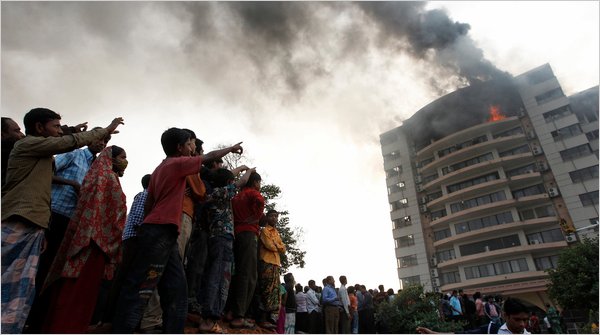
    More than 20 killed in garment factory fire in Bangladesh.

    That tragic fire came immediately to mind when the New York Times reported that more than 20 garment workers died in a garment factory fire in Bangladesh on Tuesday (Dec. 14).

    And these workers, too, were on the 9th and 10th floors of this high rise factory building.  The death toll might have been even higher had it not been lunch hour.  Some 5,000 people work in the 10-story factory building.

    Also, some authorities are saying that many exits were closed, too.  Again, reminiscent of the Triangle Shirtwaist fire.  How ironic!

    These workers were likely making pants for retailers like Wal-Mart and H & M.  Some three million people work in Bangladesh garment factories making goods for the markets in the United States.   The government there has set the minimum wage there for about $43 a month, just over a dollar a day.  And many factories still aren’t meeting that level.  Until recently, the minimum was under $30 a month.

    As we Americans shop for the low-priced pants at Wal-Mart or other retailers, it’s wise to reflect upon the real price as represented in worker misery and poverty around the world.

    It’s time, too, to let our law-makers know of the real need to pass laws to ensure foreign trade is fair and respects the need for manufacturing countries to adhere to fair labor standards and practices.  Then, such laws, as well as those already on the books, need to be enforced. Ken Germanson, Dec. 15, 2010

  • There are dates in history, for those of us who lived through them, we never forget.  Most all Americans over the age of 13 or so can tell you exactly where they were on Sept. 11, 2001, the day the Twin Towers, the Pentagon and a Pennsylvania farm field were hit by terrorists.

    For most Americans who are older than 55, the date never to be forgotten is Nov. 22, 1963, the assassination of John F. Kennedy.

    But you’ve got to be 75 years of age or older to recall vividly Dec. 7, 1941, the day of the surprise attack on Pearl Harbor.  That became clear today as December 7th passed with hardly a mention of the Pearl Harbor sneak attack that put the U. S. squarely into the throes of World War II.  It was a “Day that will live in infamy,” President Franklin D. Roosevelt told Congress as he requested support for declaring war on Japan, Germany and Italy.

    For a 12-year-old boy in 1941, the attack on Pearl Harbor was his initiation into the real world.  He soon would live through the bleak times of the first winter of the war when the Japanese took the Philippines, and our captured soldiers were forced into the cruel Bataan Death March.  He would see the real fear that the U.S. was indeed vulnerable to attacks, even as far inland as his home in Milwaukee.

    He would be shocked at the destruction of London and other English cities in the Battle of Britain; he would be in awe of the damage U.S. “Blockbuster” bombs on Germany and then totally unbelieving at the destruction on Aug. 6, 1945 on Hiroshima with the dropping of the world’s first atomic bomb.

    The 12-year-old boy, growing into young adulthood through these years, looked ahead, seeing the war becoming interminable, with the prospect that he also would follow the uncle who helped raise him into the Armed Services.  He soon saw the stupidity and tragedies of war and would soon wonder: why must humans engage in such behavior?

    Yes, December 7th is a date neither he nor any others of his age will ever forget.  He’ll never forget his mother yelling down to the basement where the boy and his brothers and their father were setting up the family’s train set to say: “The Japanese have bombed Pearl Harbor,” and his father saying, “Oh Lord, that means war.”

    At first the boy and his brother, then 11, jumped for joy, picturing how much fun it would be to “play solider” for real, only to be reprimanded by their father for insensitive behavior.  How soon the boy would learn how tragic war is!

    It’s a date the boy will never forget; soon, however, his generation will be gone, along with their memories of this “Day that will live in infamy.”  Dec. 7, 2010.