• Today, if you’re single and seeking a romantic engagement, it seems to easy. Just go online at eharmony.com, match.com, silversingles.com (the later site for those of us over 50) or one of the many other dating sites.

    It didn’t seem so easy in our younger days, though. Think back to those days when, if you were like me, you had no “steady” and seemingly very little prospect of ever finding a mate. I have to go back to 1954 when I was 24 years old. I had been without a girlfriend for more than two years, and, along with several other guys, tried unsuccessfully using various strategies to meet up with “the” girl.

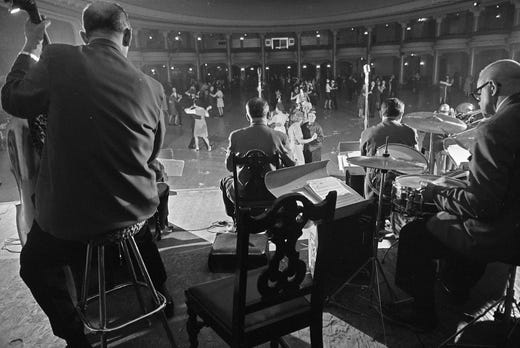
    George Devine’s Ballroom on the 2nd Floor of the Eagles Club was a major attraction for singles and married couples in the mid-20th Century.

    Often with Charlie, who had been my college roommate, we’d tour the bars seeking companionship, where the girls were either non-existent, were too old or even if we saw a girl with possibilities, we’d fail to get up the nerve to approach her, largely through our own fear of rejection. What sad sacks we were!

    In our quest, we found the best places to meet girls were at Milwaukee’s many dance halls; in those days there was the Modernistic Ballroom at State Fair Park; the Wisconsin Roof atop an office building at 6th and Wisconsin, and the Paris Ballroom (which if memory serve me right, was at 20th and Mitchell). And there were ballrooms at old Muskego Beach and Waukesha Beach, two amusement parks in the area.

    The place with the greatest possibility for a hookup, however, was Geo. Devine’s Million Dollar Ballroom, a huge, ornate room located on the second floor of the Eagles Club at 20th and Wisconsin, now known as The Rave. What a place it was on a Saturday night. Always crowded with three bands playing alternately to provide continuous dancing. There was a full-sized swing orchestra, playing tunes of the 30s and 40s; a smaller jazz band, and a polka band. When the polka band played, they’d perform the Promenade, where dancers formed two large circles, girls on the inner circle, boys the outer. As the band played, we’d march in opposite directions until the music stopped. Then we had to select the girl closest to us and dance. It was an easy way to meet a person of the opposite sex; occasionally, you might seek a further dance with them, perhaps even to the point of suggesting a future meeting. (I never connected, but recently, I met a couple who met exactly that way, dancing some 60 years ago at the old Jefferson Hall on W. Fond du Lac Ave.)

    In my case, on June 19, 1954 I married my wife of 63 years (she passed in 2017). I met her at my place of work. And, my friend Charlie. He also met his future wife at work. All this proves is that sometimes you don’t have to work too hard to find your lover; she (or he) might be there, just under your nose, waiting for you. Ken Germanson, March 12, 2021

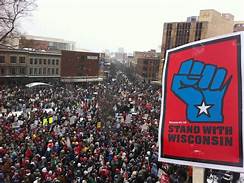
  • Ten years ago, Wisconsin union members and supporters stormed the State Capitol to protest newly elected Gov. Scott Walker’s proposal (Called Act 10) that literally took all bargaining rights away from public employee unions (except for police and firefighters unions).

    Despite massed crowds – reaching close to 150,000 persons on frigid weekends – the Act passed, by passing usual legislative protocols.  The marches proved to be inspirational events that solidified the state’s union members, from the building trades and industrial unions to the school teachers and municipal worker unions.

    Ten years later, in an interview on Wisconsin Public Radio, Walker crowed that the measure was a resounding success.  He admitted his goal had been to take the power away from “special interests,” a euphemism that hid his real goal of seeking to weaken Wisconsin’s labor movement.  Repeatedly, he claimed Act 10 to power from “the union bosses” and restored it to the “taxpayers.”  Sadly, he fooled many Wisconsin voters into believing he was lowering the taxes of middle and low-income families when the real saving went to his fat-cat, big business supporters.

    Up to 150,000 crowded Capitol to protest Act 10 passage.

    Was Act 10 a resounding success, as Scott Walker claims?

    Basically, it’s a no.

    First, there’s no doubt that Act 10 hurt Wisconsin’s unions, most obviously public employee unions and teachers unions.  Membership has dropped 41%, from 385,000 (or 15% of the state workforce) in 2009 to 227,000 (8.7% of the workforce) in 2020.  These figures are from the right-wing MacIver Institute, but are accurately reflecting Bureau of Labor Statistics.

    Secondly, the passage of Act 10 emboldened Walker and his Republican follow-alongs to pass a right-to-work law in 2015 that weakened the bargaining power of construction unions.  And, Walker’s success in these anti-union laws served as a signal to other states to do the same.  Both Kentucky and West Virginia quickly followed Wisconsin in passing such anti-union laws.

    Walker can tell you that the weakening of unions is a good thing, but it’s bad for all Wisconsin workers, union and nonunion alike. 

    Wages have stagnated in the state.  The median family income in 2019 in Wisconsin equaled $61,747, well-below the national median of $65,712.  By comparison, in neighboring Minnesota, the median income is $71,306, nearly $10,000 a year more than in Wisconsin.  Walker may be bragging that the GOP actions have cut taxes, but that means little to those whose wages have go down or have stagnated in failing to keep up with inflation.

    Study after study have shown that as union membership declines the income and living standards of all workers decline, except for those earning the big bucks.

    Additionally, teachers have suffered badly; scores upon scores chose retirement options rather than teach under the conditions imposed by dictatorial school districts.  A professor friend who taught future teachers told me that class sizes dropped as fewer and fewer young people chose this profession.  Walker’s propaganda campaign called teachers a “privileged class,” with their nine-month work year, their workday that ended at 3 p.m. or so, and with “Cadillac” pensions and health insurance unfortunately paid off for several years.  Too many of our citizens believed teachers lived such a privileged life, totally disregarding the off-hours time given to grading papers and drawing up lesson plans.  (Personally, having taught a few classes of adults, I know how exhausting just my limited experience was; I can’t image how taxing facing 30 or more squirming kids six hours a day and five days a week can be.)

    There’s no doubt the education of Wisconsin children has suffered as a result of Act 10 and the Walker attacks on teachers.

    There have been some surprising side effects to Act 10 that have a positive impact upon workers and their unions. 

    Today, workers are showing more solidarity than has been seen since the 1930s.  When Walker rammed Act 10 down the throats of Wisconsin workers, they woke up to finally understand how they were being screwed by Walker and the Republicans, who constantly – and erroneously – tried to pass off their actions as benefiting the “little guy and gal.”

    Among today’s remaining unions, we’re seeing more active memberships.  And this has led to greater militancy as well, showing employers that – regardless of Act 10 or R-T-W laws – workers acting in solidarity can win gains in wages, benefits and working conditions, and thus improve the lives of their families.

    Sadly, though, Wisconsin workers, whether teaching a bunch of school kids or working in nursing homes or toiling in the heat or cold on a construction site, are still paying the price for Scott Walker’s cavalier action of ramming Act 10 down upon the Badger State.  But, it’s to be hoped that by showing militancy and solidarity, Wisconsin workers can take actions that will give them the last laugh.  Ken Germanson, Feb. 18, 2021. 

  • The mobs retreated from the U.S. Capitol Building, but not until they had draped that august structure with the odors of hatred.  Sadly, these hordes of American citizens left their mark.  Make no mistake: Trumpism is not dead, even if that poisonous individual peacefully leaves the White House on Jan. 20th.

    As we approach the inauguration, we’re seeing some signs of sanity returning to the leaders of the Republican Party, most of whom have spent the last four years feeding into the actions of the egomaniac who has occupied the Presidency for the last four years.  Mitch McConnell (that sour-faced Doctor No) is suddenly being praised for being a statesman by not going along with the “stolen election” lies; yet, it was McConnell, whose iron-fisted leadership permitted the orange-haired nut to continue tweeting his lies and spreading his divisive hatred throughout the nation.  And other leaders of the GOP, including House Minority Leader Kevin McCarthy, Senators Ted Cruz and Josh Hawley, among too many others, cheered on Trump’s dangerous, chaotic behavior.

    Mobs marching on Capitol on January 6.

    Whether the GOP leaders will continue their return to sanity is open to question; remember there were over 140 Republican Representatives and eight Senators who voted against certifying the election results.  Several of them, like Hawley and Cruz, have Presidential ambitions for 2024 and may be using their Jan. 6th behavior as a badge of honor to claim Trump’s base in the party.

    Might these mobs soon be seen as “heroes” or “courageous patriots” for storming the Capitol?  Some rightwingers are calling them that now.  A case in point is that of Kyle Rittenhouse, who shot three persons, killing two, during the demonstrations after the police shooting of Jacob Blake in Kenosha in August.  Rittenhouse has become a hero among some groups, and there’s been robust fund-raising among groups (In just a few days after the incident, various groups had raised $900,000.)

    Right now, Trump has few supporters among the established leadership of this nation or among the nation’s “mainstream media.”  Let’s hope that doesn’t change, but there are signs that Trumpism has plenty of media support, in including that of the social media type.  Fox News for a brief moment seemed to accept Joe Biden’s victory, but already, just a few days after the Jan. 6 storming of the Capitol, you can hear the network returning to their past evil ways. 

    Facebook, Twitter and Instagram have all suspended Trump from their platforms, but there will continue to be plenty of ways through alternative sites for Trump and his cronies to spread their lies and their messages of hate.   Cable news channels like Newsmax and One America News have become the go-to viewing of more and more Trump supporters. 

    These media outfits are already harping on the point that the Jan. 6 mobs of nearly 100% whites caused less damage and harm than the numerous Black Lives Matter demonstrations of last summer.  They are still trying to claim the election was “stolen,” a truly ludicrous claim given that Biden-Harris got seven million more votes than Trump-Pence.  One America News is running pleas on how to make contributions to those Senators and Representatives who stuck with Trump in the election certification votes.

    Sadly, it appears there will still be plenty of ways for this right-wing cabal to continue spreading its messages of hate and divisiveness.  And, virtually all of their words will be nothing but lies meant to deceive their followers . . . all with the hope of expanding the ranks of “believers.”

    Too many Americans will continue to be receptive to the demagogic appeal of the Trump message.  These misguided folks are everywhere among our own families, our neighbors, our workmates and even our closest friends.  Many are kind and generous in their personal life and some, of course, are mere thugs.  Trump offered the false appeal that he’d fight for the little guy and that he was a strong leader; both proved false, but too many people still are believers.  And, there was the racism inherent in his message, and that stirred much of his support.

    President-elect Joe Biden’s basic message of building a more equitable economic society where working people can be assured of a decent living standard is the right message; it’s what most Americans desire and need.  He will face one helluva challenge to deliver on that message, but it’s got to be his No. 1 priority (after resolving the pandemic, of course). 

    Meanwhile, the country will face the cancer of Trumpism that will fester among too many of our citizens.  The question is:  Can we come up with the therapy needed to halt this cancer from metastasizing?   — Ken Germanson, Jan 10, 2021.

  • No doubt about it, Joe Biden and Kamala Harris will not have an easy time of it when they finally take office. Partisan politics is a reality right now, with few Democrats or Republicans ready to stray from their respective party lines.

    And the Congress is truly split right down the middle. Even if the Democrats somehow manage to win both Senate seats in Georgia, the Senate will be evenly divided at 50-50, with Vice President (to be) Harris needing to determine the vote. And the House Democratic margin has narrowed to about a six seat difference, leaving little room for Democratic defections.

    This would seem to call for Biden to take a cautious, middle-of-the-road approach, seeking to build an agenda through compromise. If he were to follow that course, Biden’s Presidency will fail . . .the country along with him.

    The country is facing no end of problems, to be sure. Ending the pandemic is, of course, most urgent, but Biden will need to still focus most directly on one principal goal: restoring the nation’s economy so that there will be jobs and sufficient income for all. No longer should we be looking at the Dow Jones averages to determine the health of the country; instead we must be looking statistics that tells us about employment levels, the poverty rate and average wages of workers.

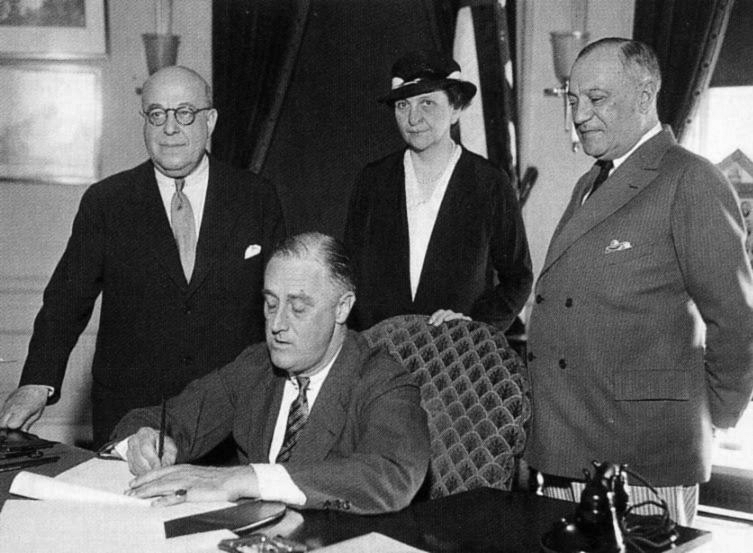
    Joe Biden and Kamala Harris, along with the Democratic leaders in Congress, must be bold! They must speak with one strong voice to develop programs that will make the U.S. economy work for all its citizens. For an example, they could look back to the New Deal of President Franklin D. Roosevelt that helped rescue the nation from the crippling effects of the Great Depression. FDR was bold in offering policies that sometimes were challenged and thrown-out by the U.S. Supreme Court, but he persisted until he was able to pass policies that put money back into the wallets of working people, fueling an economic recovery built upon their increased purchasing power.

    And if you look at history, you’ll see that FDR’s bold New Deal was a crowd-pleaser; even though he lost the support of most of the business community (and nearly all of the media), he won re-election over Republican Alf Landon in 1936 by the historic margin of 523 to 8 in the electoral college. FDR lost only two states, Maine and Vermont.

    The New Deal included direct jobs programs like the WPA, PWA and CCC, plus affirming collective bargaining rights for labor unions in the passage of the Wagner Act (National Labor Relations Act). To this day you’ll see bridges and buildings that were built as PWA and WPA projects. An addition to my own high school was built under a PWA project and my uncle, who lived with us, found employment through the WPA in a bridge-building project. My father-in-law found employment during the Depression as a CCC camp supervisor in northern Wisconsin.

    If you’re puzzled by President Trump’s popularity among blue-collar workers in this country, consider that his campaign messages (and his many lying tweets) played on the economic needs of workers, usually blaming the wrong causes, such as immigrant workers and government regulations. Yet, his message found open ears among families struggling to make ends meet with low-paying jobs.

    Indeed, Joe Biden and Kamala Harris must make lots of noise for an economic program that will help American families earn a living wage or to have a good safety net if they are unemployable. It’s not only good economics, but it’s winning politics!

    As a beginning, Biden would do well to look to the “Jobs for Economic Recovery Act,” offered by Sen. Tammy Baldwin of Wisconsin; Ron Wyden of Oregon, and others. The bill would create a federal subsidized jobs program, enabling unemployed workers to earn wages doing useful work for up to six months, with possible extensions. In addition, the program would pay for job-creating projects created by states, local governments or private groups with the federal government reimbursing wages from 58% to 100%, rising as the state’s unemployment rate might worsen. Most importantly, the bill would not permit replacing workers or undercutting prevailing or union-negotiated pay rates.

    A companion bill has been offered in the House by Rep. Danny Davis (D-IL), Rep. Gwen Moore (D-WI) and others. Moore has said she will press to have the bill placed on the active agenda.

    Joe Biden, Kamala Harris, Chuck Schumer and Nancy Pelosi would do well loud and clear in support such an economic program. It’s a winning strategy and will serve this nation well. – Ken Germanson, Dec. 31, 2020.

  • – Another reason to vote for Joe Biden

    Yes, I’m here to praise politicians. Not all of them, of course, but those politicians who believe in democracy, who believe that they need in most cases to listen to the demands of the voters, and, at other times, to have the courage to act against the majority will when they believe it is right course to take.

    Few people seem to admire politicians, viewing them as dishonest weasels or, even worse, corrupt, selfish and pompous. 

    But let’s truly consider this. “Good” politicians are essential to a democracy. How do we define “good?” Is “good,” in my view, only those who agree with me? No, of course not.

    What then is a “good” politician? He or she is first and foremost someone who believes in seeking always to balance decision-making with a number of different criteria, such as:

    • Recognizing the differing needs of his or her constituents.
    • Understanding that it’s not possible to satisfy every need, but to consider all of them.
    • Having the guts to make a decision that may upset his/her supporters when it’s the right thing to do.
    • Providing leadership, even when it’s not popular, since this is the key to governing, to getting action and accomplishing positive changes for society. 

    Thus, the “good” politician must perform a balancing act. In a sense, this politician must walk the tightrope balancing all sorts of demands, while keeping an eye on the eventual goal of reaching the other side. While doing all this balancing, he/she must never lose sight of the basic principles of honesty, commitment to the cause of representative government and the need to provide leadership.

    It’s not an easy task, but our most successful Presidents, governors and legislators have done that by practicing good politics.

    They include George Washington, Abraham Lincoln, the two Roosevelts, Theodore and Franklin D., Lyndon Johnson, Ronald Reagan, and maybe Barack Obama, even though we need to await the judgment of history to include him. All of the above were basically career politicians and all were largely successful in leading the nation. Not every reader here will agree with the inclusion of one or two listed above, but it would be hard to argue that they were not largely successful in achieving many of their respective goals.

    President Johnson in action.

    Interestingly, too, all of the above made mistakes, some causing terrible tragedies. Some even have been accused to doing shady actions at times in their careers. Take Lyndon Johnson, for instance, whose leadership provided our nation with truly life-changing achievements in voting and civil rights and in creating Medicare and Medicaid; yet, he also led us into the ill-fated Vietnam War. Though an actor by trade, Ronald Reagan also a politician. He emerged from navigating the politics of his presidency of the Screen Actors Guild to becoming governor of California before he became President in 1981. He has been credited with ending the Cold War, but he also helped move the nation into growing income inequity and was deeply involved in the discredited and illegal Iran-Contra Scandal. 

    None of the most effective presidents were ideologues; nor were they purests. Instead they were presidents who got things done; they pushed and campaigned hard for a goal, and then took what they could get. President Obama’s passage of the Affordable Care Act is a case in point; it squeaked through Congress by the narrowest of margins. The ACA is certainly a flawed act. To assure passage, Obama agreed to drop the public option that would have made the law much more effective, but if he had persisted in that goal, it was pretty obvious there’d be no ACA at all.

    Our “good” presidents have not been perfect, but they showed flexibility and an ability to work with others to provide positive change.

    And, all had plenty of political experience before they took office; rarely has the novice politician been truly successful. Joe Biden brings 47 years of political experience; our current president has three-and-one-half years. Donald Trump came into the office as a businessman, expecting to act like a CEO who is able to make an order and see everyone jump through hoops to complete his command. Thankfully, in a democracy, there’s no place for one-man rule. That only occurs in a dictatorship.

    Of the two, Joe Biden is the only one who has the political skills, experience and decency to become one of our nation’s “good” presidents. With Donald J. Trump on the other hand it’s “amateur hour,” creating some awful outcomes. For me the choice is easy. – Ken Germanson, Nov. 2, 2020

  • Following is a from a homily given by Ken Germanson in a Zoom service before the nondenominational congregation, the Community of the Living Spirit of Waukesha WI, on Oct. 25, 2020

    Like so many who had a Catholic upbringing, I paid little attention to the Bible.  I found myself guided mainly by the gospels from the New Testament that we heard on Sundays.  Even now, I must admit I still know little about the Bible.  Yet, I have learned this much:  If there’s one universal theme running through the Christian Bible . . . and indeed most of the world’s religions . . . it can perhaps be summed up by the good old Golden Rule that I recall hearing my mom quote to us kids in our childhood:  “Do unto others as you would have them do unto you.”

    The Golden Rule is certainly reflected in today’s last reading from I John 3:16-18 . . . a reading that I think best fits the theme for today.

    Now at election time, perhaps we ought to put into action the command as stated in the Golden Rule and in I John 3:16-18.  The words call for action.

    We often think that the Golden Rule applies only when it comes to our personal relationships . . . such as how generous we are with our friends . . . how unselfish we are with our neighbors . . . and how understanding we are with some members of our families who may not always be the easiest to get along with.

    We all know people who have been kind and generous to immediate friends and family but who also are complaining that they pay too much in taxes . . . that unemployment insurance supports the lazy . . . that people of color are too demanding.  

    No, we’ve got to take the principle of the Golden Rule and of I John 3:16-18 and give it a more universal meaning . . . to the decisions we make when we vote . . . and to what actions we take within the community.

    The last sentence of John reads: “Little children, let us love, not in word or speech, but in truth and action.”  And, I emphasize the word “action.”

    Let us have more  than empathy … we need true compassion, for when we feel compassion we will also feel the need to alleviate the suffering we see and to right the wrongs of society.  According to Merriam-Webster, there is a difference between empathy and compassion; empathy is merely a feeling we might have for another person’s suffering while compassion is, in addition, a call for action.

    Our nation is currently facing a combination of crises that in the long run can only be solved by community actions that are done in an atmosphere of compassion.   

    The COVID-19 pandemic has not only caused undue suffering and the deaths of some 225,000 Americans, but it has brought economic chaos to millions . . . many of whom are on longterm or even permanent unemployment or under-employment . . . others who are facing eventual eviction . . .     Strangely it has also benefited many of our wealthiest citizens.  We have seen the stock market rise at the same time workers are either without jobs or working such short hours they can’t pay the rent or put food on the table.   

    Most economists, as far as I can tell, regardless of their political bent, foresee a future in which the rich will get richer and the middle class and poor will get poorer.  As we look ahead for economic recovery . . . once we overcome the current pandemic . . . it appears these trends will continue.  Usually economists describe economic trends to be in a “V” curve . . . with the economy dropping for everyone and then recovering for everyone.  Not this time, it’s bound to be more like a “K”, with the economic fortunes of the rich increasing while the middle class and poor incomes will go down.  Thus, a “K”.

    There’s no doubt that as we eventually emerge from the grips of this pandemic, our society – and our economy – will be much different.  We will have greater challenges as many businesses will be slow to recover . . . production of goods will be decreased . . . many jobs will never return.

    In short, we may have less resources than before . . . and unless we change courses on our distribution of income . . . our future may be a devastating disaster for far too many men, women and children.  

    Historian David J. Staley of Ohio State University foresees that after the pandemic we will continue practising some of our habits of isolation, such as using Zoom rather than holding in-person meetings, all of which may foster greater individualism.  This growing trend toward individualism and isolation may block whatever progress we have made in reducing racial stereotypes and in fighting systemic racism.  How can we learn about people who are not like us, unless we interact with them?  

    On the other hand, he also says the economic fortunes of our nation’s essential workers — in most cases the most poorly paid — could go one of three ways, either toward greater inequity of between the rich and the poor, greater unemployment because of the use of more automation, or, more hopefully, with a trend toward more equal treatment of workers, largely as they see the need for joining together in collaboration to demand justice, such as through greater unionization.

    Which of those will happen probably depends greatly upon what happens in this election. 

    In nine days from now, we will end a campaign season that is unlike any this nation has ever endured.  The results of this election will affect us – the citizens of the United States, and, indeed, the world – in either terribly adverse ways, or in ways that will bring more hope for a future that benefits all, the rich, the poor and all those in-between.

    The decisions we make in these remaining two weeks call for compassion on the part of all of us.

    Even if the election ends with the election of a new President, more positive and progressive changes in our Congress and among our state leaders, there will continue to be tremendous challenges facing our communities, our states, our nation and the world.

    This is a call for our leaders to act with compassion:  that way, all of us with benefit. And, beyond this, it is a call for all of us to guide ourselves with compassion and do whatever is within our abilities to act in community with others by voting, urging others to vote and to make our decisions based on the principles of the Golden Rule and I John 3:16-18.

    I’d like to end this homily on a hopeful note by turning to the eminent African-American theologian and civil rights leader, the late Howard Thurman (1899-1981), the author of Jesus and the Disinherited.

    “Listen to the long stillness:  

    New life is stirring

    New dreams are on the wing

    New hopes are being readied:

    Humankind is fashioning a new heart

    Humankind is forging a new mind

    God is at work.

    This is the season of promise.”

    And if you think, you’re too old to do anything, consider this story that Thurman told and was related in a recent interview:

    “When Thurman was a small boy, he saw an elder, man who must have been in his eighties, who was planting pecan trees.  And young Thurman raised a question. He said, ‘Sir, you’re not gonna be around. You will not live long enough to taste the fruit from these trees.’ And the old man paused and said, ‘Son, all my life I’ve been eating from trees I did not plant. It’s my job to plant for somebody else.’” And my father said, “Just plant. There will be trees that you will never see grow, that someone else will eat from. And it’s their responsibility to plant for somebody else. And so we don’t have all that we should have, we’ve not reached the goals that we are supposed to reach, but we have started the race, and you’ve got the baton, son.  Pass it on.”

    Thus, there is much we can do as we grow older.  Again, from quotes by Howard Thurman:  “The hard thing when you get old is to keep your horizons open. The first part of your life everything is in front of you, all your potential and promise. But over the years, you make decisions; you carve yourself into a given shape. Then the challenge is to keep discovering the green growing edge.

    ####
  • One of the joys that make Milwaukee a special place to live are the many green spaces and parks. I can’t prove this, but our city may have more parks per capita than any U. S. big city — all due to the foresight of our Socialist leaders of late 19th and early 20th Centuries.

    Our County Park system is composed of 157 parks, 125 miles of multi-use trails and 14 golf courses. It grew out of our earlier municipal park systems developed by leaders like Victor Berger, Emil Seidel, Dan Hoan and Charles Whitnall, all Socialists who viewed recreational activities as necessary as other necessities of life. Interestingly, Berger’s wife, Meta, was the inspiration behind the development of the Milwaukee Public School’s Department of Municipal Recreation and its own creating of playgrounds, soccer and baseball fields and other sites. (Pickup John Gurda’s 1999 book, The Making of Milwaukee for a great summary of these developments.)

    This week, with its unusually warm and sunny weather, I took my walks in two parks near my home; both were large acreage of greenery and water nestled between traffic-heavy thoroughfares and tightly populated neighbors of home and small, sometimes grubby, industrial buildings.

    I was astounded to find this gem of a tiny pond along a park trail on a warm afternoon recently (photo at left). I had passed it dozens of time without stopping and looking at it. My oh my, what I had been missing! It seems like a swampy pond in the midst of a dense remote forest; yet, it sits less than 75 feet from one of Milwaukee’s busiest roadways.

    In another park, located smack-dab among industries and homes is the lovely tiny lake pictured here.

    Why don’t you take time out for a walk in the park? There are plenty to chose from. And, what surprising and inspiring sites you’ll find. Believe me, too, that you’ll arrive home refreshed and happy. Wouldn’t that be great?

    Look at the pictures closely. Can you reply to this blog and tell me in which parks they were located?

    My walks inspired me to write a bit of verse. You can read it here.

    Ken Germanson – Oct. 9, 2020

  • I drained my tea last night, and my heart sank! At the bottom of the cup the remainders of my tea leaves formed a frightening design. Reading them, here’s what I saw:

    Because of the failures of leadership (read Trump), the coronavirus will gain new vigor and strike down another 100,000 Americans; the rich will grow even richer while the rest of us will struggle; people of color will grow more frustrated, resulting in more marches and scenes of armed “patriots” gunning the peaceful protesters down; our racial divisiveness will get worse not better; the polar bears will lose their habitat and much of Southwestern USA will become like Death Valley and its 130 degree record heat this summer.

    That’s what my tea leaves told me last night. Scary, eh?

    But, we can seek to show that my tea leaves were dead wrong! One answer, of course, is to make sure Trump is kicked out of office and the Democrats gain control of Congress, but that’s just the beginning.

    Perhaps, the most important goal will be to redirect this nation’s wealth from the richest of Americans and dedicate it to the general welfare. Once, the ordinary Joes and Janes, Joses and Marias, Abdullahs and Angelicas have more cash in their jeans and purses, they will make the purchases to keep the economy purring. They will begin to believe that they have a stake in our nation. They will direct their attention to becoming informed citizens and voting.

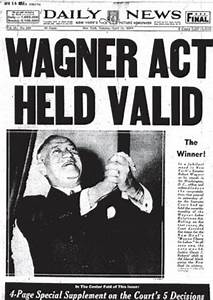
    The Wagner Act (the National Labor Relations Act) was challenged by business groups. It was ruled valid by the Supreme Court in 1937, broadening powers of workers to organize.

    Of course, tax laws can be changed to help move funds from the wealthiest to serve the general welfare, and Joe Biden has made that an important part of his agenda.

    The most critical change is to strengthen our workers’ ability to gain a living wage and decent standard of living. And they can best do that through the collective bargaining system, that is, through strong labor unions.

    Data has shown clearly that the steady gains in buying power of ordinary American families rose during the post-World War II period until the election of Ronald Reagan in 1980. It was then that the power of our nation’s labor unions began to wane, a product of changes in labor law under successive Republican administrations and in the movement of mainly union jobs in manufacturing from the USA to other nations. Since then, the living standards and the income of the average family have remained stagnate.

    Yes, the revitalization of our unions is critical to a thriving America; it results in all citizens (union and nonunion) to prosper by assuring that working people get a bigger piece of an enlarging pie.

    A strong labor movement is also needed to balance the political power in the nation. Strong unions have historically been the base of support for the Democratic Party and for progressive legislation for civil rights, the environment and health care access.

    During the Great Depression of the 1930s, workers embraced labor unions as a way to a better life and organized in masses, forcing employers to pay better and improve working conditions. They were helped in that by the passage of the National Labor Relations Act that in its earlier form gave workers the tools to form unions. Many economists credit the growth of organized labor as critical to getting the nation out of the Depression.

    An economy that rewards ALL of its citizens and not merely the managerial classes and hedge fund manipulators will take the nation a long way toward resolving the problems of poverty and racial divisions. Many are now recognizing the value of unions to maintaining a strong democracy; recent Gallup polls say that 64% of Americans view unions in a positive way.

    Today’s labor laws – and the structure of America’s unions themselves – are badly in need of change. The National Labor Relations Act now does more to protect companies from being unionized than it protects to rights of workers to organize. So-called right-to-work laws need to be repealed and fair-minded appointees need to be made to the NLRB, its five seats now being occupied solely by three Republicans, all clearly with a pro-management bias. Much of this can be remedied by legislation at both the federal and states level. Such necessary changes are part of the Biden agenda.

    Thus, a lot depends on the outcome of the November elections. But there is hope. Maybe a closer look at the tea leaves left in my cup need to be read again and there is hope ahead. – Ken Germanson, September 3, 2020

  • It was Aug, 6, 1945 – just two days before my 16th birthday – and it may have become a day that helped more than any other to form my strong view that wars are a needless horror.

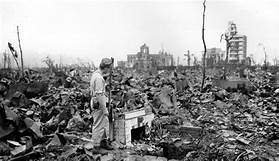
    What was left after the bomb fell.

    It was nearing suppertime on that day and I had just arrived home, having ridden my bike some four miles, my makeshift set of golf clubs on my back, from Currie Park Golf Course.  It was a sunny, clear, beautiful day.  My folks were gathered around the radio in our bungalow, listening to the news reports of the dropping of a horrible bomb on the Japanese city of Hiroshima.

    “Listen to this,” they hushed me as I entered the living room.

    The words “equivalent to 100 blockbusters” caught my attention as the radio announcers tried to describe the extent of the damage to this city.  At the time, the blockbuster bomb, developed by the United States, was a massively destructive bomb, dropped from the air to obliterate entire blocks, hitting military targets and innocent men, women and children alike.  The thought of a bomb that could do 100 times that damage was incomprehensible.  

    In those days before television, all we had were pictures from the daily newspaper, Life or Look magazine and the newsreels we saw at the movie house.  Our minds had been flooded with pictures of flattened houses and stores.  Occasionally, there’d be a picture of a dead human being, but for the most part such personal horrors were not shown, either censored by the Armed Forces or edited out due to the sensibilities of the editors.  Perhaps that’s why we couldn’t comprehend the full horrors of war.

    The dropping of this monster was justified as helping to shorten the war.  It was indeed a devil’s bargain: trading the lives of nearly 150,000 Japanese for perhaps a half million more had the war continued.

    As if to nail down the bargain, three days later the US dropped a second atom bomb on Nagasaki, killing up to another 75,000 folks.   Within a week, on Aug. 15, 1945, the Japanese dropped down their arms and we all traipsed down to clog Milwaukee’s main drag, Wisconsin Avenue, to kiss the girls and celebrate V-J Day.

    President Truman took full responsibility for the decision to drop the bomb and never wavered in claiming it was the right decision.  Most Americans at the time agreed with him, since the War had been dragging on since Pearl Harbor Day (Dec. 7,1941) and it had greatly impacted the daily lives of all of us.  To a high school student like myself at the time, we were relieved at the war’s end since it meant that perhaps we were not to be drafted into the Army.  (Of course, we were not to be spared that privilege; most of us ended up being drafted into serving in the Korean War five years later.)

    A year later the true horrors of Hiroshima were revealed in John Hersey’s long narrative in the New Yorker magazine, entitled “Hiroshima.”  In it, he told the stories of six victims of the bombing, a narrative in stark, unadorned commentary that was truly terrifying and horrible.  (The value of Hersey’s work is shown in a recent book by Lesley M.M. Blume , “Fallout: The Hiroshima Cover-Up and the Reporter Who Revealed It to the World.”)  (Blume’s book is reviewed here)

    Today – Aug. 6, 2020, another bright, clear August day – I teared up viewing an MSNBC “Morning Joe” segment on the Anniversary of the dropping of the bomb.  It made me wonder again how war can motivate otherwise moral human beings to commit unbelievable horrors upon others, even the most innocent of us. 

    In the intervening 75 years, world leaders have mercifully shied away from the use of nuclear weapons, but now many of the current leaders are running away from anti-nuclear pledges and treaties, including our own government.  Perhaps, they all ought to revisit the horrors of Hiroshima and Nagasaki.  They all ought read John Hersey’s short book.  – Ken Germanson, Aug. 6, 2020

  • The death on July 7 of my old friend and mentor, Tony Ingrassia, at age 93 in Virginia got me to reminisce about people who have influenced me most in my life.  It’s something, I think, that we should all do from time-to-time.  We are who we are largely thanks to the guidance and friendship of others.

    Tony moved away 65 years ago and we had only rare visits and exchanges of Christmas cards since.  Yet, I credit him with inspiring me into a long, satisfying career in the labor movement.  When I knew him, he was one of the best sportswriters in Milwaukee and, more importantly, the leader of our Newspaper Guild unit at the old Milwaukee Sentinel.  I learned from watching him in negotiating labor contracts and in making sure we did our homework so that we were smarter than the other side.  I was inspired with how he juggled his sportswriting job with his union work and being the father of close, tight-knit family with 10 children. 

    Tony is one of many people who helped me to grow and learn how to navigate through the struggles of life and to have enough sense to enjoy moments of satisfying happiness.

    Now let me tell you about Miss Wolf, my 4th Grade teacher at Roosevelt Grade School in Wauwatosa, Wisconsin.  Frankly, she was never one of my favorite teachers and I forget her first name; yet, though she may never have realized it, she is likely responsible for my lifelong need to write . . . and to keep writing about anything and everything.  In a sense, perhaps you can blame her for this blog.

    In the 4th Grade, I was enamored with prize-fighting, particularly Joe Louis who was a glorious sight with a well-proportioned, muscular body, a disciplined style of boxing and a gentle, warm demeanor.  And he never seemed to lose, though he came close to doing so on June 28, 1939 in Yankee Stadium when an unlikely overweight contender, Tony “Two-Ton” Galento, lasted four rounds in a bloody battle in which Galento actually floored Louis, only to lose when the fight was stopped in the fourth round.

    I wrote about that fight and submitted it to our grade school paper, “The Golden Star,” where it was published – my first story to see print.  And Miss Wolf was so impressed she induced me to write more.  By 6th Grade I was editor of the grade school paper – and I never looked back.

    Thanks, Miss Wolf, for recognizing something in me about which I could take pride.  It must have been a liberating event in my young life, helping to free me from my early years of shyness and self-doubt.  How much we all need such inspiration to help us feel our own personal worth.

    Then there was this stuttering problem.  I still stutter, though not so you’ve noticed, I hope.  But until my young manhood, I felt terribly stifled by my severe stutter; it cropped up in nearly every encounter, the ordering of a pack of Phillip Morris cigarettes (I had trouble saying the “Ph”), calling up my high school girlfriend (N – N – N – N – ancy) or even picking up the phone and answering (H – H – H – H – ello).

    Every time I had to engage in such situations, I was terrified that I would never get the needed word out of my mouth.

    I thank many persons for helping me overcome this fear of speaking out, starting with numerous speech therapists through the years, my parents for seeking help and my friends for accepting me, stutters and all. 

    There are several persons whose guidance are most memorable.  I worked most of my high school years in Whipp’s Drugstore in Wauwatosa as a soda jerk and clerk.  There, I had to answer the phone and oh! how I stuttered in trying to answer “Wh – Wh – Wh – Wh – ipp Drugs.”  It was then Waldemar Whipp, the druggist, advised me, “Look, Ken, the people who are calling don’t care if you stutter or not.  All they want is to order their ice cream or prescription.  They don’t care how you talk.” 

    Also, there was Gordon Lewis, editor and publisher of the prize-winning weekly South Milwaukee Voice-Journal, where I held my first newspaper job after graduating college.  In my job interview, I warned him that I had hoped my stuttering wouldn’t be a problem for him.  He answered, truthfully, I think, “Stutter? I hadn’t noticed.”

    These are just a few examples of how various persons have helped me throughout my life; I could name many others.  It’s just proof that to navigate this world, we can’t do it alone; we need the guidance and counsel of others.

    Just think back into your life and make a list of those who deserve your everlasting thanks. Ken Germanson, July 20, 2020