• Sometimes I look at the world through rose-colored glasses. 

    I must admit I did that on the tragic election night of 2016.  I actually thought that the crude, boorish, racist, sexist buffoon we elected might rise to the occasion and eventually become a true leader.  God knows, our nation has faced enough crises to give him plenty of occasions to surprise us and take statesman-like actions.  We’re still waiting.

    History is replete with examples where presidents have exceeded expectations.  I was born when Herbert Hoover was president and among the 13 presidents who succeed him up to the President Trump, everyone of them has surprised us, beginning with Franklin D. Roosevelt.  When he was elected, Roosevelt was a blue-blooded politician without much of a social philosophy or commitment.  Yet, through the shrewd selection of committed aides and cabinet members and a unique political sensitivity, he fashioned perhaps the greatest social revolution in our history.  And, history tells us also how he steered a basically isolationist country to support our Allies – namely the British and French – to beat back Adolph Hitler.

    FDR’s sudden death on April 14, 1945 thrust an unprepared Harry S. Truman into the presidency just three months after his inauguration as vice-president.  He did not even know there was an atom bomb in the making at the time, and just four months later had to make the decision to drop that bomb on Hiroshima and Nagasaki, thrusting the world into the nuclear age.  With a philosophy of recognizing “the buck stops here” (so said a sign on his desk), Truman made that decision in the belief it would shorten the war and save lives in the long run.  In retrospect, it may have been the wrong decision, but he made it and showed leadership.  Truman, often mocked for his nasal-Midwest voice and having failed in the haberdashery business, showed guts also in vetoing (unsuccessfully) the Taft-Hartley Act of 1947 that permanently stifled the growth of the nation’s labor unions.
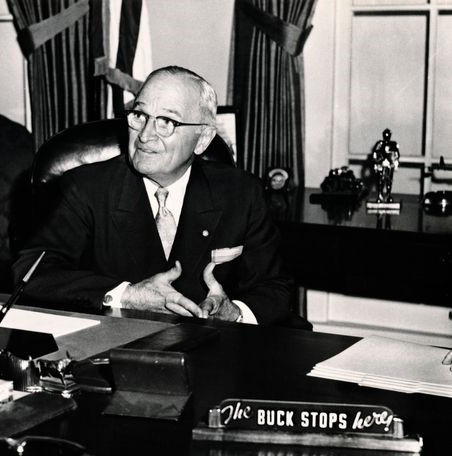
    President Truman’s desk often displayed the famous “The Buck Stops Here” sign

    Gen. Dwight Eisenhower, praised as a great general, was a lackluster president, but he displayed a strong moral and ethical presence so important in those postwar years.  He was too slow to censure Joe McCarthy’s irresponsible red-baiting crusade or to champion civil rights, but eventually he did, with decisiveness.  Ike, most importantly, warned the nation against the unbridled and dangerous power of the military-industrial complex.  Sadly, he was right.

    President John F. Kennedy’s time in office was sadly too brief; he was inaugurated on Jan. 20, 1961 with great promise.  He helped pave the way – though perhaps too hesitantly – for the start of progressive civil rights legislation.

    And what can we say about Lyndon Johnson?  Truly a politician in any sense of the word.  Certainly a bit corrupt and a Southerner, LBJ surprised all of us by spurring the passage of the truly game-changing Civil Rights and Voting Rights Acts, plus developing the Great Society.  Then, he failed us by heightening the Vietnam War, a war he publicly supported but I felt he truly was troubled by. [i]

    Even the despised Richard Nixon recognized the special nature of the presidency when he resigned instead having the nation go through a painful impeachment process that he might even have survived.  And, remember, he signed into law both the Environmental Protection and Occupational Safety and Health Acts.

    Gerald Ford, the nation’s only un-elected president[ii], showed political courage in offering partial amnesty to the so-called draft dodgers from the Vietnam War and in eventually supporting abortion rights to the displeasure of many in his own party.

    Perhaps Jimmy Carter was too nice a guy to be an effective president.  Yet, his leadership was based in values of decency and competence; though a Southerner, he openly supported the rights of Black Americans.  He was eaten up, however, by a small-minded media and the conniving of Republicans who used the Iran-hostage-taking incident to manipulate public opinion.

    Somehow the B-actor Ronald Reagan blundered through, promising “morning in America” and having several prominent theatrical moments, including his famous “take down this wall” promise about the Berlin Wall. 

    George H.W. Bush certainly could not be called a “great” president, but he did support the revolutionary Americans With Disabilities Act of 1990 in spite of major business opposition.  And, he had the courage to support a bill increasing taxes, even though it violated his own “read my lips” campaign promise not to do so.

    Bill Clinton came into office with lots of promise: a gifted orator, a winning personality, an unquestionable level of intelligence and experience in government.  Yet, he failed in providing the leadership needed to move the country forward, signing into law the awful welfare reform bill, failing to pass any form of health care legislation and supporting “tough on crime” laws.  Clinton did, however, paved the way for greater inclusion of women into leadership, appointing an unusually high number to his cabinet, plus making Ruth Bader Ginsburg only the second woman to be made Supreme Court justice.

    Even George W. Bush had flashes of real leadership in the aftermath of Sept. 11, 2001 when he rallied the nation, only to plunge it into his dishonest, ill-advised adventure in Iraq.  “W” also supported a sound immigration reform plan, in spite of resistance from many of his own party.

    In my mind, Barack Obama exuded honesty, integrity and inspirational leadership often during his presidency, even though many felt he fell short in furthering civil rights and the causes of workers and their unions.  Yet, his leadership in creating and shepherding through the Affordable Care Act can’t be questioned, even though the law itself fell short of bona fide health care reform. 

    Some of you may question my judgments on these 13 past presidents; nonetheless, it’s apparent to me that they all displayed moments of true, unselfish leadership.  We have yet to see that from the current occupant in the White House.  Will he surprise us in the remaining six months of his term?  Don’t hold your breath. – Ken Germanson, July 1, 2020

    __________________

    [i]     I was present when a small group of labor union editors met with President Johnson in the White House in April 1968 and heard him tell of the concern he felt in the continuation  of the Vietnam War.  To me he displayed sincere sorrow at his decision.  Perhaps it was an act, but I felt not.

    [ii]    Ford became Nixon’s vice-president after the elected VP, Spiro Agnew, resigned due to corruption charges.  Ford had been a prominent Michigan congressman.


  • All signs at this date in late June point to a blow-out victory in November for Democratic Presidential Candidate Joe Biden.  Major polls gave Biden a vote-total victory averaging nine points and a New York Times-Siena College Poll gave him 12-point national win and a 9-point win averaged across six key battleground states – all of which had been won by President Donald Trump in 2016.

    So it’s Biden by a landslide, right?

    Not so fast.  Remember it’s just over four months until election, and lots can happen in electoral politics in a short time. 

    You only need go back to 2016.  Virtually all polling had Hillary Clinton winning by a modest margin then; and she did indeed win the popular vote (by 2.8 million) only to be brought down by the electoral college that Trump won thanks to narrow votes in three states, Michigan, Pennsylvania and Wisconsin.

    In Wisconsin, for instance, the highly respected Marquette University poll reported less than a week before the election that Clinton had a six-point lead.  The Clinton campaign felt Wisconsin would be a cinch for them in 2016; it cut back on campaign activities and, despite pleas by state Democrats, the candidate never stepped into the state to campaign.  When the tally was done, she lost by 27,000 votes; along with unexpected wins by Trump in Michigan and Pennsylvania, the electoral college results made it possible to Trump to win.

    Now, in late June 2020, that same Marquette poll shows an 8-point Biden lead in Wisconsin and the Times-Siena poll a 9-point lead.

    Let’s go back to 1948.  I was a college sophomore at the old University of Wisconsin – Extension Division two-year campus then, and I was campaigning hard for the Democrat Harry S. Truman over a popular Republican Thomas E. Dewey who had won renown and respect for his prosecutions against New York gangsters.  I was glum on that election day: Truman was apparently doomed and before I turned in to go to sleep on election night I heard NBC’s H. V. Kaltenborn, then radio’s most listened-to commentator, predict a Dewey win, even though the early results showed Truman unexpectedly ahead.  (Note: Kaltenborn was born in Milwaukee and raised in Merrill, leaving to serve in the Spanish-American War of 1898.)

    Radio newsman H. V. Kaltenborn

    The next morning, I rode the North Ave. trackless trolley to the Extension Division’s downtown Milwaukee campus and spied a newpaper box attached to a lightpost that contained the Chicago Tribune with its infamous headline: “Dewey Beats Truman.”  Later, I learned that Harry Truman had won!

    The premature 1948 Election Day headline.

    The polls had predicted a Dewey victory of between 5 to 15 percentage points, but Truman won by 4.4 percentage points.  Burns Roper of the then-prestigious Roper Poll said the Truman win developed because an energized labor vote that had been encouraged by worries about Dewey’s strength in preelection polls.  Republicans felt their candidate would win “so they played golf that day,” Roper said.  (Read an account of 1948 election here.)

    Does all this mean to disregard the polls?  No.  Polls can offer important clues as to trends facing candidates.  Today’s polls are uncannily accurate, but only at the time they are taken.

    Lots can change in a few short days.  Many experts claimed the Clinton-Trump election changed about ten days before the 2016 election when FBI head James Comey reported that Clinton’s email practices were reckless, even though they may not have been criminal.  Who knows what true – or untrue – charges might be leveled against Joe Biden just days before the 2020 election?

    The Trump campaign is loaded! They’ll have gazillions of bucks to throw into TV ads and other campaign strategies.  The Republicans continue to be united with Trump, even those GOPers who should know better.

    Remember Harry Truman came back in 1948; can Trump do the same in 2020?  There is one critical difference between Truman and Trump: Harry Truman was a true man of the people; he was perceived as “one of us,” even with his boring, nasal-toned speech, his proclivity to using four-letter words, his simple way of life and his gaffs.  But he proudly claimed “the buck stops here” and he truly did make decisive decisions, even some that many questioned.  He was a leader.  Trump lacks those humbling characteristics – and he’s a coward who will never admit to a mistake or take responsibility for any decision.

    Nonetheless, Trump is not dumb when it comes to commanding center stage and he won’t accept losing.  Be ready for anything from his camp. 

    History thus leaves a warning!  Never be overconfident and work like hell for your candidate, no matter how one-sided an election may look.  I’ve participated in many a political campaign and nothing frustrates me more than when I am asked for my opinion as to whether my candidate would win the election.  I always refuse to answer that question.  My advice is to keep your eye focused on whatever you can do for your favored candidate, regardless how well or how badly he or she was doing in the polls. – Ken Germanson, June 25, 2020

  • Some people believe the clout of the police unions is too powerful and that they should be abolished, or at least weakened. Is that a way to begin reforming policing? No way!

    There’s a belief that politicians of both parties are scared stiff of retaliation by the police union if they support reforms. Others complain that errant officers too often are protected from disciplinary action due to the existence of unions that use the union contract to protect unnecessarily violent officers.

    The police unions have indeed shown great political strength, and the Republican Party has largely been the beneficiary, just as that party has become the darling of the National Rifle Association. Yet, the laws that are passed are done by politicians – not by union lobbyists – and politicians need to recognize their obligation to develop legislation that benefits all of the citizenry.

    Let’s first remember one thing: police officers are workers and all workers deserve the right to self-organization and the right to unionize!

    Secondly, the union’s obligation is to protect its members. That’s a principle purpose of unionizing: “one for all, all for one!” Thus, if a police officer (i.e. worker) is disciplined or discharged, a union leader’s obligation is to protect that worker and to insure that his or her rights are protected. The union must assure that the charges against an officer are adequate to permit the discipline he/she may be facing; they must assure that the Department following proper procedures.

    I spent 35 years as either an active local union member, a union representative or as a national union official and was called upon to represent many workers who were disciplined. There were some members who I truly didn’t like and might have done questionable actions, but I represented them as best I could. They deserved to see their rights protected, even if they were eventually fired or disciplined; but the more important reason was because in representing that worker I was protecting the right of future workers against being unfairly disciplined.

    It’s also important to realize that the union does NOT hire the individual worker; rather, It’s the employer, or in the case of the police, it’s the municipal employer. Thus, if the department hires a rogue officer, we in the union are obligated to represent that officer. The problem begins in the recruiting, hiring and training of the officer – and that’s a management responsibility.

    Let’s then get past this idea to abolish the right of police officers to have a union and let’s see what can be done in the future.

    A lot of change needs to begin with the management of the police force, the municipal government, the chief and the top supporting officers. The passage of laws that provide for more community-oriented policing with sufficient funding is a must. Further legislation such as banning chokeholds and unnecessary use of tear gas and other near-lethal crowd control measures is needed. Those chosen to be lieutenants and captains and deputy chiefs must be men and women with an understanding of community needs and must be people who reject the old, punitive ways of policing. The Department itself must foster a more collaborative spirit with the community within which it serves – rather than viewing citizens as the enemy.

    Strong management, then, is a must.

    As a union representative, I found it was much easier dealing with a management that may be tough, as long as such toughness is accompanied by consistency, honest and straight-forward practices. The toughest manager to deal with is one who is nice to you one day and an unreasonable SOB the next.

    Now is not the time to so restrict police unions that they will be unable to fully represent their members; if the unions are gone, you can bet the quality of police work will drop. Look what happened in Wisconsin when Gov. Scott Walker and the Republican legislature took away collective bargaining rights for public employees, including teachers. Scores of teachers fled the ranks, drawing early pensions or moving to other jobs; teachers’ colleges reported drop in students who wanted careers in teaching and the quality of public education suffered.

    Bill Fletcher, Jr., author, talk show host and longtime unionist and civil rights activist writes: “If one were to eliminate all police or law enforcement unions tomorrow, the problems that are being faced with law enforcement today would barely change. Why?  Because the law enforcement unions are not the problem; the history, culture and practices of the U.S. law enforcement system are the problem.” See In These Times article, June 12, 2020)

    It is my hope that the current public demonstrations against police brutality will prompt the leadership of the police unions to recognize the need to broaden their goals, to realize that continued hardline resistance to change may result in the public demanding the curbing of police union rights. That means accepting the responsibility of supporting reasonable restraints to the use of undue physical force to subdue recalcitrant offenders; that means dropping the “blue line” mentality that makes it impossible to rout out the bad cops.

    Most of this change will have to come from within the union itself, from members who join together to vote out the old line leaders who foster such an “us vs. them” attitude with citizens.

    Police unions have in their power to do much to lessen today’s current episodes of violence. It’s my hope they will do just that. – Ken Germanson, June 16, 2020

  • This nation is in crisis!  A terrible virus continues, largely unabated and expected to grow in the future, our economy is tanking with little immediate hope of revival, and now our cities are aflame and facing a police-state shutdown.

    Yet, the one person who could be in position to lead us through this crisis is offering nothing but petty vindictiveness and childish taunting.  President Donald J. Trump has failed us miserably.

    Just look at how he responded to the devastation in Minneapolis and St. Paul; rather than offering help and words of hope to the citizens of those two great cities, he chose to blame the strife on “Democrat” mayors.  Then, he personally took credit for the presence of National Guard troops entering the cities to clean up the chaos, an action that he only had peripheral involvement, if any.

    As the chaos spread throughout the nation in cities large and small, President Trump ratcheted up the rhetoric, calling upon governors and mayorss to “dominate” and use force if necessary to quell the protests.  As he spoke on June 1 from the Rose Garden, protesters gathered outside the White House gates; all was peaceful until police and accompanying troops moved in to move the crowd out so he could march across the street to stand in front of historic St. John’s Episcopal Church holding a Bible for a photo op.  His only real purpose, we’re certain, was political to appeal to his Evangelistic base.

    Also, during his five-minute remarks in the Rose Garden, he snuck in a statement that federal troops would be protecting Second Amendment Rights.  Again, a political appeal to his gun nut supporters.  Note, he didn’t mention the First Amendment, the amendment that is the very foundation of our democracy.

    At this time, what we all need is a President who can use his commanding presence to heal our divisions and summon our resolve to remedy our current distressing issues.

    That’s what presidents have done in the past.

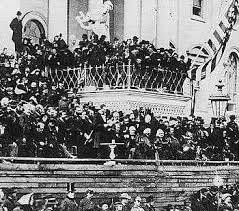
    Lincoln delivering 2nd Inaugural Address

    Trump likes to compare himself with Abraham Lincoln, claiming that both men faced a hostile press, and that he (Trump) might even be treated worse than the Great Emancipator.  Trump has even gone so far as to suggests he’s the greatest President in history.  In a 2018 interview with Author Bob Woodward, he said, “nobody’s ever done a better job than I’m doing as president.”  How totally laughable!  It’s hardly worth a comment, except to remind us that Lincoln responded with compassion in seeking peace in the midst of strife.  

    In the midst our current combined crises, Trump could well take a lesson from how Lincoln looked to heal the wounds of the Civil War. 

    In his Second Inaugural Address in 1865 as the Civil War was nearing an end, Lincoln spoke with great understanding and compassion: “With malice toward none, with charity for all, with firmness in the right as God gives us to see the right, let us strive on to finish the work we are in, to bind up the nation’s wounds, to care for him who shall have borne the battle and for his widow and his orphan, to do all which may achieve and cherish a just and lasting peace among ourselves and with all nations.”

    Taking office after the assassination of John F. Kennedy, President Lyndon B. Johnson, from historically pro-slavery Texas, led the country to pass the Civil Rights and Voting Rights Act.  When confronted with the 1967 race riots, he responded by establishing the Kerner Commission that sought solutions to the underlying problems that cause such disturbances.

    Even some presidents who may not be regarded as particularly strong have risen during crises to summon the best from the nation.  After Sept. 11, 2001, George W. Bush spoke eloquently from the ashes of the World Trade Center to bring reassurance to the American people.  Though his subsequent decisions to engage us in Iraq were disastrous, Bush’s words sought to heal, not divide.

    Dwight Eisenhower – a great general, but never credited with being a strong President – responded by bringing in federal troops to enforce school desegregation orders in Little Rock, Arkansas, even though such action were unpopular among many of his supporters. 

    There are other examples where Presidents sought to heal – not divide – but Donald J. Trump’s own self-centered desires prevents him from setting the kind of example required of leaders.  And, the country suffers and may descend deeper into the abyss of hatred and despair.

    Yet, there’s hope, and it lies with the governors, mayors and other officials, including police chiefs to provide the leadership needed to bring us together.  Many are doing just that; and it lies in each of us to encourage such leadership. – Ken Germanson, June 2, 2020


  • It was about 70 years ago that I first read O. E. Rolvaag’s “Giants in the Earth,” a book that was published in 1927 and was often included in literature courses back in the mid-20th Century.

    In all the years since, I’ve never forgotten reading the novel about the Norwegian immigrant family that joined three other families in the 1870s to homestead on the bleak plains of South Dakota. Recently, I ordered a reprint of the novel — long since forgotten by most readers — from our local independent bookseller and have begun to read it again. I learned soon that it’s a most fitting read during this time of Covid-19 isolation, since it has forced me to understand how important the experiences of the family — the optimistic Per Hansa and his despairing wife, Beret, and their children — illustrated two traits that were within the nature of our ancestors that helped to create our nation.

    First of all, is the patience and persistence that was required by Per Hansa’s family in order endure the harsh bitterly cold and then the stifling heat of South Dakota weather while living in tight quarters of their sod house. The moment I begin feeling sorry for myself for the current isolation I think of that family, huddled together in cramped quarters during the seemingly never-ending winters; I read how Beret grows more and more pessimistic that the family will survive. And, yet, she perseveres, trusting that her sometime impulsive husband will figure out a way.

    All of a sudden I began to realize that spending eight-weeks in a 21st Century isolation doesn’t seem so bleak. After all, didn’t I have my computer, a television set with its 300 channels, shelves of books and a telephone to keep me company — along with my partner?

    The other trait the Per Hansa family showed was an understanding of the value of “collectivism.” There’s a myth that it was our independent nature that brought about the pioneering spirit that caused our ancestors to settle this nation, to move west from the East Coast to Ohio, then Iowa, the Dakotas and eventually Oregon and California. In reading “Giants in the Earth,” you’ll see how the four Norwegian families staked out their respective 640-acre sections of potential farmland by working together, by sharing tools, joining in planting and harvesting crops, and providing emotional support in times of stress or fear from possible attacks by predators of various sorts. It’s obvious the Per Hansa and his family could not have survived without their neighbors.

    Today, I wonder: Have we lost that spirit of cooperation and collaboration that was so needed to settle America?

    During this coronavirus period we’ve been told that scientists and health experts were nearly unanimous in their view that social distancing along with the wearing personal protective gear would be the only way to slow down the impact of the highly contagious Covid-19. Yet, far too many Americans are crying out that their “freedom” has been taken away by “safe at home” orders and have chosen to deny that they had any stake in protecting their health and most importantly the health of others.

    The sight of people cramming into taverns in Wisconsin on the night that the State’s Supreme Court ended the governor’s “stay at home” order was particularly alarming and disgusting. While it’s OK, perhaps, to risk you own health, it’s certainly wrong to risk the health of others. Yes, perhaps you’re a young person who is impatient to “beer up,” but when you do so in a crowded gin joint you risk the chance of going home and carrying the virus to a grandparent in your household or a co-worker on the job.

    Those who demonstrated against the “stay at home” orders were merely being selfish and showing little regard for their fellow citizens. They cared little for the “collective spirit” that was needed to build this great nation. Eighty years ago this May 12th, Winston Churchill told the British they would have to experience “blood, sweat and tears” in the face of the Germany’s blitz bombing of London. And the Brits responded in great fashion.

    Sadly too many Americans are rejecting our pioneer spirit that caused us to join together with others to solve mutual problems or to resolve issues so that “all” may prosper. Too many seek to be “independent” to do whatever they want.

    We’ve seen that play out in the lower interest shown by so many persons in joining bowling leagues, supporting their church, becoming union members and participating in many other activities. (Note: tennis courts — once in heavy demand 40 years ago — today are often empty with weeds growing in the cracked asphalt.)

    In truth, there were many more of us who understood our role in our “collective” society during this time of enforced isolation and recognized that in our need to protect ourselves against the virus we were joining together to protect everyone else. In Rolvaag’s novel that was based on his own family’s experiences, it was persistence and collectivism that was needed to survive and thrive. More of us need to take that lesson to heart. — Ken Germanson, May 13, 2020

  • Today is Easter Sunday and most of us are sequestered in our homes, apartments, hospital rooms or jail cells.  There will be no Easter Egg hunts for the little ones; nor will the Christian church pews be squeezed tightly (as they are now but two times a year).  Likely, few families will be together around an Easter ham.

    For non-Christians and non-believers, this also will be a different day; even in normal times those folks can’t helped by being engulfed with the wide celebration of the Resurrection.  Not so today.

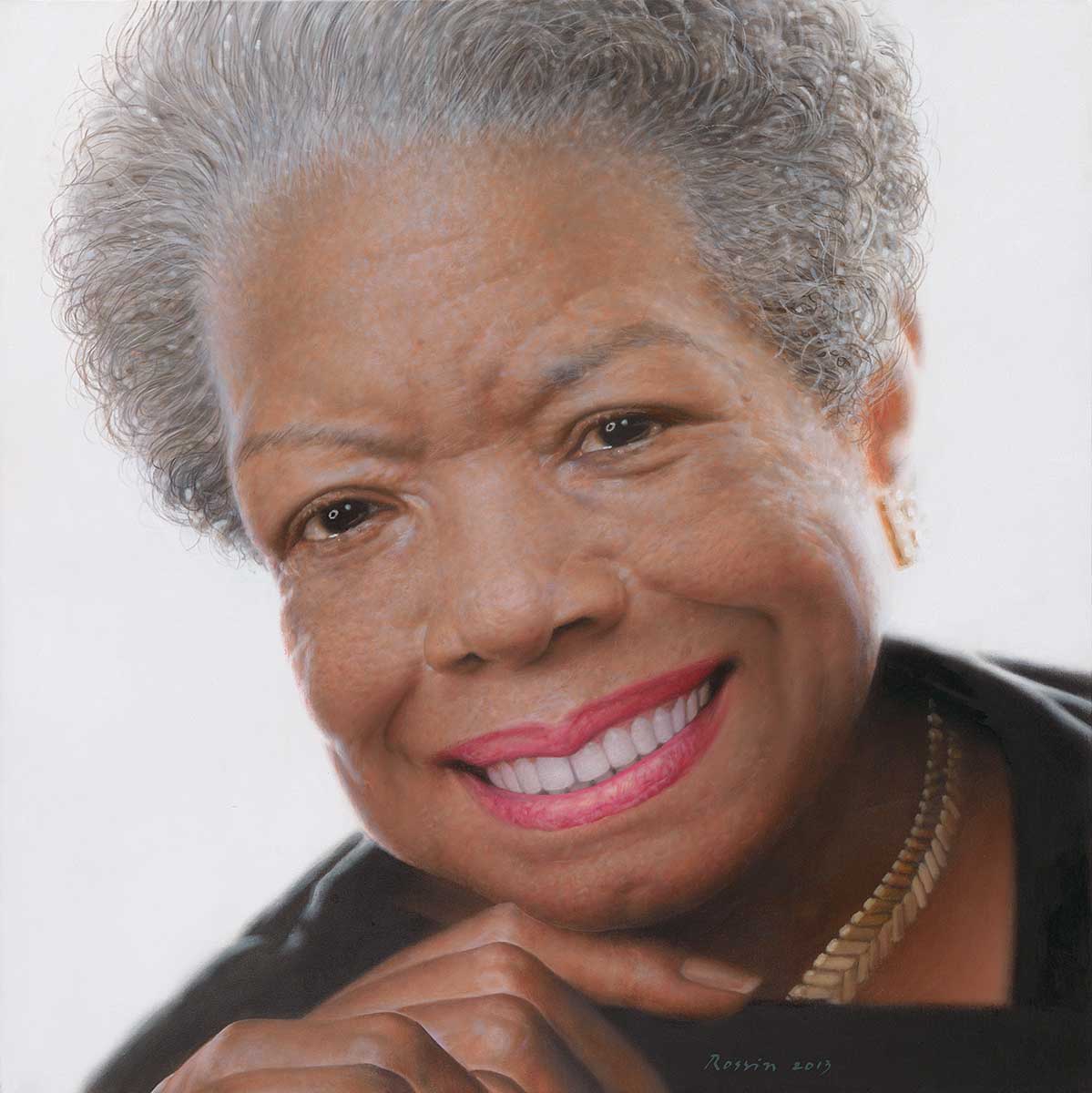
    Yet, let us reflect on the words of Maya Angelou, “This is a wonderful day, I have never seen this one before.”

    Angelou-portrait
    Maya Angelou

    How can we greet this Easter morning in high spirits, as Poet Angelou entreats us to do?  The COVID-19 deaths are piling up day-by-day, their effect now moving from hard-hit New York City throughout our land, after already infecting virtually every nation, some worse than others.

    Maya Angelou reminds us that every day is a new experience, maybe a day of sadness and pain, but also a day of hope and opportunity.  Every new day must be welcomed as “wonderful,” in her words.

    What about those suffering from COVID-19?  By all reports, it is mind-bogglingly painful for those with the worst symptoms and facing death.  For those folks, how can another day be “wonderful?”

    And, how about those in jails where avoiding close contact and getting the virus may seem inevitable?  Nurses, room cleaners, doctors and medical technicians; and first responders of all types?

    Even for many of us who are relatively safe from exposure, the current epidemic has us worried about our jobs and having enough income to pay the rent, buy medications, purchase clothes for the kids and stock up with food.  Economic despair has hit virtually every family, except those at the top of the income scale.

    Trying to begin each day with the view that is will be a “new day” that will offer the chances of some “wonderful” things happening can certainly help us get through this current crisis.  For those suffering the greatest, the dawn may seem to offer more pain and suffering; yet, we must seek to find ways to see that the day may bring renewed hope.

    I reflect on people facing a terminal illness, recalling how my late wife accepted her coming death as an unstoppable cancer spread through her system.  She never complained and was smiling in greeting visitors while being a cooperative patient to her caregivers.  She knew her days were limited; yet I think she welcomed each new day and what it might bring.

    John McCain relates how he welcomed each new day during his 5 ½ years of internment in a North Vietnamese POW camp, including two years of solidarity confinement.  He found his survival, he wrote in 2008, in being able to find “communication with someone, even if it’s only a wave or a wink, a tap on the wall, or to have a guy put his thumb up. It makes all the difference.”  He also kept his mind busy, fantasizing on recalling history or even writing fiction.  Perhaps he instinctively understood Maya Angelou’s hopeful piece of prose.

    Today is Easter, a special day and a day for bring joy and hope.  That’s the spirit we need to carry each and every day of the year, and that’s particularly vital when the going gets tough.  Ken Germanson, April 12, 2020.

  • When Vanilla Ice Cream Vanished and Hoarding Was Unpatriotic

    No toilet paper to buy?  Nor disinfectant?  Eggs?  Bread?

    Today’s empty shelves are rarely caused by shortages of the goods, but by the hoarding and over-buying by many panicked American families.  Sadly, this hoarding mentality seems to be growing exponentially; when my neighbor buys several packages of toilet paper rolls, I’m tempted to rush to the store to get my rolls of toilet paper.  After all wouldn’t I be justified in doing so?  What happens when there is no more TP?  

    But, I should restrain myself.  The fact is will likely be plenty of toilet paper rolls — and other critical goods — available as long as we don’t hoard; the markets are being re-stocked on a regular basis.

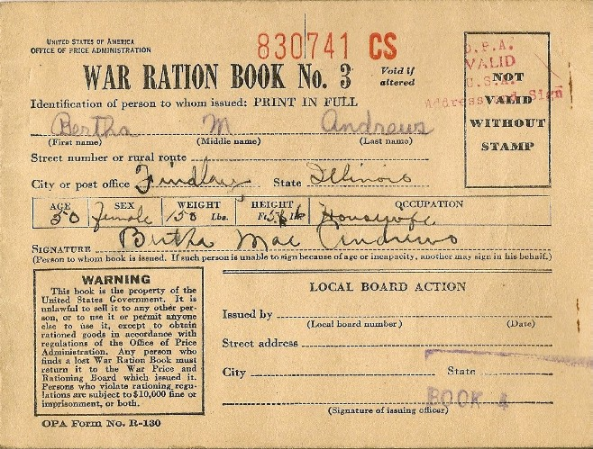
    Perhaps we need to bring back the spirit that motivated many Americans during World War II — often termed the “greatest generation.”  Remember, the war was won not only ration-book-three-frontby the soldiers, sailors and marines at the front, but by the citizens at home who worked in the war plants (see “Rosie the Riveter”) and cut back or changed their consumption habits (and their life style) all in the cause of supporting our troops in order to end the war successfully.
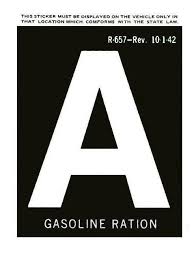
    True, there were Americans in the period from 1941 through 1945 who hoarded goods, who lied about their needs to obtain more ration stamps or who profiteered through their businesses.  Yet, it was my observation — as a teenager during those years — that Americans more generally accepted the sacrifices necessitated by supporting the war effort.  I recall that hoarding was frowned upon as unpatriotic.

    Yet, the U.S. government enacted a strict rationing program, particularly covering sugar, milk, butter, gasoline, paper goods, shoes, nylons and silk.  

    Take gasoline, for example.  Rationing began nationwide on December 1, 1942 and ended on August 15, 1945.  Most car-owners got an “A” card sticker for their windshield, entitling the vehicle to four gallons a week (about 45 to 60 miles of driving in the cars ofimages the period).  Business owners and key personal in vital industries got a “B” card, or eight gallons a week.  Doctors, nurses and other key workers got a “C” card, allowing a high level of driving.  And speed limits were 35 MPH for the duration. For a short time in 1943, rations were reduced further and all pleasure driving was outlawed.

    My dad got a “B” card, largely because he worked in the tanning industry and leather goods were in heavy demand, due to the need to provide footgear to our fighting troops.  His  “B” card allow basically enough gas to get him to and from work.  Obviously, our family took no vacations during the summer as we had in the years leading up to the war.  

    Your ration book was guarded with as much care as you would a valued family heirloom; you didn’t mislay it or lose it.  In a spirit of neighborliness, we’d share any unused stamps with a relative, friend or neighborhood who might be in more urgent need.

    I spent most of the war years either delivering newspapers or working as a clerk-soda jerk in a drug store.  To conserve newsprint, the newspapers severely cutback on they number of pages; the usually thick Milwaukee Journal of the daimages-1y was no more than eight pages in size on Saturdays, for example, which severely curtailed my ability to toss the rolled up paper onto a porch from my bicycle.

    Our drugstore prided itself on its hot fudge sundaes; we used a premier fudge and used one of the areas finest ice creams.  Eventually, the milk shortage grew so bad that we could no longer get vanilla ice cream, forcing us to make our famous hot fudge sundaes with pineapple sherbet.  It wasn’t the same, but our customers understood.  After all we were all in this fight together!

    Today’s coronavirus crisis is very much a war and it will require all of us to sacrifice in many ways.  To be truly neighborly, we must restrict the urge to hoard and rush to the store to gather everything off the shelves.

    Perhaps we need to adopt the attitude of the “greatest generation” of World War II.  Ken Germanson, March 22, 2020

  • “Call it democracy, or call it democratic socialism, but there must be a better distribution of wealth within this country for all God’s children.” — Martin Luther King, Jr. in speech before Negro American Labor Council, 1961.

    Socialism has become a subject of serious discussion in the United States, likely due to the popularity of various Democratic presidential candidates, like Sen. Bernie Sanders who professes to be a “democratic socialist” and others like Sen. Elizabeth Warren whose policies closely mirror those of some form of socialism.

    And according to a 2018 poll, 51% of younger people (millennials) view Socialism as a “positive,” showing how popular the once largely ignored political philosophy currently has become, particularly among younger voters.

    As we all know, the concept of Socialism has been around for perhaps two centuries; in this country, it reached perhaps the zenith of its popularity in the decades before and after the year 1900.  Nowhere was Socialism more prominent than in Milwaukee, largely due to its connection with the labor movement.

    It likely gained a foothold in the aftermath of the Bay View Tragedy of May 5, 1886, in which seven persons involved in eight-hour-day marches spurred by the Knights of Labor and the fledgling American Federation of Labor were killed by state militia.  Socialists were much involved among the workers in those marches and though the quest for the eight-hour-day fizzled after the Tragedy and the Haymarket Affair in Chicago of May 4 that year, it spawned a recognition among workers and their unions that political action offered a more promising course of action for improving the lives of workers.

    The enthusiasm for Socialism thrived in the late 19th and early 20th Century, largely among labor activists, young intellectuals and certain immigrant groups.  Its popularity, however, was hardly universal, but it formed a rallying cry for more militant workers who were interested in forming strong unions.

    Many working people turned to Eugene V. Debs, who offered the promises of unionism as a way to win better lives for their families.  As head of the National Railway Union, Debs had prompted as nationwide boycott by railway workers in support of the 1894 strike against the Pullman Company in Chicago.  The boycott ended when the Federal government sent in troops to quell disturbances and Debs and other union leaders were found in contempt of court.  Debs was sentenced to serve three to six months in jail.

    While in jail, he was visited by Milwaukee Socialist and future Congressman Victor Berger who talked of the principles and Karl Marx.  Upon his release, Debs declared he

    Unknown-2
    Victor Berger, of Milwaukee, was nation’s first Socialist Congressman 

    was a Socialist and in 1898, Berger and Debs founded the Social Democratic Party which in 1901 became the Socialist Party of America.  Debs went on to become a four-time Socialist candidate for President, garnering peak of nearly one million votes in 1920 — at the same time he was in prison for espionage for having opposed U.S. involvement in World War I.

    At the time, Socialism in this nation faced continual opposition by nation’s largely corporate-owned newspapers; during the “red-scare” of post-World War I period, many Socialists were unfairly linked to Russian communists, a comparison that continues into the 21st Century, perpetuated by right-wing politicians and their lackeys in the conservative media; i.e., conservative talk radio, Fox News and bloggers.

    Nonetheless, Socialism today has found favor among large pockets of U.S. citizens, principally among younger voters.  Perhaps they’ve realized that Socialism (in most formats) has called for a society where there is economic equality, reasonable regulation against the worst sins of capitalism and greater justice for all citizens.  They’ve realized that many of Socialism’s longterm goals, such as a progressive tax system, Social Security, workplace safety, were preached for more than 120 years by Socialists like Debs, Berger and Norman Thomas.

    Yes, Socialism had played is great role in building a fairer and more equitable America, and, in a way, it can be said it all began with the labor unions in Milwaukee.  — Ken Germanson, March 14, 2020

  • How about re-establishing the Mitchell Park Domes as the city’s icon?  For years, it had been used to symbolize Milwaukee, only to be deposed by the Calatrava-designed Milwaukee Art Museum and its spreading wings on the lakefront.

    Yes, the Domes are in need of serious and costly repairs, but the dramatic geodesic Domesstructures are more than 60 years old.  Just as and aging body needs more maintenance, so do buildings.

    Let’s get on the with decision to save the Domes.  They are symbolic as to what Milwaukee is!

    Throughout the 20th Century, our city had been symbolized by various buildings; first, came our Flemish-styled City Hall (a marvel when it was completed in 1895 as the tallest occupied structure in the world).  Later, it might have been the 22-story Wisconsin Tower (our skyscraper – hmmm) or County Stadium or the Zoo.  In truth, our conservative city had few spectacular structures to highlight until the U.S. Bank Center with its 42 stories on the lakefront was completed in 1973 (it still is the tallest building in Wisconsin).

    Until the 21st Century, the Domes were the ubiquitous symbol for our community.  Then, in 2001, the “Calatrava” opened and it became the oft-used icon for the city, only occasionally replaced by Miller Park or the newly opened Fiserv Forum, both built with Unknown-1huge chunks of taxpayer money to support private sports entrepreneurs.
    Of all of our city’s symbols, I opt for the Domes as most indicative of our city’s history, its basic environment and its goal of serving all of its residents, rich and poor and those in-between.

    Milwaukee’s Socialist history is indeed something to proud of – regardless of anyone’s political preferences.  Its park system is among the finest of any metropolitan community, and was established largely by the Socialists that were prominent in both the County and City governments of the early 20th Century.  The Domes were established by Milwaukee County with taxpayer money and thus all Milwaukee County residents are its owners.

    The Domes are affordable for all of our residents: its basic fee of $8 for adults is reduced by one dollar for residents and three dollars for resident seniors.   Children under five are free; kids from five to seventeen are $6 (one dollar less for residents) and the first Thursday of every month is a free day.  Compare that to the small fortune it takes to buy tickets to Brewers and Bucks games and to the basic admission of $19 for the Milwaukee Art Museum.

    Consider, too, how the Domes provide a welcome floral atmosphere during our gray and frigid winters.  How sweet it is to wander through the three domes offering differing plant environments: the desert, the tropics and a seasonal exhibit that changes five times a year.

    And, yes, the geodesic domes provide a beautiful sight perched atop the bluff in Mitchell Park tower over the one-time industrial heart of our city, particularly when lit at night.  Thus, they are a fitting and pleasing icon to represent our city.

    The Domes also are located in the midst of neighborhoods that have become home to our burgeoning Hispanic population.  Those neighborhoods are creating a renewed sense of community and are working hard to regain their onetime vigorous and lively environment.  Repairing and up-dating the Domes would certainly help in maintaining the strength of those neighborhoods.

    Sadly, the half-century-old domes are in dire need of costly repairs.  Some advocate tearing them down and replacing them with a more conventional conservatory, but it would tragic if the Milwaukee County Board chooses that course of action.

    If our community can come up with more the $500 million to assist in the building both Miller Park and Fiserv Forum to serve mainly the private enterprise interests of sports team owners and those who can afford their expensive tickets, surely we can find a way to fund the less costly repairs needed to keep the Domes a vibrant symbol of our growing city.

    If you agree that the Domes deserve to survive, check in with the Friends of the Domes organization to see if you can help in keeping the Domes alive and well and as a rightful icon of our city. – Ken Germanson, Feb. 29, 2020

  • It’s easy to look at the current state of affairs on Planet Earth with despair.  It’s easy, too, to see no chance for hope of positive change in 2020.

    Each month the results of global warming become more apparent with forest fires, terrible rains and snows, huge floods in some areas of the earth and drought in others.  Scientists and climatologists are virtually united in accepting the truth that these often tragic phenomena is the result of climate change.

    While most nations of the world accept that truth and are joining in the effort to take steps to slow down the rate of warming, our nation — led by our Cheerleader-in-Chief — is turning not only a blind eye to the obvious environmental catastrophes, but is actually turning back the clock and weakening environmental laws.

    In addition, the pages of the New York Times (the only paper that covers much of the world’s news) are filled each day with stories of terror attacks, of dictators that ruthlessly and wantonly govern their nations, of the growing fear of nuclear attacks and of outbreaks of ebola and other infectious diseases.  Among the many current tragedies of the times.

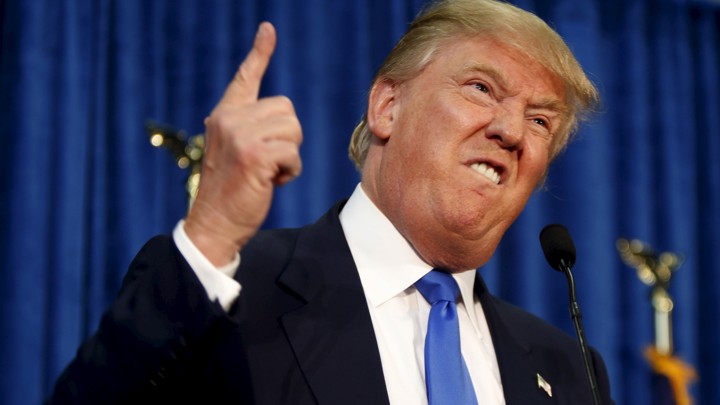
    In the United States — supposedly the “greatest nation in the world” — our democracy is in danger of unravelling, led by the Cheerleader-in-Chief who has won significant support from a steady 40% of our citizens by wooing them with a constant stream of lies

    Republican presidential candidate Trump gestures and declares "You're fired!" at a rally in Manchester
    The Cheerleader-in-Chief ranting before an adoring audience of supporters.

    and mean-spirited tweets.  He is further supported by nearly all Republican senators who should know better but join in his cheering section and will most likely not find him guilty in the impeachment proceedings.

    Many of us look on in alarm, wondering how nearly all Republicans love this awful man so warmly.  The answer, however, is clear: by and large, he has delivered on the GOP agenda by lowering taxes for the rich, by turning back regulations on the banks and the financial industry and by weakening regulations on worker safety and environmental standards — all aimed at increasing profits for corporations and enhancing the wealth of the rich.

    It’s mystifying, too, to watch so many of our citizens becoming enraptured with the Cheerleader-in-Chief, even when their own incomes and living standards are suffering.  These misguided folks are often in our small towns and rural areas, where earnings continue to be stagnant, where health care is hard to access and where educational opportunities are limited.  Their very futures are made worse by the policies of the Republicans and those of the Cheerleader-in-Chief.  

    whether these citizens are wooed by what might be a false sense of nostalgia, an appeal to want life as it used to be when African-Americans were stuck in their ghettos, when our Hispanic populations only showed up for harvesting crops and then returned to Texas, and when Muslim, Sikh and Hindu residents were a novelty.  What these citizens fail to realize is that when they seek to push back on these “different” populations they are actually stifling their own hopes of a better life.  It’s obvious that many of our citizens are still infected with a lingering racism that clouds their ability to study the issues openly and to act rationally for their own good as well as that of others.  

    As we enter 2020, are we without hope?

    Of course not, for a life without hope is hardly a life worth living.  Throughout the nation, in our urban centers, within our sprawling suburbs and among our ranches and farms there is an awakening of the American spirit.  People in “red” and “blue” communities alike are organizing to end racism, to rebuild an awareness of the need for environmental protections, to call for fairness in our justice systems, to seek living wage jobs and to create strong schools so all children have an opportunity to share in the ever elusive “American dream.”

    It’s our hope in 2020 that Americans will join in even greater numbers and dedication to tell the truth about the issues of the day and to take action to remedy them so that all may prosper.  And, there may even be hope that many who are currently enthralled by the Cheerleader-in-Chief may learn to reject his tweeting rants and raves and look to join in resolving our current problems together.

    In 2020, that means we must urge our Senators from both parties to fully consider the evidence contained in the impeachment of the Cheerleader-In-Chief’s actions and act according to their conscience and not because it is politically comfortable.  

    Also 2020 is an election year.  Need we say more?  Unless the C-i-C is found guilty in the senate, Americans must remove him in November, and some of the Republican cronies who blindly supported him.  That will mean the Democrats must walk away from primary battles and unite on a winning candidate if we are to unseat this totally unsuitable leader.  

    Is all that too much to hope for?  – Ken Germanson, Dec. 31, 2019