• It dawned on me that as my 90th birthday approached that I was extremely blessed — not only that I had survived all these years but because of the good fortunes of life that I had no control over.

    I was blessed at my birth – August 8, 1929 – to be born Caucasian AND male.  In my lifetime, those two factors made it possible for me to live in relative comfort, always having access to sufficient food and adequate shelter while also having opportunities to relax and have fun.  Most people in this world have never been so blessed.

    Being born Caucasian, of course, provided me with the assurance that when as a child I

    Ken on Trike
    Ken (left) with brother, Jerry.  We were fortunate to be born into a strong family and comfortable life.

    walked into the Ben Franklin Five-and-Ten store in our neighborhood that the manager would not be eyeing me suspiciously, worrying that I might steal some penny candy.  A black boy my age would have faced constant scrutiny.  And now, as an adult I can pass a state trooper a few miles above the speed limit without being stopped; if I was black, my chances of being pulled over would have been greater, for sure.

    I was blessed to have been born a boy in an era when a male child was able to pursue whatever career he fancied, as long as he persevered in it and had some basic abilities.  My late wife Ann, born in 1930, graduated in journalism from the University of Minnesota in 1951 – the same year I did from the University of Wisconsin, also in journalism – and she was truly talented, winning a Phi Beta Kappa key in the process.  Yet, when she took her first newspaper job, it was on the Society pages, not in the news section.  Her college friend, also a female, wanted to be a sportswriter; of course, that didn’t happen.  In Ann’s case, she met me, we married and within a year she left the trade to bear and raise our five children.

    We were both blessed to have our family, but I often wondered whether she might have been happier to continue working as a newspaper reporter or editor.  But remember, the 1950s were the years when the belief was that “a woman’s place was in the home.”

    I was blessed to be born into a home where our parents had both the wherewithal and the motivation to care for me and my two brothers, to be attentive to our needs, to assure we got medical care when and if we needed it, and to make our home a welcoming place.  My father, a tannery worker, was lucky to have remained employed during the Great Depression, though his wages were cut so drastically that we lost the home my parents had purchased in 1930.  Yet, we stayed in the home – a comfortable brick bungalow – as renters until 1947, largely because the landlord was unable to find buyers for the residence.  Yes, truly blessed to be in a safe neighborhood where we could play ball in the streets or in vacant lots and go to decent schools.

    I was blessed to be able to find a way to get a college education; my parents were unable to pay for my tuition or living costs.  Yet, at that time, I was able to find a job working weekends, nights and summer vacations for an employer who ran a retail “beer depot” and wholesale beer distributing business.  With those earnings and wages I earned busing tables I was able to pay the $60 a semester tuition plus the room costs (averaging no more than $5 a week) and still have 35 cents left over so that I could buy a quarter of beer for a Saturday night splurge with my buddies.

    I was blessed, too, for surviving two near-fatal medical crises.  At age 15, my appendix burst, spreading poison through my system.   Normally that would have meant death, but it was 1945, the war was nearly over and penicillin – a drug that had saved thousands of wounded soldiers and sailors – had just been released for civilian use.  I was told I was the first patient in Milwaukee’s St. Mary’s Hospital to receive the drug.  It saved my life, an early example of how the miracles of modern medicine became available at a critical time.  My second near fatal experience was ten years ago when I had a massive heart attack.  I was saved by the coincidence of being in the emergency room when it hit and getting treated by a celebrated physician who happened to be on call that Sunday morning.  Now at age 90, I am still alive and quite active, again kept alive by modern drugs that weren’t available in earlier days.

    I have since realized that my life has continued through these two medical crises because there were funds to pay for that care.  In my teen years, my father’s modest salary was enough to cover the costs of the penicillin and now, as a senior, I have not only Medicare but an excellent supplemental health care plan, thanks to my union.

    It took me a long time to realize that I entered this life with more chips on the table than most children in this world.  Certainly my chances of leading a largely fulfilling life were far greater than if I had been born into poverty, had been African-American or Hispanic or had grown up amid unsafe neighborhoods and lousy schools.  In the race of life, I truly started ahead of many children who were also born in 1929.

    Somewhere, sometime, in the years ahead, may we create a world where all children are born on equal footing.  That is my 90th Birthday wish. – Ken Germanson, Aug. 12, 2019.

  • It seems these days that no one is a racist, particularly President Trump.  Take his word for it: “I don’t have a racist bone in my body.” (Tweet on July 16, 2019)

    How often have you heard a person proclaim, “I am not a racist”?  The phrase comes from people who soon will be talking about “those people” or burst out with a liberal supply of “thems.”  What such folks are clearly saying is that they are not like “them,” obviously referring to African-Americans or Hispanics or Asians or Middle-easterners, Racism Symboland obviously inferring that such others are inferior.
    Nonetheless, I’m reluctant to brand someone as a “racist” based solely upon an occasional insensitive statement; it’s when such statements become that person’s standard vocabulary that you can call them by the “r” word.  Thus, I’m willing to overlook Joe Biden’s remark that he was able to deal with those notorious racist Senators, James Eastland and Strom Thurmond, in creating legislation in Congress.  His point was to show that in a democracy lawmakers have to work with “the enemy” every so often to get things done – that in passing laws Biden had to deal with Eastland and Thurmond, despite knowing full well that he disagreed not only with their racial policies, but with their anti-union and reactionary economic issues.

    Like Trump, Biden declared not to have a “racist bone” in his body. (MSNBC News, June 23, 2019)  Unlike Trump, however, Biden’s recent record of supporting legislation and  policies that break down racism and seek to overcome economic inequities speaks for itself (even though early in his career he showed strong opposition to school busing that raised questions about his past record).

    The truth is:  It is by one’s deeds that one’s racism shall be truly determined.

    Trump’s deeds have clearly demonstrated a trend that will hardly move to heel the racial wounds of our nation.  His campaign began with a racial theme (Mexican immigrants are rapists, etc.) and have continued with repeated rabble-rousing against immigrants and more recently against “The Squad,” the four women Democratic representatives, urging them to go back to where the came from.  (It’s a particularly ironic message since all four are American citizens and three were born in this country.  Of course, they are all women of color and are outspoken progressives.)

    His support of gutting the Affordable Care Act (which hurts largely working families of which minorities are major demographic) is emblematic of deeds that reek of racism.   So does his opposition to increasing the minimum wage, his immigration strategies, his two appointments to the Supreme Court, his anti-union administrative actions and much more.

    Most dictionary definitions of racism say that it is “a belief that race is the primary determinant of human traits and capacities and that racial differences produce an inherent superiority of a particular race” (Merriam-Webster)

    By that definition, it is clear that many of us may indeed harbor such views deep within us, and likely they may have been formed in earlier, less-enlightened years or by family or neighborhood environments.  The question is how we seek to overlook those thoughts of superiority and to perform deeds that provide for building a society of equality, peace and harmony.

    Sadly, when leaders such as our President act to stifle efforts to unify people of all races, colors and creeds, it is then they shall be labeled as “racists,” and properly so.

    Yes, it is by their deeds they shall be known. – Ken Germanson, Aug. 3, 2019


  • Kenneth A. Germanson, president emeritus, Wisconsin Labor History Society, prepared this paper for the May 22, 2019, public input session at Kenosha concerning the proposed Wisconsin Historical Museum to be built in Madison.  

    The state of Wisconsin was born and grew into a Great State thanks to the working people who toiled on the state’s farms, its many industries or upon the Great Lakes and the state’s waterways.

    More than their sweat and brains, the state’s workers also understood they had the power to build a state that provides for all people to live in a healthy and productive environment. They understood, too, that such power came only through organizing themselves into labor unions, farm associations and cooperatives. Too often history concentrates solely upon the politicians and moneyed leaders to tell the story of our state

    1024px-Seal_of_Wisconsin.svg
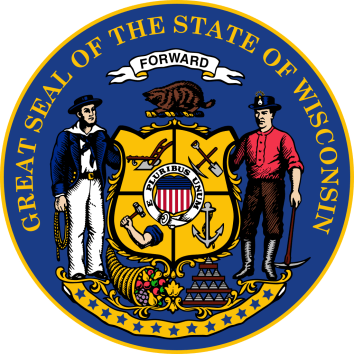
    Great Seal of Wisconsin features workers and their tools

    and the nation.  Let’s not forget the people – our hard-working ancestors who foresaw that through their trials and struggles they could build a future for all of the children and grandchildren of the future.

    Thus, it is only fitting that these workers and their collective organizations be prominently enshrined within the walls of the proposed new Wisconsin History Museum in Madison.

    There are plenty of examples of how working people have joined together to create a better life, not only for their own families but also for their neighbors and friends and generations to come.

    Back in the 19thCentury when the industrial revolution spread into Wisconsin, workers faced terrible exploitation in toiling in incredibly unsafe and unhealthful conditions, working long hours, yet failing to earn enough to move their families out of squalid hardly livable dwellings.  The quest for the eight-hour day became a symbol for their actions to bring about a better life, and nowhere was that more vigorously fought than in Wisconsin.

    In Milwaukee in 1886, that coalesced into massive eight-hour-day rallies, parades and marches, ending with Wisconsin’s bloodiest labor event in history – the Bay View Massacre – when the state militia fired into the marchers, killing seven.  That event has been credited with helping to spur on the development of progressive political parties in Milwaukee, like the Socialists, who worked with the Progressive Republicans of “Fighting Bob” La Follette, to pass many far-reaching legislative initiatives that made Wisconsin a forerunner in socially positive policies.

    Twelve years later, in Oshkosh, then the Millwork Capital of the Midwest, Carpenters’ Union members struck seven factories for 10 weeks, shutting down production in the city. After the strike was settled, two local union officers and the union rep from Chicago were charged with conspiracy. Why?  Their crime was only that they helped to organize the workers; at the time, such activities were sometimes considered to be “robbing” the company owner of his profits.  Famed attorney Clarence Darrow came from Chicago to argue the case – taking eight hours in a final summary argument – to win acquittal.  It was a landmark decision in that case.

    The 1933 milk strikes are an example in which desperate farmers organized to withhold selling their milk when the prices got below a certain level.  Many farmers organized into milk pools, basically cooperatives, to halt other farmers from marketing their milk, hoping to boost prices.  This tactic was used in all parts of the state, often resulting in violence, with at least three deaths reported.  It was a desperate tactic done in desperate times and should not be forgotten.  While the strikes themselves may not have led to immediate relief for Wisconsin dairy farmers of the day, they did highlight their difficult economic situations and likely helped to bring about the New Deal agricultural reforms of Franklin D. Roosevelt, as well as the organization of farm groups like the Grange, the Farmers Union and the Farm Bureau.

    These are just three examples of collective actions that involved the ordinary citizens of the state. There are many more, including the long Kohler Strikes of the 1930s and from 1954 to 1965; the UAW-Allis Chalmers strikes of both 1940-41 and 1946-47; the paper mill worker’s quest the Fox Valley during 1901 and 1902 for having Saturday night off.  Just to name a few.

    Not as well-known, but just as worthy of being memorialized, are those examples of how workers and farmers, through their collective organizations, have contributed to the welfare of the entire community.  Since its founding in 1893, the Wisconsin Federation of Labor (forerunner to the Wisconsin State AFL-CIO) was constant in its fight for a strong public education system at all levels, K-12 into college.  They have sought strong building and health codes that protect the entire community.  Nonprofits benefit from the volunteer work provided by members of unions and cooperatives, both by providing vital staffing and as members of boards. United Way campaigns no doubt benefit from the support of the labor movement at all levels in urging members to make substantial contributions that benefit communities throughout the state.

    There is a unfortunate tendency when developing a Museum of any type at focusing on building structures, because they are easy to portray.  There’s even greater tendency to focus on industry leaders or politicians, while neglecting the people who have toiled to produce the goods and services and who have gone on to foster collective actions through unions and other organizations to improve the living standards for everyone.

    It is most fitting to note that the Great Seal of the State of Wisconsin honors the state’s worker heritage.  The two figures on the seal are a sailor and a miner and they frame a shield containing a plow (farming), a pick and shovel (mining), anchor (navigation) and an arm and hammer (manufacturing).

    The new Wisconsin Historical Museum needs to recognize the people of Wisconsin, not merely its buildings or the big name business leaders or politicians. Ken Germanson – May 23, 2019

  • stock-photo-adorable-ten-month-old-baby-boy-wearing-a-happy-new-year-hat-1191962056(A bit of lame poetry to herald in the New Year, with apologies and a hearty “Happy New Year” to those I have failed to mention.)

    Join and raise your glasses high

    To bid chaotic eighteen good-bye.

    We offer a cheery and Happy New Year

    for family and friend far and near.


    A toast to children Laurie and Dave

    And Joanne and Rick: All the rave!

    May we ne’er forget our lovely and talented Jill

    And dear Ann, the rock of our family still.

    For granddaughters Erika in the city of Mad

    And Lindsey in Portugal, a hearty sip of glad.

    How about Zack with his trumpet, what a cat!

    Lee and his brushes and Eliot his bat.


    Pouring the bubbly for nieces and nephews,

    Jerry and Ellie’s kids, so many for boat crews,

    Linda, Donald, Jane, Susie, Thomas and Jack.

    Sending cheers to ‘bama, alas and alack,

    For Tom and Elsbeth’s marvelous throng, a tip of hat

    To Ned and Julie, Becky, Paul and Matt.


    At midnight, to sweet Jean, a hug and a kiss

    It’s something I surely won’t want to miss.


    May the new year bring victories caloric-y

    To Brewer fans Colin Campbell and Greg Gorecki.

    Many smiles to the Johns, Ted and Mary;

    The Hanrahans, Bill and Clare; and Steve and Lorna Cupery,

    Gus and Joanne Ricca and Paul and Elena Calhoun.

    For Singer Jerry Grillo, many a time to croon.

    New Year wishes for David and Ellie

    And all the Riemers, plus Jackie Kelly.


    To our friends at AFL-CIO, we fill the glasses happily

    For Linda and Carla and new pres Stephanie;

    And Judy Burnick, we best not forget

    Robin and Pam at our regret.

    Cheers to Kari Lerch and Andi Elliott at CA

    And give them the tools to save the day.


    Raise our glasses high and let’s cease

    Turmoil and share in a New Year of peace.

    — Ken Germanson, Dec. 28, 2018

  • From the bountiful blessings of our Thanksgiving table, I give thanks to

    Terence V. Powderly for founding and leading the Knights of Labor, our earliest and

    Powderly-terence-1890
    Terence V. Powderly

    most sustaining national workers union, for proclaiming the principle of solidarity and inclusiveness that has featured the best of our union movement;

    Samuel Gompers, the immigrant cigar maker who founded the American Federation of Labor that bound together so many of our nation’s union and recognized the need to influence our nation’s leaders;

    Frank J. Weber, Socialist, union leader, legislator, who helped form coalition with Wisconsin Progressives under “Fighting Bob” La Follette, to build the state’s progressive traditions;

    Joe Hill, unfairly convicted of murder in Utah, whose songs and spirit helped give  inspirations to working people for generations to follow;

    Eugene V. Debs and Milwaukee’s Victor Berger, two great socialist leaders, whose beliefs in the power of working people to build a greater nation and who served time in jail to serve the purposes of world peace;

    Emil Seidel, Dan Hoan and Frank P. Zeidler, three Socialist mayors, who build our city that is known for efficient and corrupt-free government and community spirit;

    The sit-down strikers in Flint, Michigan who inspired a nationwide movement that brought labor contracts to millions of workers in the 1930s;

    The millions of workers whose courage involved putting their jobs and sometimes their lives on the line to build strong unions and provide decent paying jobs, with benefits and safe and decent workplaces;

    The seven workers in Bay View who walked into the guns of the militia, losing their lives in the quest for the eight-hour day;

    1-2-10DA-25-ExplorePAHistory-a0k6x8-a_349
    Homestead Steel strike scene

    The workers at Carnegie’s Homestead Mills in 1892, the railroad workers who supported the Pullman Car Company strikers, and to all those whose solidarity led to a better future.

    It is for all these men and women of the past that I give thanks, for their foresight, for the selfless courage so that I and my family and millions others can enjoy this Thanksgiving Day in the warmth of our dining room and a too-filling meal.  

    Happy Thanksgiving!

  • “Fool me once, shame on you.  Fool me twice, shame on me.”

    We, the American public, have already been fooled twice by our leaders about the truth on international incidents.  Both times, the resulting actions were disastrous. 

    Now, we need to resist being “fooled” for a third time, this time by a claim that the Syrians, apparently with help from Russia and Turkey, have been using chemical weapons against the rebels.  Frankly, I don’t honestly know whether the Trump Administration claims that chemical weapons were responsible for 42 deaths at the former rebel stronghold of Douma are true or not.  Most likely they are true, but I still have lingering doubts.

    The first time we Americans were fooled was when the Lyndon Johnson Administration claimed that two U.S. destroyers were attacked in the Gulf of Tonkin on

    220px-USS_Maddox_(DD-731)
    USS Maddox,, one of the destroyers in Tonkin incident.

    Aug. 4, 1964.  It later turned out the “attack” may indeed have never occurred as it was characterized.  Even though the reports about the incident were still sketchy, the next day President Johnson called upon Congress to enact the famed Gulf of Tonkin resolution that gave the President authority to take all necessary measures to repel any armed attack against the forces of the United States and to prevent further aggression. It also declared that the maintenance of international peace and security in Southeast Asia was vital to American interests and to world peace.  And within two days, Congress passed the bill with an overwhelming bi-partisan vote.

    Presidents Johnson and Richard Nixon used that resolution to escalate the Vietnam War, and for years the American public supported that action, until eventually tiring of the War.  During that time, any of us who questioned the wisdom of our Vietnam experience were called “traitors,” “unpatriotic” or even “commies” by the many Americans who were duped about the realities of our engagement in Vietnam.

    The second example of being fooled was in 2003 when the George W. Bush Administration claimed Iraq had weapons of mass destruction.  Again, the same scenario developed, although this time there was more skepticism throughout the country. 

    images-1
    Secretary of State Colin Powell at UN claiming WMDs existed in Iraq.

    Nonetheless, Congress with some opposition approved the attack on Iraq.  Throughout the debate, the Bush Administration provided “evidence” of the existence of WMDs; later it was learned such “evidence” was circumstantial at best.  No WMDs were ever found; yet the war began.

    In both of the examples, we saw government propaganda at work.  Sadly, the American media largely went along with the fiction until a few more enterprising journalists began to look more closely into the government’s claims.  Yet, in both incidents, the damage had been done, bringing 58,209 U.S. casualties in Vietnam and nearly 4,489 in Iraq.  In addition, more than a million citizens of both countries were killed, coupled with terrible devastation to their infrastructure.  

    It’s Sunday morning, April 14, as I write this.  It’s spring and the grass should be green and the trees filled with buds, but we have more than an inch of snow and more is coming.  To the north of us in Green Bay, there’s a foot on the ground.  I’m far from the Syrian city of Douma, so how am I to know about the truth of chemical weapons?  Must I take the word of our government?

    President Trump ordered the attack two days earlier, even before an international commission had a chance to verify that chemical weapons were indeed used.  We’re told Syrian President Assad is an evil devil, and it certainly appears that way.  Assad and his Russian allies deny the use of chemical weapons.  

    How am I to know the truth?  The government tells us the attack was a success in knocking out much of Syria’s chemical facilities with minimal casualties.  

    President Trump declared “Mission Accomplished.”  Will that prove true?  Sounds familiar.   Didn’t President Bush declare “Mission Accomplished” just a month after we  invaded Iraq?   How true was that claim?

    — Ken Germanson, Milwaukee WI, April 14, 2018


  • December 7, 1941 – August 6, 1945 – November 22, 1963

    April 4, 1968 – September 11, 2001

    What do these dates have in common?   For me, they are dates I will never forget.  (If you’re not sure what the dates refer to, see end of this comment.)

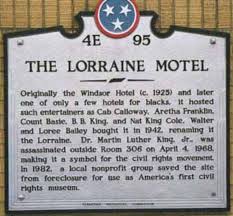
    Today, I reflect upon that day 50 years ago today, April 4, 1968.  That day Martin Luther King was shot in Memphis Tennessee, a date that will live in American history as testimony of the racial hatred that has flourished in this nation and continues to the present day.

    I recall vividly, the morning after, April 5, when I was sitting in the old Orlando Hotel in imagesDecatur, Ill., when the black boldface headline in the Decatur Herald-Review proclaimed the killing of Dr. King on the balcony of the Lorraine Hotel in Memphis.  I was devastated by the news because I had seen Dr. King just five months earlier at a conference at the University of Chicago where he spoke out eloquently against the U.S. involvement in the Vietnam War.

    As I read the news, a grizzled veteran labor union representative (at the time I was a newly hired union rep) wandered by, saw the headline and said something like, “Good, they finally got the b—–d.”  As angered as I was at the comment, I was either too shocked, or too new on the job or just plain cowardly to argue with him.

    His reaction, however, was not surprising, since the majority of white Americans were either scared that Dr. King’s leadership that might stir up black resentments, thought he was a communist or would bring violence to the nation.

    What the old union rep had forgotten or never knew – along with many white Americans at the time – was that Dr. King was truly on the side of all Americans who might have been denied economic or social justice.  He opposed the Vietnam War in part because the task of dying in the jungles of Southeast Asia was being done by poor and working class young men (women were not a major part of the fighting force then). The college educated sons of the privileged classes were exempt from the draft in those days.  Case in point:  Most of the “chicken hawks” who led us into Iraq on the myth of weapons of mass destruction.

    The old union rep should also have realized that Dr. King was in Memphis supporting the union sanitation workers at the time of his death. Dr. King saw the labor movement, in spite of its spotty history in civil rights causes, as a major way to bring working classes, particularly African-Americans, into a better standard of living.  He was on his third trip to Memphis in support of the striking members of public employees’ union (AFSCME).

    His final speech mainly is remembered as for his eerie promise that he had “been to the mountaintop,” thus foretelling of his death by assassination that next morning. In reality, most of the speech was involved with bringing justice to the striking workers.

    He pleaded with his audience in that Memphis Masonic temple on April 3 that economic justice required that they support the strikers, urging that “we’ve got to give ourselves to this struggle until the end. Nothing would be more tragic than to stop at this point in Memphis. We’ve got to see it through. And when we have our march, you need to be there. If it means leaving work, if it means leaving school — be there. Be concerned about your brother. You may not be on strike. But either we go up together, or we go down together.”

    It was a message of solidarity that could be preached by any union leader urging support for a group of strikers.

    Dr. King was a unifying force for America and sadly too few Americans understood that in 1968; as the years went by, most have given at least “lip service” to the work of the great man.  He was, yes, a civil rights leader, but in many respects, he was also a leader in the cause of worker rights.  Ken Germanson, April 4, 2018.

    December 7, 1941:  The Japanese bomb Pearl Harbor, putting U.S. into World War II.

    August 6, 1945:  The US drops the atom bomb on Hiroshima, Japan to begin the nuclear age.

    November 22, 1963:  The assassination of President John F. Kennedy.

    April 4, 1968:  The assassination of Dr. Martin Luther King, Jr.

    September 11, 2001:  Nearly 3,000 killed when planes plow into World Trades Center and Pentagon.

  • Exactly sixty years ago this past March, I boarded the ancient No. 10 (Wells Street) streetcar for one of the final runs of a streetcar on Milwaukee streets.

    It was a nostalgic run for me that day – then a 28-year-old reporter for the former Milwaukee Sentinel – sent to do a feature story on Milwaukee’s last streetcar; the final run would come later that night, but for morning newspaper deadlines my feature story had to be based upon an earlier trip.

    Now sometime later this year, streetcars will again run down Milwaukee streets, an initiative spurred on by generous Federal grants and a belief that modern streetcars will lead to a revitalization of the city – a belief certainly not shared by all Milwaukeeans.  Its success remains to be seen.

    I will certainly make an effort to board one of the first runs of the new streetcar, even though it will hardly be much of a service for me, due to its limited scope.  Of course, I’ll be riding the modern, new streetcars, definitely more comfortable than the streetcrs of more than sixty years earlier. Strictly for nostalgia!


    mkeg1938
    1938 Map of Milwaukee transit lines.  Streetcar routes shown in orange. Photo courtesy of Dan Steininge

    Streetcars once were key to Milwaukee’s early development as a city.  For the first 20 years of my life, they were the means by which mom took us kids to the doctors and dentists; they took me and my classmates and neighborhood buddies to movies and trips downtown; they took mom and us three boys to Schusters on Third and Garfield for school clothes, and they took me on dates through much of high school. Early in his years as Milwaukee mayor (1948-1960), Frank Zeidler rode the No. 19 car from his home near N. 2ndand W. Locust Streets to City Hall. 

    But it was the No. 10 streetcar that remains most vividly in my memory.  Throughout my childhood, the No. 10 took us from its westernmost terminal, a narrow station in the Wauwatosa village (Harwood Ave. and W. State St), along a right-of-way adjacent to the Milwaukee Road tracks, turning S. on N. 68thSt., and then east on Wells, where it continued into downtown, usually to a doctor’s, dentist’s or optometrist’s office, all of which were downtown.

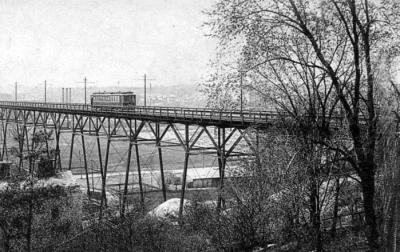
    In my early years, I turned into a pathetic scaredy-cat as the car approached the rickety Wells Street trestle that ran from approximately N. 41ststreet, over the Menomonee River industrial valley (including Piggsville) to N. 37thSt.  The ancient structure, composed of spindly struts, swayed in the wind and I was certain the streetcar would topple off, plunging mom, my two brothers and me into oblivion. Of course, it never happened and in later, more mischievous years I remember going with a bunch of kids and trying to

    978-EB-on-Wells-St.-@4th-150x150
    No. 10 eastbound on Wells Street

    challenge gravity by swaying in unison as the streetcar crossed the creaking, precarious trestle.

    The streetcars were hardly carriers of luxury.  To enter, one had to climb up steep portable stairs that dropped down when the motorman (there were no women driving the units then) stopped and opened the doors. I have no recollection of what disabled or older folks did to enter the car.

    Cold and drafty in winter, there were heating units placed under several seats, which meant a passenger faced two choices, getting a hot seat or shivering.  The seats were of a lacquered wicker.  Summertime was no better; there was no air conditioning, of course, and thus windows were usually open, letting all sorts of bugs to enter, along with the stink of then-industrial Milwaukee from the tanneries, packinghouses, foundries and Red Star Yeast.

    318273-M
    Wells Street Viaduct made for scary ride.


    What was most fun for mischievous kids, the streetcars had fronts on both ends.  When a streetcar hit the end of its line, there was no way to turn the car around, so the motorman merely unattached the control handles from what had been the front end of the car and carried them back to the other end, latching them in, making the rear now the front.  Then he’d walk back, switching the seat backs so they reversed direction.

    The more daring of us kids would often hightail it to the rear of the car, sitting on the motorman’s seat (now at the rear).  There, a kid could ring the dinger, hitting a button on the floor, angering the motorman. (Streetcars had no horn, but the motorman would use the dinger to warn autos or pedestrians of its presence, though such warning was hardly necessary due to the noisy nature of a streetcar’s run.)

    Both ends of the car were equipped with a “cow-catcher,” a devise that could be dropped to clear the tracks of any debris.  I was told some kids, playing the rear of the car, might drop it, forcing the motorman to stop and raise the unit in order to continue.  I never did that!  That was really being naughty.

    From what we’ve seen of the new streetcars, they’ll afford a comfortable ride, most likely smooth and quiet.  I’ll make sure to be one of its first riders.

    I may enjoy it, I suppose, but it won’t be the same. — Ken Germanson, March 31, 2018


  • No doubt, President Donald Trump’s comments about “shit hole” countries is racist.  Whether he said them or not is beside side the point.  There have been too many Trump tweets and comments with racist overtones to overlook them.  The president is certainly racist, and the evidence was there long before his vulgar comment last week about Haiti, Honduras, El Salvador and some African nations.  NewYork Times Columnist David Leonhardt has compiled a list of Trump’s more notable comments, all of which drip with racism.

    Yet, the president has said several times, “I am not a racist. I am the least racist person you have ever interviewed.”  Perhaps it’s just Trump being Trump (he seems incapable to speak without exaggeration) and he might even believe it.

    Certainly, Trump is not the first president who has used racist remarks, or may have even personally been racist. It is well-known that Presidents Washington and Jefferson owned slaves at the same time they were founding a nation based on the principle that “All men are created equal.”  The Great Emancipator himself, Abraham Lincoln, believed that Negroes deserved to be free, but that they were of a lesser people and should be returned to Africa.  President Woodrow Wilson was known to support the “Birth of a statue-of-liberty-new-york-ny-nyc-60121.jpegNation” movie that glorified racism.  President Harry Truman was known for his salty language and grew up in a racist environment and President Lyndon Johnson (whose language may have been even more salty) uttered the “n” word repeatedly.

    Yet, there is a major difference between Donald Trump and the Presidents mentioned above.  They did not let whatever racism that was in their souls govern the actions they took on behalf of the nation; nor did they advertise their racism over and over again.  Instead, Lincoln freed the slaves, Wilson supported policies that helped the unfortunate of the nation, Truman desegregated the Army, Navy, Marines, Air Force and Coast Guard, and Johnson pushed through both the Civil Rights and Voting Rights acts — perhaps the most far-reaching civil rights legislation since the Civil War.

    In deep contrast, Trump uses racism to curry support among white Americans, to spread fear and to build divides among Americans that may never be healed.  His remarks, even more importantly, stir whatever racism may lurk in the souls of all of us.

    Yes, we all are racist.  We can’t help it.  We weren’t born racist, of course, but we all grew up in environments that foster racism.  It’s universal.  I grew up during the Great Depression in a suburb that then was lily white and reportedly had an ordinance that banned “Negroes” from remaining in town from dusk to dawn.  I never went to school with students of other races.  I knew of only one Jew during my school years and later learned I was one of the few friends he had.  (Years later, I ran into him while shopping and he expressed his long gratitude to me for being his playmate in grade school. He  believed he had been shunned because of being Jewish. I was his friend — not to because I was especially moral — but because I had fun with him.)

    Even after more than sixty years of civil rights advocacy, I find thoughts creeping into my head that could be considered racist, particularly when encountering a dreadlocked teen African-American boy and thinking he’s a thug.  Thankfully, my rational mind tells me otherwise, and I dismiss such negative thoughts about the boy.

    Similarly, I learned that some of my black friends had resisted traveling into Milwaukee’s once all-white South Side because of their perceptions of all whites as being “honkies.”  For years, those fears were warranted, even though there were many South Side whites who would have been welcoming and friendly.

    Yes, we are all racist.  What is important, however, is that we not let whatever latent racism exists within us become fueled by the thoughtless remarks from an unthinking President.  Some Americans, obviously, find that Trump’s dangerous remarks justify their own racism, making it right to act in ways that would injure or humiliate people who are “different” or of another color.

    It’s right to denounce the President’s racist remarks and to remind ourselves how dangerous such remarks are to building a strong and just society.  We must also examine our own selves to assure that whatever racism may rest within us is forever buried. – Ken Germanson, Jan. 18, 2018.

    ####

  • Many of us have looked for removal of Sheriff David Clarke from office, not only for his outlandish views on matters like gun violence (arm yourself citizens, he once urged), immigration abuses (round ‘em up and ship them back) and policing (I’ll clean up city neighborhoods better than Milwaukee police), but also because of his failed administration of the Sheriff’s Department.

    Rally protesting Sheriff Clarke
    A recent demonstration urging resignation of former Sheriff Clarke

    How indeed could he be expected to oversee this important County department while traipsing all over the country as the darling of the NRA, Donald Trump and every anti-immigrant group in the nation?  The six deaths at the County Jail since 2016 and the fact that 70 mile an hour traffic is constant on our 55-mph freeways both point to failed management.  And yes, “the buck stops at the top” – with Sheriff Clarke.  (It’s important not to taint the hard-working and dedicated deputies for the failures at the top.)

    We’re glad David Clarke is gone, perhaps to greener more lucrative pastures for him.  He’ll be the show cow of rightwing groups that want to find a token black law enforcement officer to strengthen their creds.  They’ll pay him handsomely.  Oh well!

    Now, will the sheriff’s department become better run?  Will inmates of our overcrowded County Jail find themselves in safer, more suitable surroundings?  Will our many immigrants feel more at ease in their homes?

    Right now, the fate of the Sheriff’s Department rests in the hands of Gov. Scott Walker, who by law gets to appoint an interim sheriff who will hold office until the Spring 2018 elections.

    This is a critical appointment.

    Walker, who had turned a deaf ear to any complaints about Sheriff Clarke, is likely to appoint someone who sympathizes with the departed cowboy.  According to Milwaukee Neighborhood News, Walker had not responded before to groups like the Coalition for a People’s Sheriff, a group of organizations convened to defeat Clarke because of his “incompetent,” “unethical” and “inhumane” actions.

    It’s doubtful Walker will be open to involving community groups in making his decision, unless it’s the Milwaukee Association of Commerce or Republican Party.  All signs point to a political appointment.

    It’s true as well that the person he appoints will have an advantage when it comes to the spring election; officeholders, even when they were appointed, usually get elected.

    Nonetheless, Milwaukee County residents must continue to make noise to urge community involvement in the appointment process.  It sometimes works.  Christine Neumann-Ortiz, of Voces de la Frontera, points out that mounting pressure — including two statewide boycotts and demonstrations that attracted tens of thousands as well as the threat of lawsuits and possible criminal charges related to the jail deaths — contributed to Clarke’s departure.

    If Walker ignores such citizen pressure, there’s always the election.  Sadly, the spring municipal elections are hardly noticed by too many citizens.  Voter turnout is historically low.

    The time is now – seven months ahead of those elections – to organize in a real grassroots endeavor to assure that Milwaukee County elects an effective, fair-minded and humane County Sheriff who will quickly erase of the shame on a department that had been tainted by the 15-year-tenure of David Clarke.   Ken Germanson, Sept. 2, 2017.